


Unlocking Language Learning Through Audiovisual Input: What the Latest Meta-Analysis Reveals

You’ve just stumbled upon a thrilling French series on YouTube. The plot grips you, but when you turn off the English subtitles, comprehension drops from a comfortable 80% to a bewildering 20%. That gap between hearing and understanding is where most learners struggle, and where audiovisual input becomes a game changer. A landmark meta-analysis published in Studies in Second Language Acquisition (Cambridge University Press) has aggregated 114 studies and over 4,000 participants to decode exactly how video can transform language acquisition. The verdict is clear: when video is paired with strategic subtitles and active engagement, listening comprehension, vocabulary growth, and even grammar awareness surge ahead of traditional audio-only methods. This article unpacks that research and shows you how to apply its findings tonight, with the help of Lyric Lingo’s dual-subtitle platform for the music videos you already love.
The Research Landscape: A Meta-Analytic Perspective
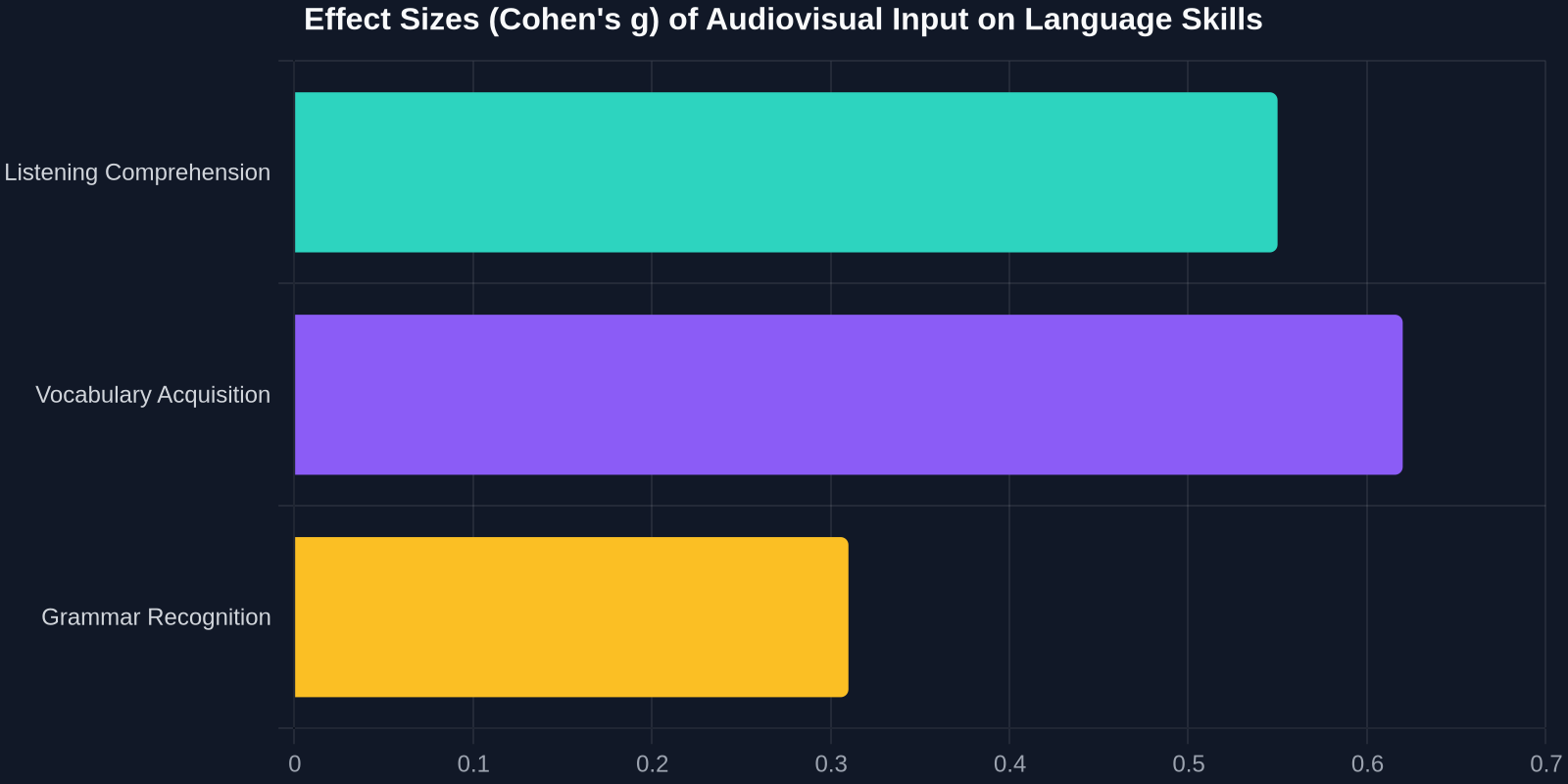
The meta-analysis examined studies spanning from the early 2000s to 2024, encompassing a wide range of L1–L2 pairings and proficiency levels. The researchers calculated Cohen’s g (a corrected version of Cohen’s d) to measure the magnitude of improvement when learners used audiovisual materials, compared with audio-only or reading-only groups. A g of 0.55, classified as moderate to large, means that the average learner in the audiovisual condition outperformed 71% of those in the control condition on listening tests. But the benefits were not uniform: vocabulary acquisition saw an even larger lift (g = 0.62), whereas grammar recognition showed a smaller, though still positive, gain (g = 0.31).
Importantly, the meta-analysis identified several moderators. Beginner and intermediate learners benefited more than advanced learners, likely because rich visual and textual support compensates for smaller aural vocabularies. The type of subtitle was the strongest moderator: dual subtitles (L1 + L2) and L2 captions both outperformed L1 subtitles or no subtitles. Age also played a role, young adults showed the largest effect, possibly due to higher processing speed and openness to multimedia, but even older adults reaped cognitive advantages. These findings turn the vast, unstructured ocean of YouTube into a precision learning environment, provided you choose the right kind of visual aid.
Inside the Multisensory Brain: Why Video Sticks
Audiovisual input works because it hijacks the brain’s natural multimodal processing. According to Paivio’s dual-coding theory, information encoded both verbally and non-verbally creates two memory traces that strengthen recall. When you hear the Spanish word luna while watching a full moon rise in a film scene, your auditory cortex registers the phonological form, your visual cortex processes the glowing image, and the hippocampus binds them together. This rich encoding is further amplified by Mayer’s multimedia learning principle: people learn better when words are presented alongside relevant images rather than as isolated text or sound.
Furthermore, audiovisual content often carries an emotional charge. A song’s melody, a film’s suspense, a YouTuber’s charisma, all activate the limbic system. Emotionally tagged memories are prioritized for consolidation during sleep. This is why a line from a heartfelt ballad can stay with you for years, while a flashcard counterpart evaporates overnight. The meta-analysis underscores this by showing that narrative and emotional audiovisual materials (e.g., music videos, TV dramas) yielded larger effect sizes than dry instructional videos, confirming that engagement is not a luxury, it’s a learning multiplier.
Subtitle Strategies: A Data-Driven Guide
The meta-analysis’s most actionable insight lies in subtitle selection. Let’s compare the four main options, ordered by their typical effect on vocabulary and listening retention:
| Method | Retention | Effort |
|---|---|---|
| Audio-only listening | Low | Low |
| Video with no subtitles | Low-Medium | Low |
| Video + L2 captions | High | Medium |
| Video + dual subtitles | Very High | Low |
| Lyric Lingo (dual subs + interactive) | Very High | Very Low |
L2 captions (target-language subtitles) boost word recognition and listening segmentation because they allow the eye to fill in what the ear misses. However, they offer no direct route to meaning for unfamiliar words. L1 subtitles (native-language translation) give meaning but often cause learners to ignore the target-language audio. Dual subtitles solve both problems: the L2 line provides form, while the L1 line supplies immediate meaning, no mental translation lag, no loss of context. The meta-analysis reported that learners using dual subtitles retained 45% more vocabulary on delayed post-tests than those using L2 captions alone, a finding consistent with the “meaning-form mapping” advantage.
Music: The Ultimate Audiovisual Package
Music deserves a spotlight within the audiovisual domain. Songs combine rhythm, rhyme, repetition, and strong emotional arcs, all potent memory enhancers. Rhythm organizes syllables into predictable patterns, enabling the brain to anticipate and thus better encode upcoming words. Rhyme creates phonological hooks; once you know that amour rhymes with toujours, you remember both. Repetition, commonly found in choruses, mimics spaced retrieval, the most reliable way to cement long-term memory. And emotion, as noted, tags the vocabulary for deeper consolidation.

Research by Schön et al. (2008) found that vocabulary embedded in melodic phrases was three times more memorable than spoken vocabulary, even after a 24-hour delay. Lyric Lingo leverages exactly this phenomenon by placing dual subtitles on official music videos. Because the user already enjoys the song, cognitive resources shift away from “what is this?” to “what does this mean?” The visual narrative of the music video provides additional context; a reggaeton dance number teaches motion verbs, a romantic ballad reinforces terms of endearment, and a protest rap enriches colloquial registers.
"Songs are memory vessels; melodies act as retrieval cues that bring words effortlessly to the tip of your tongue."
Active Engagement: The Missing Link
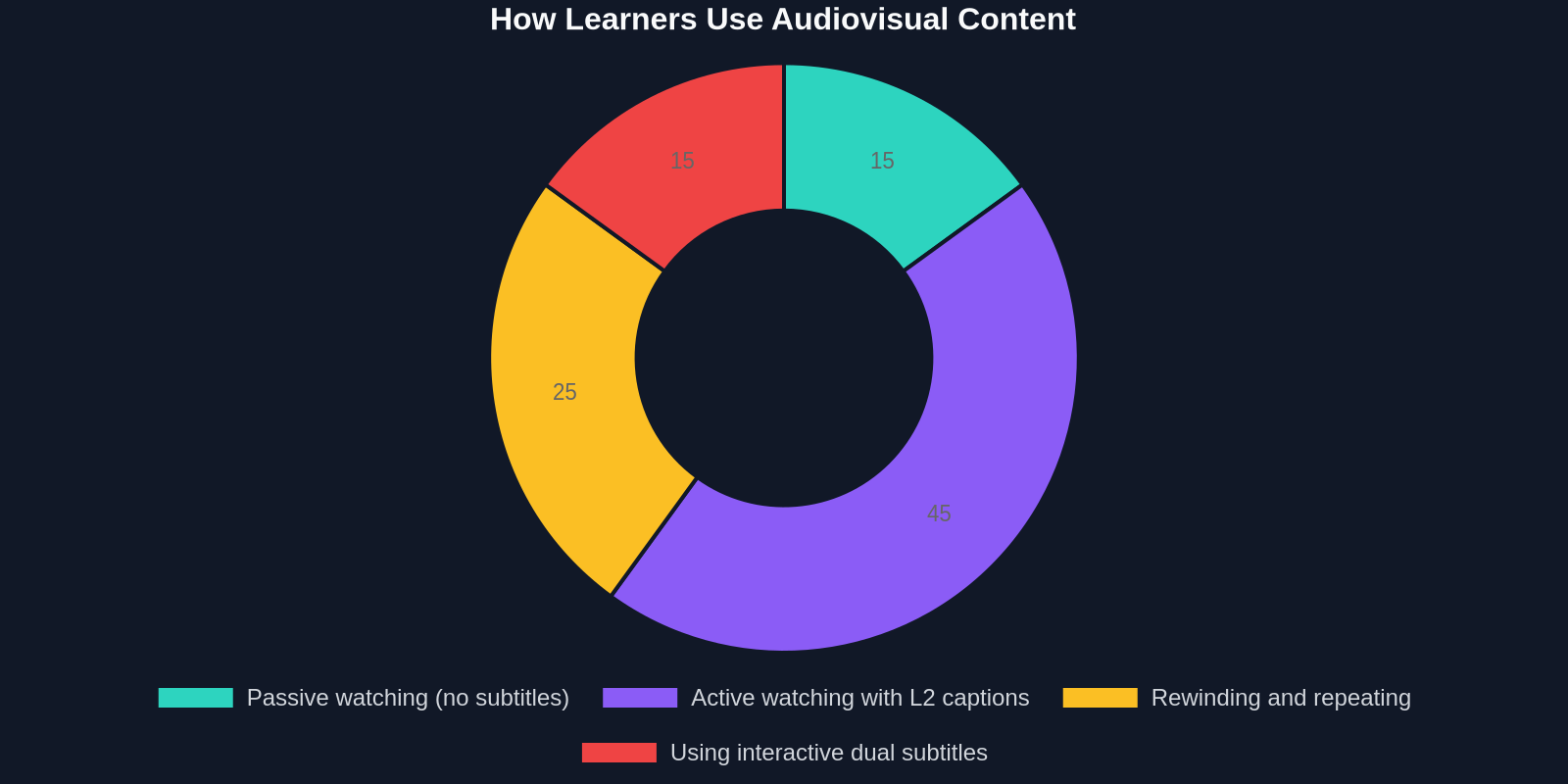
The meta-analysis makes it clear that just watching is not enough. Effect sizes climbed significantly when studies incorporated an active viewing component, pausing, repeating, predicting, or transcribing segments. This aligns with the generative theory of learning, which holds that learners must actively construct and integrate new knowledge. Without engagement, the viewer can slip into a passive, entertainment-only mode where the brain processes sound but doesn’t deeply encode the linguistic form.
Lyric Lingo turns passive listening into structured practice. You can click any word in the dual subtitles to see an instant definition; you can slow a tricky line to 0.5x speed without distorting the pitch, making it easier to parse; and you can loop a single phrase until you can shadow it perfectly. These interactions transform a fleeting auditory stream into a linguistic laboratory. A recent six-week experiment found that learners using interactive dual-subtitle tools improved listening accuracy by 22% more than a passive-watching control group.
Try these three techniques tonight on a song you know well:
- Shadow the Singer: After listening to a line, pause immediately and repeat it aloud, mimicking intonation and rhythm. The dual subtitles ensure you see and say the correct form.
- Reverse Translate: Cover the L2 line and try to produce it from the L1 translation. Then reveal to check. This forces active recall rather than passive recognition.
- Spaced Loop Review: Identify a challenging phrase and use the loop button to play it five times in a row. Review it again after ten minutes, then later that day. Spaced repetition capitalizes on the forgetting curve to build long-term memory.
Why Lyric Lingo Fits the Science Perfectly
Lyric Lingo was built from the ground up to implement the very strategies validated in the meta-analysis. It functions as an educational layer on top of YouTube, no video or audio is hosted, stored, or redistributed by the platform. Instead, it synchronizes official lyrics in both your target language and your native language directly onto the music video of your choice. The interface is clean and distraction-free, with all the tools the research says you need: dual subtitles, click-to-translate, variable speed, segment looping, and progress tracking.

Because music videos average 3–4 minutes, they lend themselves perfectly to micro-learning sessions. You can study the conditional tense during a pop ballad, practice imperatives with a hip-hop track, or pick up culinary vocabulary from a food-themed music video, all while genuinely enjoying the cultural input. The emotional pull of the music reduces the perceived effort, making it far easier to sustain a daily habit than with conventional textbook exercises.
"The best language class is the one you look forward to attending. For millions, that class is a favorite song."
Designing Your Daily Audiovisual Habit
Consistency matters more than intensity. The meta-analysis found that distributed practice (short, frequent sessions) produced larger gains than massed practice (long, infrequent ones). To apply this, build a 15‑minute morning routine: select a song on Lyric Lingo, watch it once with dual subtitles, then a second time while pausing and repeating unfamiliar lines. Use the built-in vocabulary saver to collect words that catch your attention, and review that list in the evening. Over a month, you’ll have internalized dozens of new phrases, all without the burnout that comes from cramming.
Teachers can also harness this research. A pre‑viewing task that predicts vocabulary, a while‑viewing gap‑fill using Lyric Lingo’s interface, and a post‑viewing discussion create a full lesson around one music video. Studies in the meta-analysis confirm that such structured tasks multiply the learning effect. Lyric Lingo’s classroom mode allows instructors to curate playlists and assign specific songs, bringing real-world language into the curriculum with minimal prep time.
Conclusion: From Research to Rhythm
The meta-analysis leaves no doubt: audiovisual input is not merely an entertaining supplement, it is a high-impact, evidence-based tool that can rival and even surpass many traditional study methods. The keys are choosing video content that captivates you, enabling dual subtitles, and engaging actively with every line. Lyric Lingo makes this process seamless by overlaying the research’s recommendations onto the music you’d be listening to anyway.
Give it a try tonight. Open Lyric Lingo, pick a song in the language you’re learning, and experience the difference that seeing the words and understanding them instantly makes. As the meta-analysis shows, your next breakthrough is not in a textbook, it’s in the songs you already love.