


Turning Up the Volume on Bilingualism: How Music and Dual Subtitles Overcome Language Learning Challenges

For every person like Ms. O'Laughlin, who fluently navigates both French and English in a professional setting at the Sloan School of Management, Massachusetts, there are thousands of learners who feel stuck on the path to bilingualism. The dream of switching effortlessly between languages often collides with the reality of forgotten vocabulary, muffled audio, and the dreaded intermediate plateau. Yet, emerging research and practical tools are turning the tide. By combining the universal appeal of music with the clarity of dual subtitles, language learners can finally transform passive listening into a robust, evidence-based study method. This article explores the science, the practice, and the tools, like Lyric Lingo, that make bilingual mastery not just possible, but profoundly enjoyable.
The Reality of Bilingual Skills: Challenges We All Face
Becoming bilingual is a marathon, not a sprint, and most language learners encounter a familiar set of obstacles. Listening comprehension consistently tops the list. Native speakers often blend words, drop syllables, and use colloquialisms that textbook audio never covers. The result? Learners understand their teacher perfectly but freeze in real conversations. Vocabulary retention is equally ruthless: you can memorize a word today and it evaporates by next week. Grammar, when stripped of emotional context, feels like an abstract code rather than a living language. And without immersion, the brain receives too few repetitions to automate any skill.
These challenges persist because traditional methods, flashcards, grammar drills, and sterile dialogues, ignore how the human brain actually encodes long-term memory. The solution lies in leveraging the brain's natural affinity for patterns, rhythm, and emotional engagement.
Many learners stay trapped at an intermediate plateau, unable to bridge the gap between structured lessons and the unpredictable, rapid-fire reality of native speech.
The Cognitive Science of Music and Memory
Music is not merely entertainment; it is a neurological powerhouse. When you listen to a song, your brain activates the auditory cortex, the motor areas (if you tap along), and the limbic system, which processes emotion. This multi-sensory engagement creates a rich memory trace. Researchers call it the "earworm effect": a melody that lodges itself in your mind, dragging the associated lyrics along with it. Language educators have long exploited nursery rhymes to teach children, but adult learners can harness the same mechanism to accelerate vocabulary acquisition.
Rhythm acts as a scaffold. The predictable beat and rhyme schemes in music narrow down the possible words that can fit, essentially providing a form of spaced repetition with each chorus. When you sing along, you’re practicing pronunciation, intonation, and sentence flow in a low-anxiety environment. The emotional connection you feel toward a song further anchors the language, making recall almost effortless.
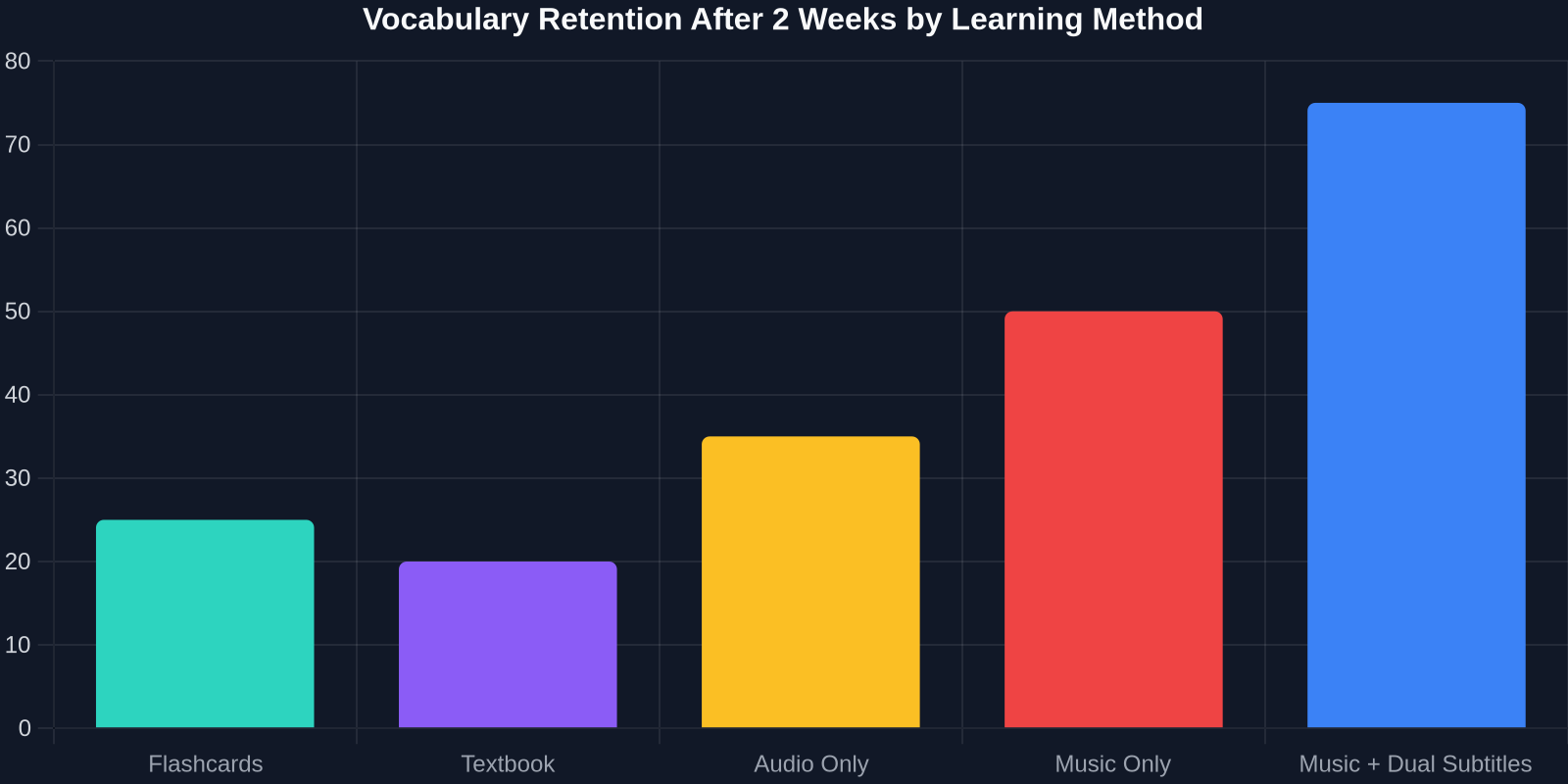
The chart above illustrates a stark contrast: traditional flashcard review yields modest retention, while learning through music, and especially music paired with dual subtitles, dramatically improves long-term recall. This is where technology steps in to optimize the process.
Dual Subtitles: The Missing Link in Language Learning
Watching foreign-language videos with standard subtitles helps, but it’s often an all-or-nothing gamble. Learners either rely too heavily on their native tongue or struggle to connect the audio to the translation. Dual subtitles, displaying both the original language and the learner’s target language simultaneously, bridge this gap. They provide instant, side-by-side comparison, allowing the brain to map sounds to meanings in real time without pausing to look up words. This uninterrupted flow preserves the emotional and narrative arc of the content, which in turn enhances memory.
| Method | Vocabulary Retention | Listening Improvement | Learner Engagement |
|---|---|---|---|
| Passive listening only | Low (15-20%) | Minimal | Low (easily distracted) |
| Listening + standard subtitles | Medium (35-45%) | Moderate | Medium |
| Listening + dual subtitles | High (65-75%) | High | High (active comparison) |
The comparison table demonstrates that dual subtitles offer the most balanced and effective approach. By removing the friction of dictionary lookups, learners stay immersed. Lyric Lingo’s implementation of dual subtitles on YouTube videos takes this further by allowing users to click on any word for an instant definition and to save tricky phrases for later review. This aligns with the “input hypothesis,” which states that we acquire language best when we understand messages that are slightly above our current level.
How Ms. O'Laughlin Uses Music to Maintain Her Bilingual Edge
Consider the professional reality of bilingual individuals like Ms. O'Laughlin, who manages correspondence and negotiations in both Canadian official languages daily. Maintaining that edge requires constant, low-friction exposure. Instead of dry news reports, she incorporates French-Canadian artists into her commute. By watching music videos with dual subtitles on Lyric Lingo, she catches idiomatic expressions like "lâche pas la patate" (don’t give up) that rarely appear in formal lessons.
Similarly, twenty-five University of Scranton education students have begun student-teaching assignments this Fall 2026, many in dual-language classrooms. Their supervisors are increasingly recommending video and music-based tools to supplement traditional materials, noting that children and adult learners alike respond to the multimodal input. These future educators are embedding dual-subtitled songs into lesson plans to teach everything from verb conjugations to cultural nuance.
The AI-Powered Future of Language Immersion
The AI for Good Global Summit 2023 highlighted how artificial intelligence is personalizing education in unprecedented ways. In language learning, AI can analyze your known vocabulary and listening habits, then recommend songs or videos that target your specific gaps, introducing those tricky subjunctive forms or regional slang exactly when you’re ready for them. Lyric Lingo’s smart recommendation engine works quietly in the background, turning your natural curiosity for new music into a curriculum that adapts to your level.
This is not a distant dream. Already, platforms combine automatic speech recognition to give feedback on your singing (and pronunciation), while natural language processing breaks down lyrics into digestible chunks. The result is an immersion experience that once required a plane ticket, now accessible anytime you open a YouTube tab.
Practical Steps to Transform Your Music Time into Study Time
You can implement a structured, music-based learning routine tonight using nothing more than your favorite streaming service and Lyric Lingo’s dual subtitle player. Here’s a step-by-step guide:

- Select an earworm. Pick a song you genuinely enjoy, preferably one with a clear narrative and repetitive chorus. For French learners, something like Indila’s "Dernière Danse" works beautifully; for Spanish, Morat’s "Cuando Nadie Ve" offers rich vocabulary.
- First watch: dual subtitles on. Watch the entire video while reading both captions. Don’t pause. Absorb the context, the melody, and the emotional tone.
- Second watch: target language only. Switch to showing only the original language subtitle. Try to follow along. Note which phrases you understood clearly and where you got lost.
- Shadow the singer. Sing or speak along with the lyrics, mimicking the rhythm and intonation. This builds oral fluency and muscle memory.
- Break it down. Revisit one verse that confused you. Click on unknown words to see definitions and save them for later flashcard review.
- Review with the chorus. The chorus will repeat throughout the week as an earworm, each mental re-play is a free spaced-repetition session.
Just as dedicated puzzlers find daily joy in solving clues like those in the New York Times Spelling Bee, "These are the answers and solution to the New York Times Spelling Bee Puzzle", language learners can turn lyrics into a vocabulary game. Challenge yourself to catch every word of the bridge on a first listen, or translate a verse back into your native language before checking the dual subtitles.
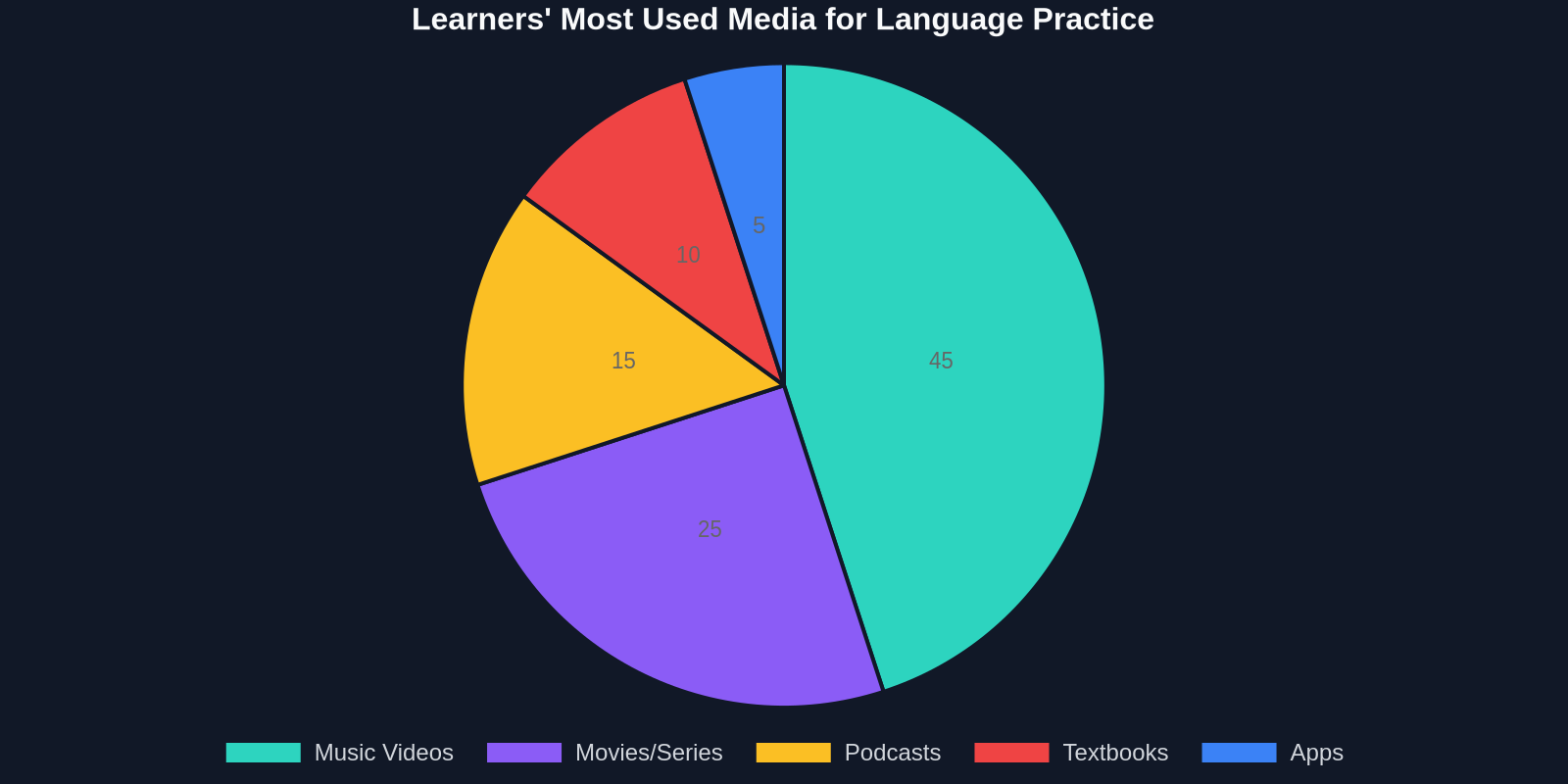
The pie chart above confirms what many of us intuitively feel: music videos dominate as the preferred medium for language practice. They are short, emotionally charged, and culturally rich, qualities that textbooks rarely replicate.
Overcoming the Intermediate Plateau with Musical Repetition
The intermediate plateau occurs when you’ve mastered basic grammar but lack the vocabulary and automaticity needed for fluid conversation. Music is uniquely engineered to beat this stagnation. A typical pop song repeats its chorus a dozen times, each repetition a review of high-frequency sentence structures. For instance, the conditional tense in French ("je voudrais") appears in countless love songs, embedding the ".
The chorus of a well-chosen song can function as a spaced-repetition algorithm, naturally reviewing your target grammar points every few minutes without any effort on your part.
Moreover, songs expose you to informal language, slang, and connected speech that academic materials sterilize. When you hear "gotta" instead of "got to" in an English song, your brain learns to parse fast speech. Over weeks, this passive training significantly improves your ability to understand native speakers at full speed.
The Long-Term Cognitive Benefits of Bilingualism
Investing in bilingual skills is one of the most potent things you can do for lifelong brain health. Research consistently shows that actively using two languages enhances executive function, the mental skills that include working memory, flexible thinking, and self-control. Bilinguals are better at filtering out distractions and switching between tasks. Even more compelling, the cognitive reserve built through a lifetime of bilingualism delays the onset of dementia symptoms.
The act of learning and maintaining a language, especially through engaging inputs like music, creates and strengthens neural pathways. Every time you decipher a lyric in real time, you’re giving your brain a workout that pays dividends for decades. So, the next time you feel guilty about watching another music video, remember: you’re not procrastinating, you’re future-proofing your mind.
From Passive Listening to Active Mastery
Becoming bilingual no longer requires moving abroad or spending hours on dreary drills. By harnessing the emotional pull of music and the clarity of dual subtitles, anyone can create a personal immersion environment that rivals living in a foreign country. Tools like Lyric Lingo make this effortless, overlaying structured learning onto the YouTube videos you already watch. The evidence is clear: rhythm and meaning combined lead to lasting fluency. So plug in your headphones, choose a song that moves you, and let the dual subtitles guide you past the plateau. Your bilingual future is already playing, you just need to read along.