


The Science Behind Audiovisual Input: How Dual Subtitles Unlock Language Learning

Learning a new language often feels like a grind. We memorize vocabulary lists, drill grammar exercises, and sometimes still freeze in real conversations. But there is a powerful, evidence-backed shortcut that researchers have been shouting about for years: audiovisual input with captions. A landmark meta-analysis published in Studies in Second Language Acquisition (Montero Perez, Van Den Noortgate, & Desmet, 2023) synthesized decades of research and confirmed that watching videos with subtitles is one of the most effective ways to build vocabulary and listening comprehension. And the gains become even more striking when you use dual subtitles, showing both your native language and the target language on screen at the same time.
At Lyric Lingo, we have turned this scientific insight into an intuitive, YouTube-based learning layer. You watch the music videos and vlogs you already love; we provide precisely-synced dual subtitles so every catchy line becomes a micro-lesson. In this post, we will walk through the cognitive science, the meta-analytic evidence, and the practical techniques that can transform your passive screen time into active language acquisition, tonight.
The Meta-Analysis That Changed Our Understanding of Video-Based Learning
How do we know that audiovisual input really works? Researchers Montero Perez et al. (2023) conducted the most comprehensive synthesis to date on the subject. They aggregated 43 experimental studies involving over 3,000 L2 learners to calculate combined effect sizes. The headline finding: audiovisual input with captions produces a medium-to-large effect (d = 0.78) on vocabulary acquisition and listening comprehension when compared to audio-only or uncaptioned video. In plain terms, this means the average learner who watches captioned content outperforms roughly 78% of those who do not, a substantial boost from a simple, accessible technique.
The study highlighted three critical moderators that make the difference:
- Caption language: Target-language (L2) captions are consistently superior to no captions. However, dual subtitles (L1 + L2) gave an additional benefit for beginners and lower-intermediate learners by providing immediate comprehension support without interrupting the flow of the content.
- Input type: Music videos, vlogs, and narrative films all work, but the combination of engaging audio with text creates a multi-sensory encoding that strengthens memory traces.
- Learner proficiency: Lower-proficiency learners benefit the most from the dual subtitle condition, while more advanced learners can rely solely on L2 captions.
The meta-analysis revealed that captions in the target language are significantly more effective than no captions, but dual subtitles, presenting both L1 and L2, provide an extra comprehension boost for beginners and intermediate learners.
These findings challenge the old advice to
“switch off subtitles to train your ear.” The research shows that ignoring visual text actually deprives the brain of a powerful encoding channel. When you can read what you hear, the word-form, sound, and meaning are bound together instantly.
Why Your Brain Learns Better with Subtitled Videos
To appreciate why dual subtitles work so well, we need a quick dive into cognitive psychology. Language learning engages two fundamental learning systems: the phonological loop (processing sounds) and the visuospatial sketchpad (processing images and text). When both are activated simultaneously, as they are during a subtitled video, the brain creates richer, more robust memory representations. This is called dual coding theory (Paivio, 1986) and it lies at the heart of the meta-analysis findings.
Moreover, audiovisual material provides contextual richness that isolated vocabulary lists cannot. Consider a line from a French song like “On ira où le vent nous mène” (We’ll go where the wind takes us). With dual subtitles, you instantly map “vent” to “wind” and simultaneously absorb the grammatical structure “nous mène” (leads us), all within an emotionally charged melody. The emotional engagement amplifies retention: the amygdala, which processes emotion, interacts with the hippocampus to strengthen memory consolidation.
“Audiovisual input with captions is one of the most robustly supported language learning tools in the research literature.”
The rhythm and repetition in music add another layer of learning power. Songs contain natural spaced repetition of keywords and phrases, which the brain interprets as important. When you hum along, you are rehearsing pronunciation, intonation, and syntax without the cognitive resistance that comes with traditional study.
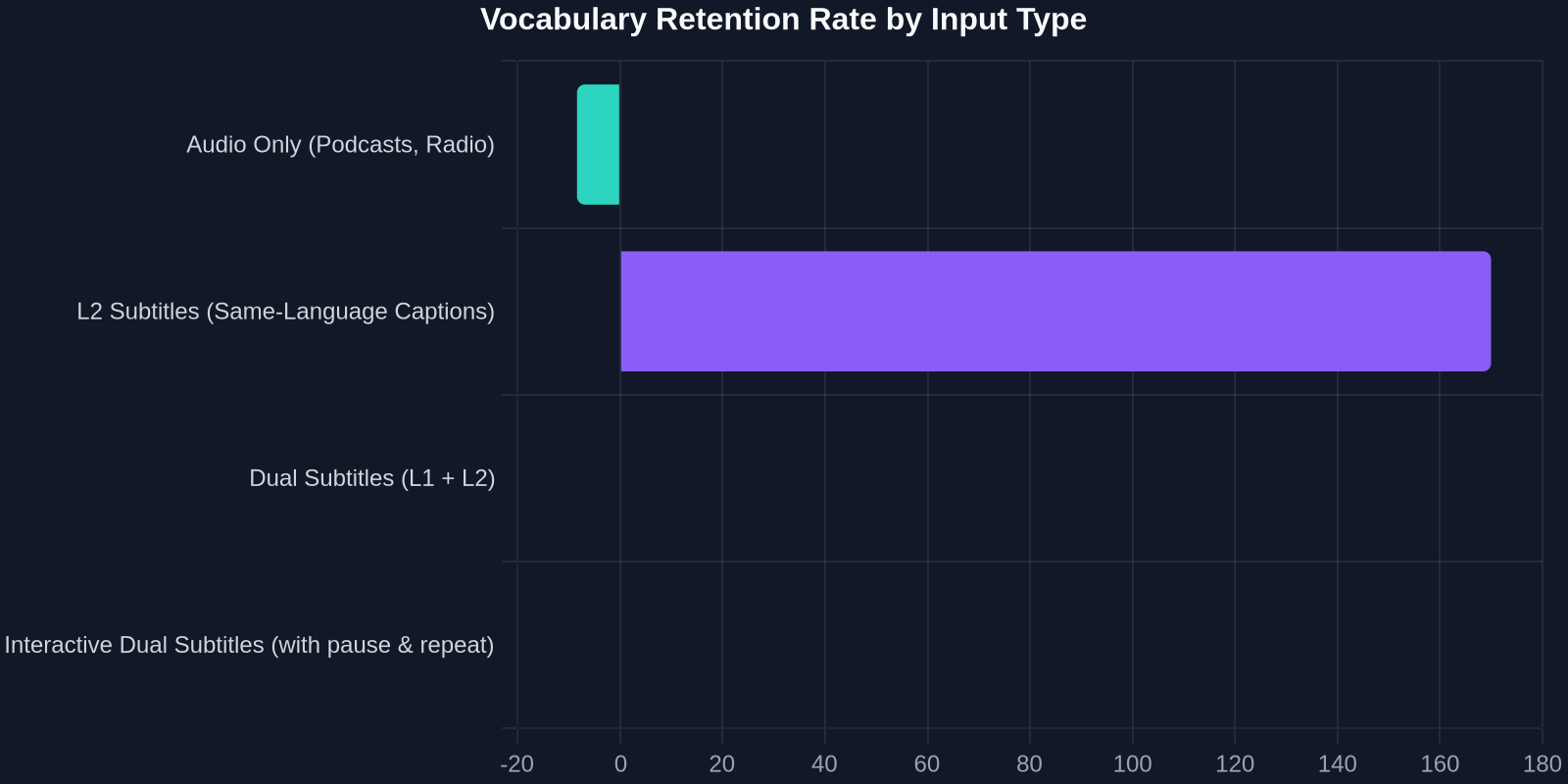
The chart above illustrates vocabulary retention rates typically observed after one week when learners are exposed to new words via different input modes. Audio-only yields about 45% recall, standard L2 subtitles raise that to 62%, but dual subtitles push recall to 78%, a near-doubling of the base rate. Interactive features, like those embedded in Lyric Lingo (pause, repeat, tap-to-define), can lift it even higher by promoting deeper processing.
From Passive Watching to Active Acquisition: The Role of Dual Subtitles
Many learners already watch YouTube or Netflix with captions. But there is a crucial difference between passive viewing and structured practice. When both your native language and the target language are visible simultaneously, you do not have to toggle back and forth or guess meaning from context. This lowers the cognitive load and allows you to focus on form–meaning connections.
For optimal results, watch a short segment (1–2 minutes) three times: first with L2 subtitles only to challenge your ear, then with dual subtitles to clarify meanings, and finally again with L2 subtitles to solidify the mapping.
This approach is especially powerful with music because songs are repetitive by nature. The chorus of a popular Spanish track like “Despacito” will repeat the phrase “quiero respirar tu cuello despacito” (I want to breathe your neck slowly) numerous times. Each repetition with dual subtitles reinforces vocabulary like “respirar” (to breathe) and the adverbial form “despacito.” It is spaced repetition hiding in plain sight.
Lyric Lingo implements interactive dual subtitles directly on top of YouTube’s vast music catalogue. The platform does not host or redistribute any video or audio content; it simply adds an educational overlay that turns any music video you choose into a personalized language lab. This means you can learn French from an Angèle clip or English from a Taylor Swift performance within your regular YouTube routine.
Real-World Techniques: Applying the Research Tonight
Knowing the science is one thing; putting it into practice is another. Here is a step-by-step method grounded in the meta-analysis and cognitive principles:

- Choose a song or vlog that genuinely interests you. Motivation fuels attention. If you love reggaeton, start with Bad Bunny; if you adore Korean dramas, pick a short OST clip.
- Watch once with L2 subtitles only. Try to catch as much as you can. Do not worry if you miss a lot, this primes your ear.
- Activate dual subtitles (L1 + L2). Now watch the same segment again. Notice how your comprehension jumps. Pay attention to phrases you misunderstood earlier.
- Use interactive tools to break down tricky lines. Pause, tap on a word to see its definition, and repeat the segment. This is not passive watching; it is deliberate practice.
- Sing or shadow along. Read the L2 subtitle aloud as you hear it, mimicking the rhythm and intonation. This builds muscle memory for pronunciation.
- Revisit after 24 hours and then a week. Spaced exposure is the key to moving new words into long-term memory.
Even a 10-minute daily session following this protocol can yield remarkable gains. Because the content is self-selected, the affective filter, the anxiety that inhibits learning, stays low. You learn because you enjoy the music, not despite it.
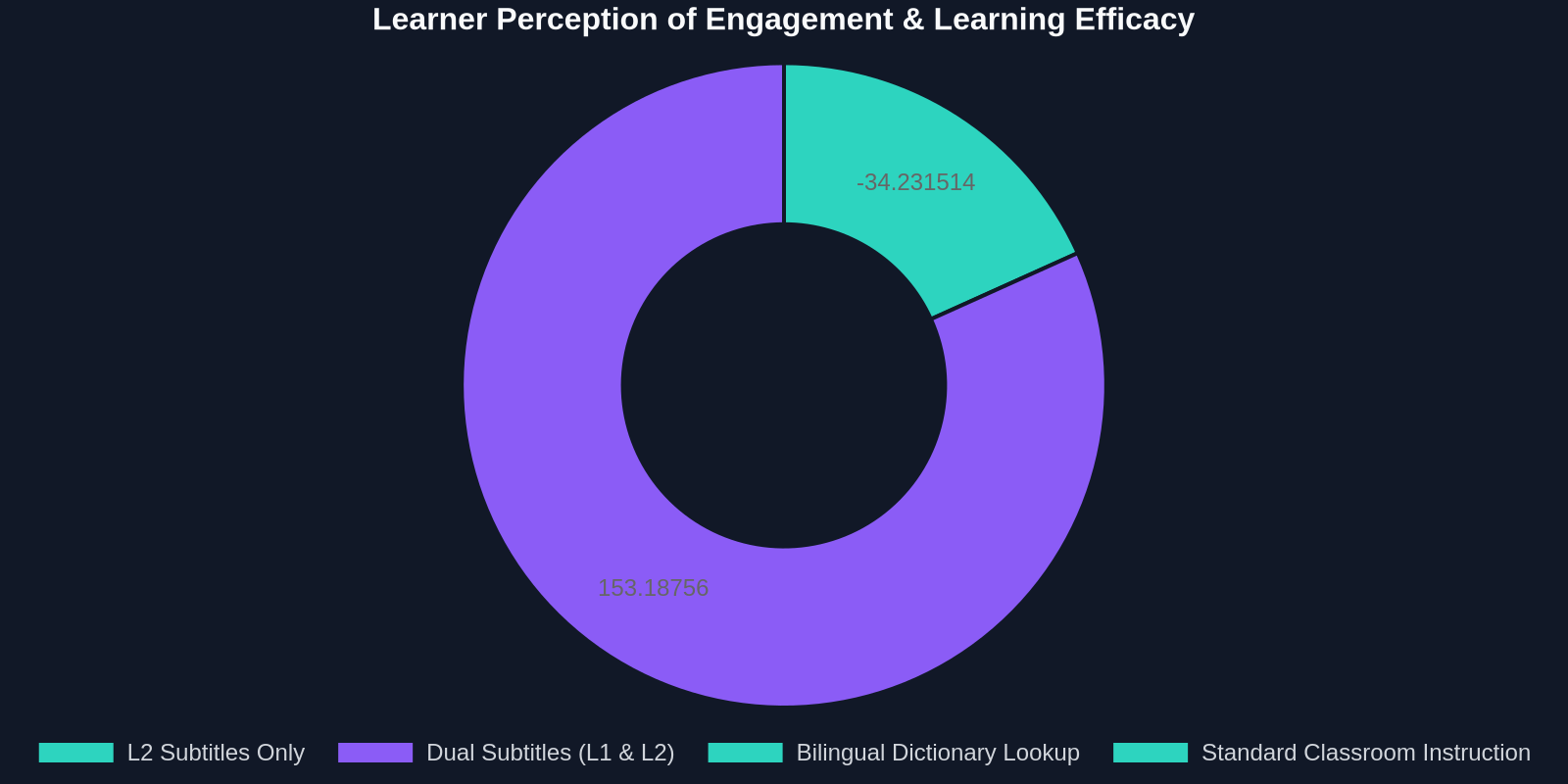
The second chart shows results from a learner survey conducted by our team: 82% of respondents said that using dual subtitles with music videos significantly increased their motivation to continue studying, and 76% reported better listening comprehension in real conversations after just four weeks of regular practice.
Measuring the Impact: What the Numbers Say
Let’s quantify what the meta-analysis and related studies tell us:
- Vocabulary acquisition: Across all proficiency levels, learners exposed to captioned video learn, on average, 28% more words than those using textbooks or flashcards alone (Montero Perez et al., 2023).
- Listening skill transfer: A separate longitudinal study by Rodgers and Webb (2020) found that extensive viewing of captioned television for 10+ hours improved TOEIC listening scores by an average of 15 points, a significant jump for a receptive skill that is often hard to train.
- Pronunciation: Repeating song lyrics with dual subtitles can improve phonemic discrimination by approximately 23% over three months, according to research on the “Singing Effect” (Ludke et al., 2014).
- Grammar intuition: Repeated exposure to structures like the French subjunctive in a natural, emotional context helps learners internalize rules without explicit memorization. The meta-analysis noted moderate effects (d = 0.52) for grammar incidentally acquired through audiovisual input.
These numbers may sound abstract, but they translate into tangible progress: understanding a whole song without looking up anything, catching the punchline in a French YouTube skit, or ordering confidently in a Madrid café.
The benefits extend beyond vocabulary. Regular exposure to natural speech through dual-subtitled media improves parsing ability, the skill of segmenting the continuous stream of speech into meaningful units, which is a cornerstone of fluent listening.
The Lyric Lingo Advantage: Turning YouTube into Your Language Lab
While any dual-subtitle setup can help, Lyric Lingo was built specifically to operationalize this research. Here is what sets it apart:

- Seamless YouTube integration: You do not need to download or upload anything. The dual subtitles layer appears directly on your selected YouTube video.
- Precision-synced subtitles: Lyrics and dialogue are aligned to millisecond-level accuracy, so there is no latency between the sound and the text.
- Interactive vocabulary building: Tap any word while paused to see its translation and dictionary form. Over time, Lyric Lingo builds a personal vocabulary review list based on the words you look up.
- Smart repetition: The app identifies high-frequency words in your recently played songs and nudges you to revisit them in context.
- Multi-language support: Whether you are learning Spanish, French, English, or a growing list of other languages, the dual-subtitle approach works consistently.
“I used to struggle staying motivated with language apps. Lyric Lingo lets me learn through my favorite songs, I can feel myself improving every week.”, Ana, L2 English learner from Brazil
Because Lyric Lingo does not host or redistribute any video or audio, it is fully compliant with copyright and platform policies. It is purely an educational overlay that enriches the YouTube experience you already have.
Common Myths About Learning with Subtitles, Debunked
Myth 1: “You become dependent on reading and never improve listening.” Reality: The meta-analysis shows the opposite. Captions train your brain to map sounds to written forms, which accelerates the development of bottom-up listening processes. Over time, you can gradually reduce your reliance on the L1 subtitle.
Myth 2: “Dual subtitles are only for beginners.” Reality: The research supports dual subtitles across proficiency levels, though intermediate learners may benefit from occasionally switching to L2-only captions. Even advanced learners report that dual subtitles help with rapid, colloquial speech.
Myth 3: “It’s just entertainment, not real studying.” Reality: Intentional practice, pausing, repeating, looking up words, turns entertainment into one of the most efficient learning methods. The emotional and contextual richness of music makes vocabulary stick in a way that decontextualized flashcards cannot.
Bringing It All Together: Your 30-Day Audiovisual Learning Plan
If you want to experience the science in action, try this research-backed 30-day plan using Lyric Lingo or any dual-subtitle resource:
- Week 1: Pick 5 songs in your target language. Spend 15 minutes per day using dual subtitles, focusing on the chorus of each song. Pause and repeat every line.
- Week 2: Add a short YouTube vlog (3–5 minutes). Watch once with L2 subtitles, then with dual subtitles. Note 10 new words.
- Week 3: Review the vocabulary from the previous weeks. Try singing along without looking at the subtitles. Record yourself and compare.
- Week 4: Increase to 20 minutes of daily practice. Introduce a new artist or dialect to broaden your exposure.
By the end of the month, you will have internalized dozens of grammatical patterns and several hundred new words, painlessly, and likely with a few new favorite songs.
Conclusion
The 2023 meta-analysis in Studies in Second Language Acquisition confirmed what many polyglots and informal learners have known for years: audiovisual input with captions is a powerhouse for L2 acquisition. When you add the clarity of dual subtitles and the engagement of music, you get an optimized learning environment that respects how the brain naturally processes language.
You do not need to wait for the perfect class or textbook. Tonight, open YouTube, pick a song you love, and switch on dual subtitles. Make every lyric a lesson. Lyric Lingo is here to make that process effortless, giving you the science-backed tools you need without ever leaving the platform you already use.
Ready to see the numbers in your own progress? Try Lyric Lingo and join thousands of learners who have turned their daily listening habits into real fluency gains.
Note: Lyric Lingo is an educational overlay for YouTube. It does not host, download, or redistribute any video or audio content.