


The AI Shadow: How Parents Using AI Every Day Shape the Next Generation of Language Learners

In a recent Business Insider story, a working parent admitted that their children watch them use AI tools "every day." It’s a candid snapshot of modern life, and one that carries profound implications for how the next generation will learn, think, and communicate. While the headline focuses on the blurring of work and home, language learners and educators should see something else: a new form of modeling that can spark curiosity, accelerate vocabulary acquisition, and turn a family’s YouTube playlist into a bilingual classroom.
Children are natural mimics. Long before they master grammar, they acquire language by absorbing the sounds, rhythms, and patterns around them. Now, when a parent dictates a prompt to an AI assistant, asks it to translate a phrase, or uses a lyric-finding tool on a favorite song, a child’s observation circuit lights up. The question is no longer whether kids are learning language from tech, it’s what kind of linguistic input we’re providing. When AI is used strategically, it becomes a window into new words, sentence structures, and even entire cultures.
This post explores how parents’ daily AI habits, everything from writing assistants to music translation, are silently shaping the language learners of tomorrow, and how you can harness that shadow learning with a tool like Lyric Lingo to turn passive screen time into an active, research-backed language habit.
The New Modeling: Parents as AI Pioneers
Walk through any co-working space or home office, and you’ll hear the hum of AI at work. Parents are using writing assistants to draft emails, translation tools to communicate with foreign clients, and code generators to build side projects. What’s striking is that this isn’t niche behavior anymore. The rise of specialized tools like Anthropic’s Claude Code has coincided with a tangible shift in the job market.
The surge in AI-adjacent roles underscores what many households are experiencing firsthand: AI is not a futuristic concept, it’s the current professional landscape. When children see parents navigating this world, they absorb more than tech literacy; they internalize the rhythm of questioning, iterating, and refining that lies at the heart of effective communication.
"It’s primarily about navigating a place where you don’t have to build a data center, there’s lots of jobs, there’s lots of investment.", AI industry leader
That observation, shared by an AI executive describing the post–data center economy, points to a reality where the currency is not just code but clarity, the ability to articulate a need and refine an output. For language learners, this is the same skill that turns a hesitant tourist into a confident conversationalist.
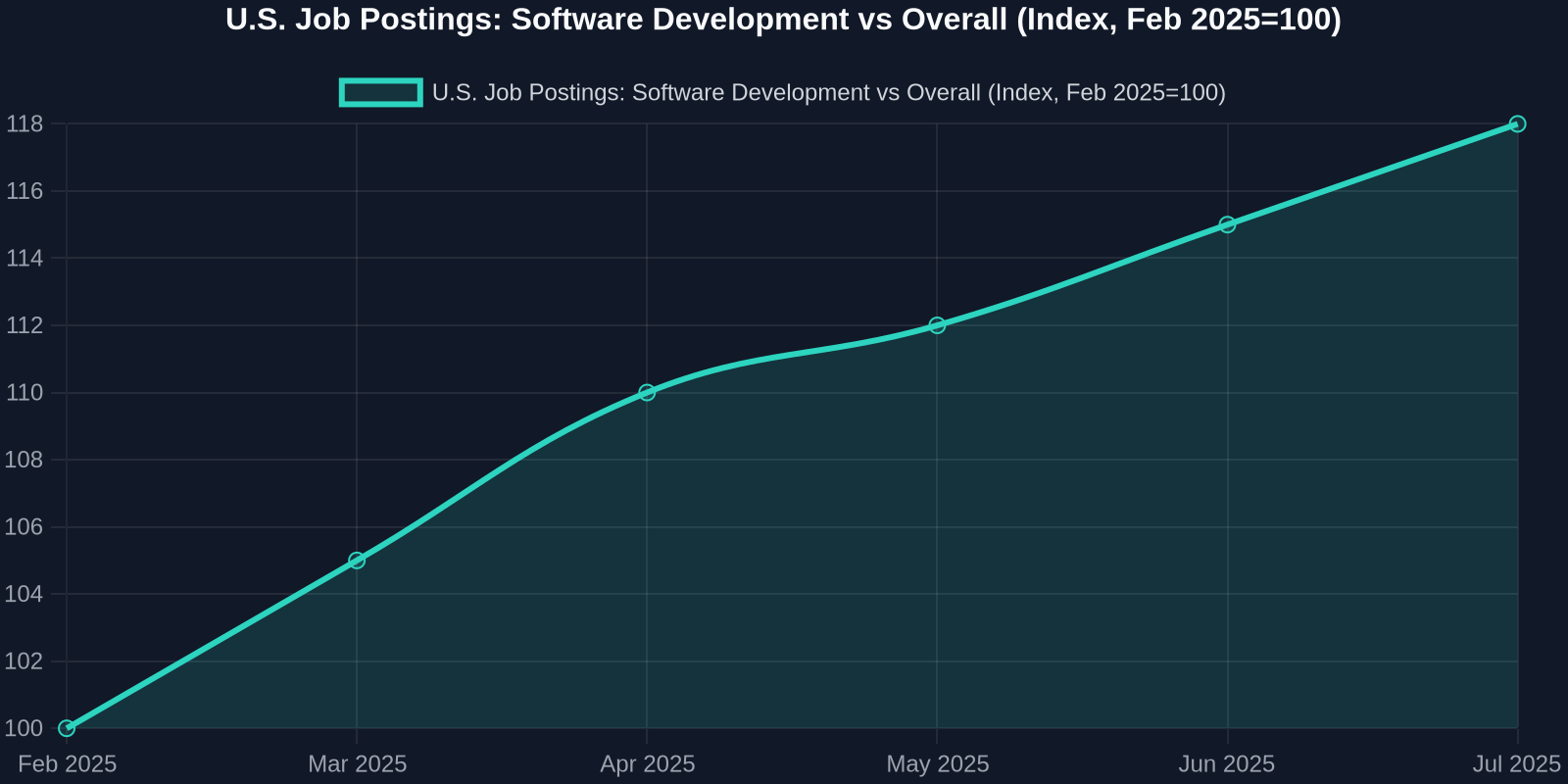
The line chart above tells a clear story: as overall job listings plateau, demand for software development roles keeps climbing. That increase isn’t confined to engineers; it ripples into content creation, translation services, and edtech tools that bring AI closer to everyday learning. The child watching a parent debug a prompt or fine-tune a translation is absorbing a masterclass in metacommunication.
From Observation to Action: How Kids Learn by Watching
A fascinating study analyzed 15 group-produced prompts and their development processes, all crafted by university students training in Early Childhood Education. While the setting was a classroom assignment, the core finding is relevant to homes everywhere: the act of constructing a prompt, choosing words, structuring a request, and evaluating the result, mirrors the same cognitive steps kids use when learning a new language.
The 15 patterns identified ranged from simple commands to elaborate, iterative conversations. Children as young as four who observe parents engaging in such interactions begin to develop what researchers call “questioning strategies.” These are not abstract concepts; they are the very building blocks of communication. A child who sees a parent say, “Translate ‘thank you’ into French, then give me the pronunciation” is learning that language can be broken down, requested, and verified.
This is the shadow curriculum of the AI household. When a parent uses a voice assistant to settle a debate about a song lyric, or types a query into a translation app during dinner, the child witnesses language as a puzzle to be solved. That mindset is transformative for vocabulary acquisition, especially when paired with emotionally resonant content like music.
The Language Learning Connection: AI-Powered Music and Subtitle Immersion
Memory research has long confirmed what poets know: rhythm and rhyme make words stick. A comprehensive study on music and vocabulary retention found that learners who engage with target language through song recall significantly more words than those who study with text alone.
Now, combine that with the observation data from households where parents use AI to explore foreign-language music. A parent might say, “I’ll use this tool to find out what ‘Despacito’ really means.” The child sees the translation pop up, hears the melody, and pays attention. It’s an instant multisensory learning moment.
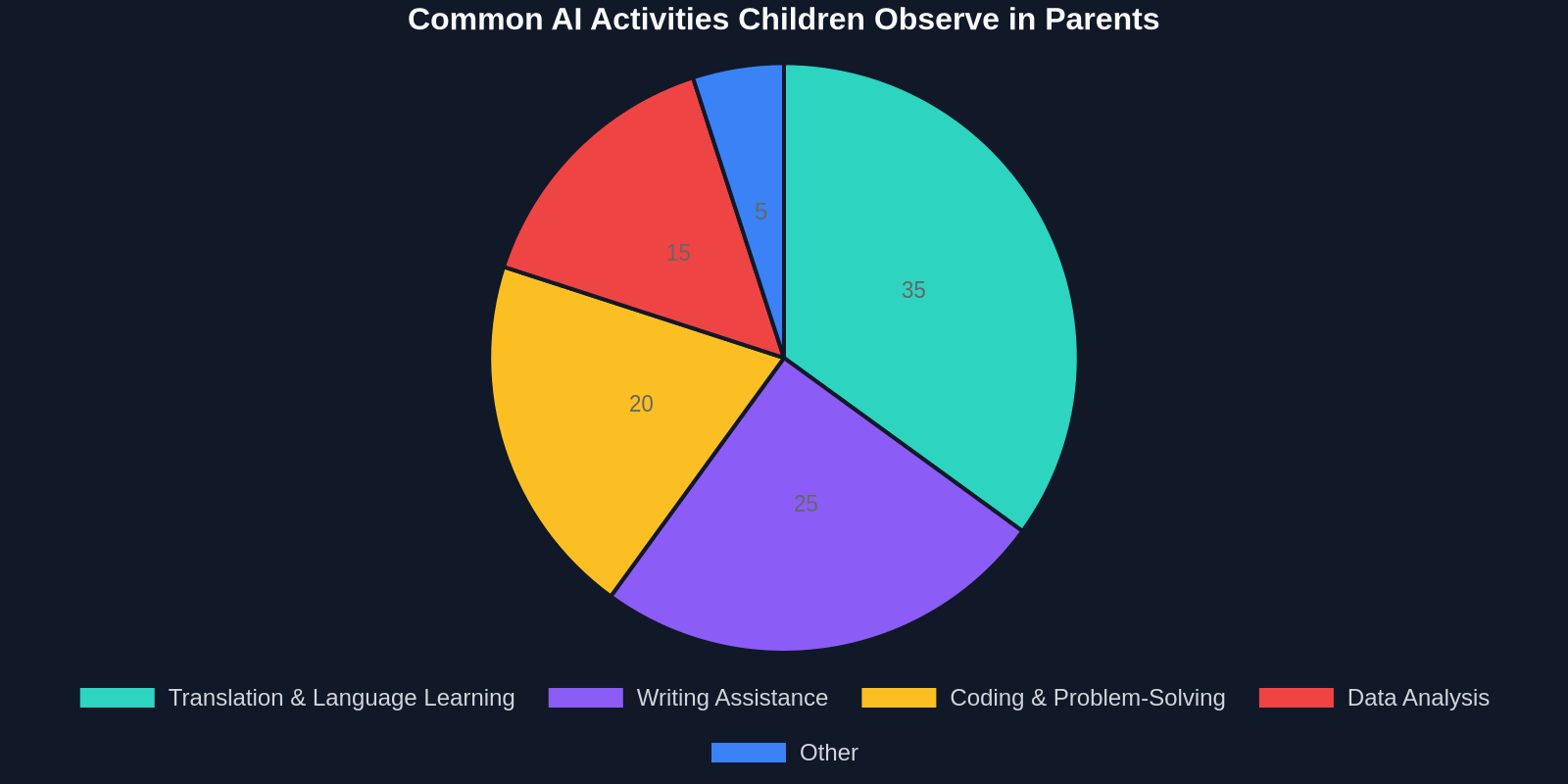
The pie chart above shows what children actually observe when parents use AI. Translation and language learning top the list at 35%, far outpacing coding or data analysis. This suggests that many parents are already, perhaps unknowingly, turning daily AI use into a cross-linguistic learning session. But without structure, those moments remain fleeting.
That’s where the right tool extinguishes passive consumption and ignites active practice. Lyric Lingo acts as an education layer for YouTube, adding dual subtitles to the music videos families already watch. A parent playing a Spanish pop hit can activate side-by-side lyrics in both Spanish and English, immediately elevating casual listening into a deliberate study session. The child sees word–translation pairs in real time, internalizes pronunciation through rhythm, and begins to associate vocabulary with emotion and movement.
Navigating the Risks: Imperfect AI and Critical Thinking
No technology is flawless, and AI language tools are no exception. Recent reports about AI-powered vulnerability scanners highlight a critical nuance: while algorithms can detect errors at impressive speed, fixing those errors, whether in code or in translated nuance, remains profoundly human work.

A child watching a parent accept an AI-generated translation without checking might absorb the idea that language is always literal. But languages are full of idioms, regionalisms, and emotional undertones that machines struggle to capture. This is why the best AI-assisted learning environments don’t replace teachers or native content, they complement them.
Lyric Lingo, for instance, doesn’t generate translations on the fly using a black-box algorithm. It pairs authentic, human-curated subtitles with the original lyrics, preserving the artistic intent while making comprehension accessible. This approach teaches children that translation is an art, not just a code swap, and that verifying a song’s meaning is part of the fun.
How Lyric Lingo Turns Passive Watching into Active Practice
For families who already spend time on YouTube, the leap from “watching” to “learning” takes only a few clicks. Lyric Lingo overlays a clean, distraction-free dual-subtitle panel onto music videos, allowing viewers to see both the original lyric and a parallel translation. Research on dual-subtitle presentation shows it significantly improves listening comprehension and vocabulary recall compared to single-language captions.
| Learning Method | Vocabulary Retention | Required Effort |
|---|---|---|
| Traditional flashcards | Low-medium | High (tedious) |
| AI-generated practice sentences | Medium | Medium |
| Music with AI dual subtitles (Lyric Lingo) | High | Low (enjoyable) |
When a learning method aligns with what children already love, music, rhythm, and visual cues, the effort barrier vanishes. They don’t have to be coaxed into a drill; they simply request their favorite song and see the language broken down. Over weeks, repeated exposure to high-frequency words like “coraŸón” or “liberté” cements them into long-term memory, powered by the emotional weight of the melody.
Importantly, Lyric Lingo does not host or redistribute any video or audio. It simply adds an interactive subtitle pane on top, respecting copyright while supercharging learning. This makes it a safe, educator-friendly tool that parents can feel good about.
Practical Steps for Parents to Shape AI-Positive Language Habits
Raising a language-aware child in an AI-saturated home doesn’t require a curriculum, just intentionality. Here are research-backed practices you can start tonight:

- Narrate your AI use. When you ask an assistant to translate a phrase or explain a lyric, speak the prompt aloud. Say, “I’m going to ask it for the French version of ‘happy birthday.’ Listen for how the words sound.” This demystifies the technology and models active inquiry.
- Make music time bilingual. Choose a song from a target language playlist, activate Lyric Lingo’s dual subtitles, and watch together. Pause to repeat a line, mimic the singer’s intonation, and discuss any new words.
- Validate AI outputs together. If a translation seems awkward, look it up in a dictionary or compare with another source. Teach your child that checking is part of learning, not a sign of failure.
- Use emotion as a glue. Ask, “How does this song make you feel? What do you think ‘mon ami’ means in that line?” Emotional engagement strengthens memory retrieval pathways.
- Celebrate small wins. When your child recognizes a word from a song outside of music, maybe on a menu or in a conversation, point it out. “You knew ‘gracias’ from that song you like!” This builds metacognitive awareness.
Conclusion: The Shadow That Becomes a Spotlight
The Business Insider story captured a simple, everyday truth: children learn from what we do, not just what we say. When parents use AI openly, they are teaching more than tech skills, they are modeling curiosity, problem-solving, and cross-linguistic thinking. The data backs it up: from rising job demands for clear communication to the neural retention magic of music, the fusion of AI and language learning is not on the horizon; it’s in our living rooms.
Lyric Lingo exists at that intersection, turning YouTube from a passive stage into an active language lab. It doesn’t distract from the music; it deepens engagement with it, making every beat a vocabulary rehearsal. So the next time your child watches you tap out a prompt or sing along to a translation app, know that you’re laying down language pathways. With the right tool, that shadow learning can step fully into the spotlight.