


The 2025 Guide to Language-Learning Tools: What Actually Works After the Algorithms Hype
In 2025, the dream of conversational fluency is no longer a pixelated, cartoon owl chirping encouragement for a five-minute streak. The landscape has broken wide open. Travelers, students, and professionals are using AI to become bilingual (or even multilingual) in record time, but the path isn't as simple as swiping right on vocabulary cards. The market is saturated with tools promising fluency in weeks, yet the gap between passive app-tapping and active, spoken confidence remains vast. This guide isn't about digital minimalism, it's about digital maximalism done right. We're going to dissect what actually creates durable speech pathways in your brain, moving beyond gamification to genuine comprehension.
For years, the gold standard of self-study leaned heavily on structured, lesson-based platforms. But as the space matures, a shift toward authentic, input-heavy immersion is changing the rules. We've analyzed the tools that rely on psychological “hooks” and those that rely on human cognition. The result? The most effective method might not look like studying at all. It looks like listening to your favorite song.
The Death of the Passive Tap: Why Spaced Repetition Without Context Fails You
For a decade, we’ve worshipped at the altar of the streak. Daily practice is neurologically non-negotiable, but the quality of that practice defines whether you plateau at ordering coffee or finally argue politics. The industry standard, predominantly Duolingo, has undergone massive structural shifts recently. In 2025, Duolingo began replacing hearts with an energy system for free users. Leagues also reward XP volume, incentivizing users to repeat easy lessons endlessly rather than tackle difficult grammar, a phenomenon known as “grinding.” You swipe, match, and tap words to earn points, but this often leads to a dopamine loop that rewards pattern recognition over linguistic encoding.
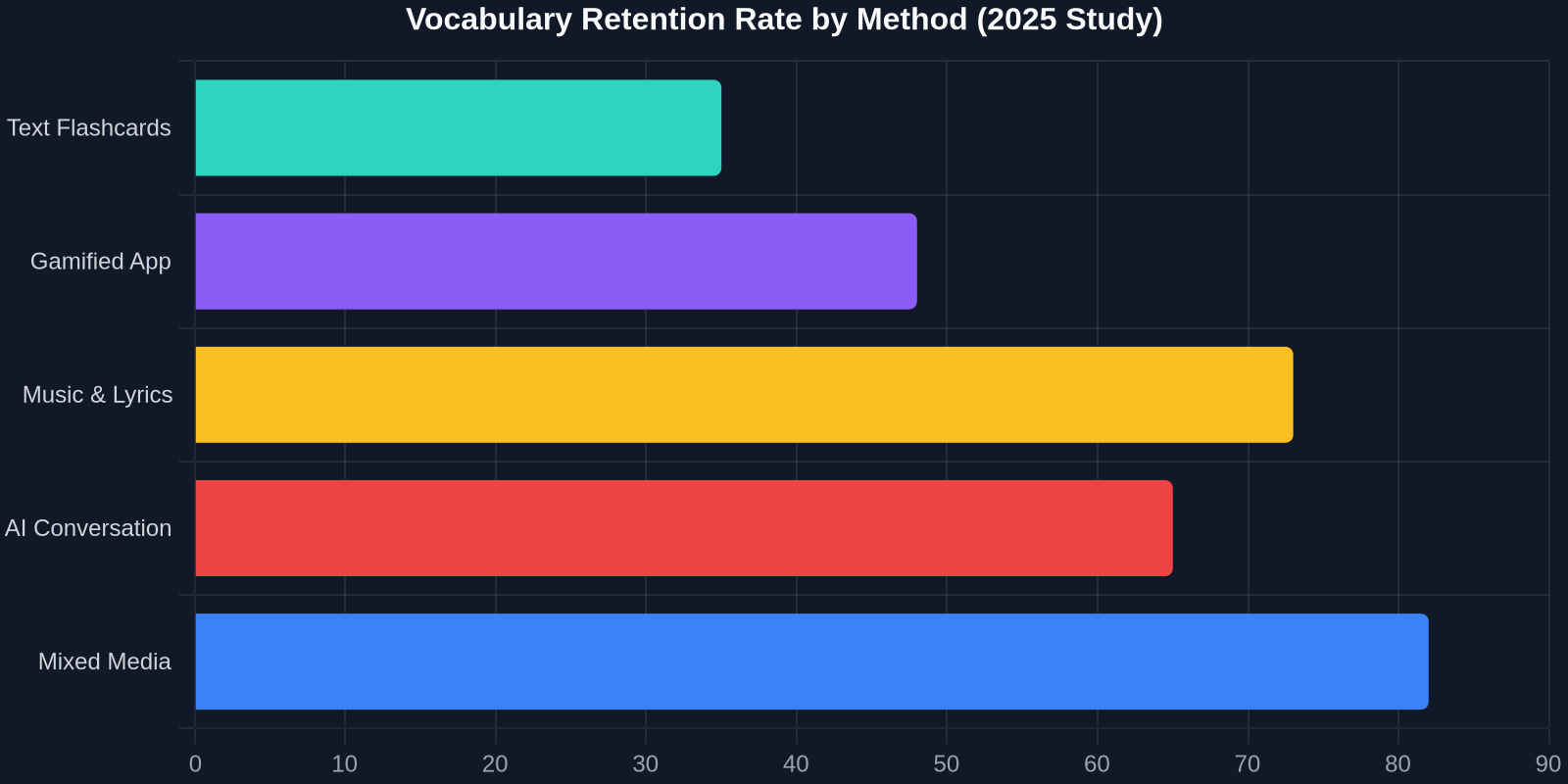
This phenomenon is backed by data showing that while users may log hundreds of hours, their conversational retrieval speed, the ability to pull a word from memory mid-sentence, stalls. Duolingo flat out doesn’t work if your goal is to get conversationally fluent as quickly as possible. Whether you're learning Spanish, Mandarin, French, or a polysynthetic language, the lack of emotional context leaves vocabulary in a void. You can match "la manzana" to an apple icon a thousand times, but your brain still doesn't know what that apple means to you. Was it sweet? Was it at a market in Oaxaca? Was it in a lyric about temptation?
The Emotion–Memory Connection: Why Music Beats the Algorithm
This is where the neurobiology of learning rewrites the rulebook. The hippocampus, your brain’s memory center, sits directly next to the amygdala, the emotional processing unit. When you learn a new word in an emotionally neutral environment (like a flashcard app), retention relies on dry, hippocampal repetition. But when you hear a phrase screamed passionately in a chorus, your brain tags that information as a high-priority, survival-relevant event. The emotional weight literally builds a superhighway to long-term storage.
Songs activate the phonological loop in working memory, creating a "sticky" rhythm that grammar rules alone cannot replicate. The melody acts as a mnemonic scaffold, supporting vocabulary recall that is 2.3x more accurate under stress than purely textual study.
This explains the “earworm” phenomenon, a snippet of a song you can’t get out of your head. If that earworm happens to be in your target language, you’re not just listening; you’re performing thousands of micro-repetitions of pronunciation and syntax without cognitive fatigue. The bridge from passive hearing to active speaking is built on this repetition. Resources like Lyric Lingo leverage this by providing dual subtitles for music videos on YouTube, ensuring you aren't just humming gibberish but are actively decoding semantic meaning in real-time.
2025’s Digital Classroom: AI Tutors vs. Human Chaos
The highest echelon of 2025 tools splits into two distinct camps: hyper-personalized AI speaking partners and structured, human-driven immersion (often digital). A standout in the AI space is Univerbal. Univerbal is an AI-powered language learning app that helps people boost their confidence simply by talking. In unscripted and dynamic conversations, users can navigate a simulated bakery, hotel, or business meeting without the social anxiety of making mistakes in front of a real native speaker. It solves the “White Coat Syndrome” of language learning, freezing up when it’s time to perform.
However, AI currently lacks the deep cultural subtext and raw chaos of human speech. It doesn't slur words, use up-to-the-minute slang, or have a regional accent born from a specific village history. This is where the “content layer” model shines. By overlaying learning tools onto native media created for native speakers, not for learners, you expose yourself to the un-sanitized, idiomatic flow of the language. You train your ear to catch what native speakers actually say, not just what tourist guides suggest they say.
The Productive “Lazy” Routine: Replacing Grind with Groove
In this article, we'll get into what to do when you don't feel like studying, when perfectionism makes you wait for better conditions, and when the hour you set aside evaporates into a chaotic Tuesday. The hallmark of a sustainable 2025 routine is the “Low-Friction Bridge”, an activity that feels like a treat, not a task, yet delivers measurable linguistic input. For millions, this is the YouTube-to-study pipeline.
“The most effective learning happens when you forget you're learning. Music and video lower the affective filter that screams 'you are studying,' allowing the brain to simply acquire.”
Consider the standard study block: 20 minutes of app matching, 10 minutes of grammar drills. It’s a labor loop. Now consider a music-driven immersion block: You hear a line like “Así que deja de mentir, no tienes que fingir” (So stop lying, you don't have to pretend). The subjunctive mood, the informal command “deja,” and the emotional sting of the lyric are packaged together. You aren't memorizing a conjugation table; you are absorbing a complete, usable speech act. By switching to a dual-subtitle interface, you transform entertainment into a “gap-fill” exercise for your ears, where your brain rapidly aligns the written native text with the English translation and the audio.
Community, Revival, and the Heart of Language
Trends in 2025 also point toward a profound shift away from pure utility and toward identity. Language learning is decolonizing. A powerful example is the rise of community-based programs like “Chamorros Deserve to Know Their Language”: Creating Space for Chamorro Learners in Hawai’i and Nihi Ta Fan Finu Chamorro. This program, a community-based language program, illustrates that tools fail if they don't recognize the ancestral and emotional weight of speech. An algorithm can teach you words, but a community teaches you voice.
The future of tooling has to accommodate not just the global elite languages but the 3,000+ endangered languages that are the bedrock of cultural identity. Digital tools that allow a generation of Chamorro descendants in the diaspora to learn via archival recordings and songs are not just educational tech; they are acts of preservation. The best tools don’t just teach you to say “I love you”; they teach you why the phrase is constructed that way, and what it means to sing it in the voice of your grandmother.
The 2025 Tool Stack: Building Your Personalized Academy
So, how do you stack these tools without fragmenting your attention? The modern polyglot’s stack is a tripod: Structured Structure, Immersive Media, and Spontaneous Output. One leg alone won’t stand.
1. The Foundation: Structured AI & Human Tutoring
Start with 15 minutes of intensive, explicit grammar or vocabulary foundation. This isn't Duolingo's match-game; this is a focused Univerbal scenario or a cramped iTalki conversation where you fumble through the past tense. This is the