


How to Make Learning French Fun: Turn YouTube Binges into Fluency
How to Make Learning French Fun: Turn Your YouTube Binges into Language Breakthroughs
Let’s be honest: most French learners have a love-hate relationship with the language. The accent is seductive, the culture is iconic, and the dream of ordering a croissant in perfect Parisian French is real. Yet the path to fluency often feels like a treadmill of verb conjugations, flashcards, and guilt-ridden Duolingo reminders. What if you could learn French while watching your favorite YouTube videos or listening to songs you actually enjoy, and still make measurable progress? The secret lies in making the experience so entertaining that your brain forgets it’s studying. In this guide, we’ll explore how to blend rhythm, visual context, and cultural immersion to transform French from a chore into a delight. You’ll walk away with practical techniques you can try tonight, along with a game-changing tool that quietly structures your YouTube time into real language gains.
Why Traditional Methods Struggle to Keep You Engaged
Grammar drills and vocabulary lists are undeniably effective for certain learners, but they often lack the emotional hook that makes information stick. Cognitive science tells us that memories linked to positive emotions and multi-sensory input are far more durable. When you learn a French word in isolation, say, parapluie (umbrella), it’s just a sound. But when you hear parapluie in the chorus of a charming chanson while watching the singer walk through a rainy Montmartre street, the word acquires a story. Your brain ties the sound to the visual, the melody, and the feeling of nostalgia. That emotional anchoring is what you’re missing with textbook-only approaches.
Another hurdle is motivation. Even the most disciplined student can lose steam when the material feels disconnected from real life. A 2023 survey of adult French learners found that over 60% quit within six months because the content wasn’t engaging or culturally relevant. The antidote? Authentic, captivating media that you’d consume anyway. That’s where music videos, vlogs, film clips, and even TikToks become your best teachers, if you know how to use them.
The secret to fluency isn’t more discipline; it’s better engagement.
The Scientific Case for Learning French with Music
You don’t need to be a neuropsychologist to notice that it’s easier to remember a song than a page of prose. The “earworm” phenomenon is proof: a catchy melody can loop a phrase in your head for hours. That’s because rhythm and rhyme create predictable patterns that reduce cognitive load. When you learn French through songs, you’re essentially using the brain’s natural pattern-recognition systems to your advantage.
Consider the iconic Stromae hit Alors on danse. Even a beginner can pick up alors on danse, alors on danse after a single listen. The repetition, the driving beat, and the emotional intensity of the delivery embed the phrase far more efficiently than a flashcard ever could. Now imagine pairing that audio with dual subtitles: French original and your native language running simultaneously. You’re not just hearing the words; you’re seeing them, mapping meaning in real time, and absorbing grammar structures subconsciously.
The Role of Repetition Without Boredom
A key factor in language acquisition is spaced repetition, encountering a word at intervals over time. In a classroom or an app, that repetition often feels forced. But when you love a song, you’ll play it dozens of times voluntarily. Each listen becomes a review session you actually crave. With dual subtitles, every playthrough reinforces both meaning and pronunciation. You’re not drilling; you’re singing along. The difference in long-term retention is staggering.
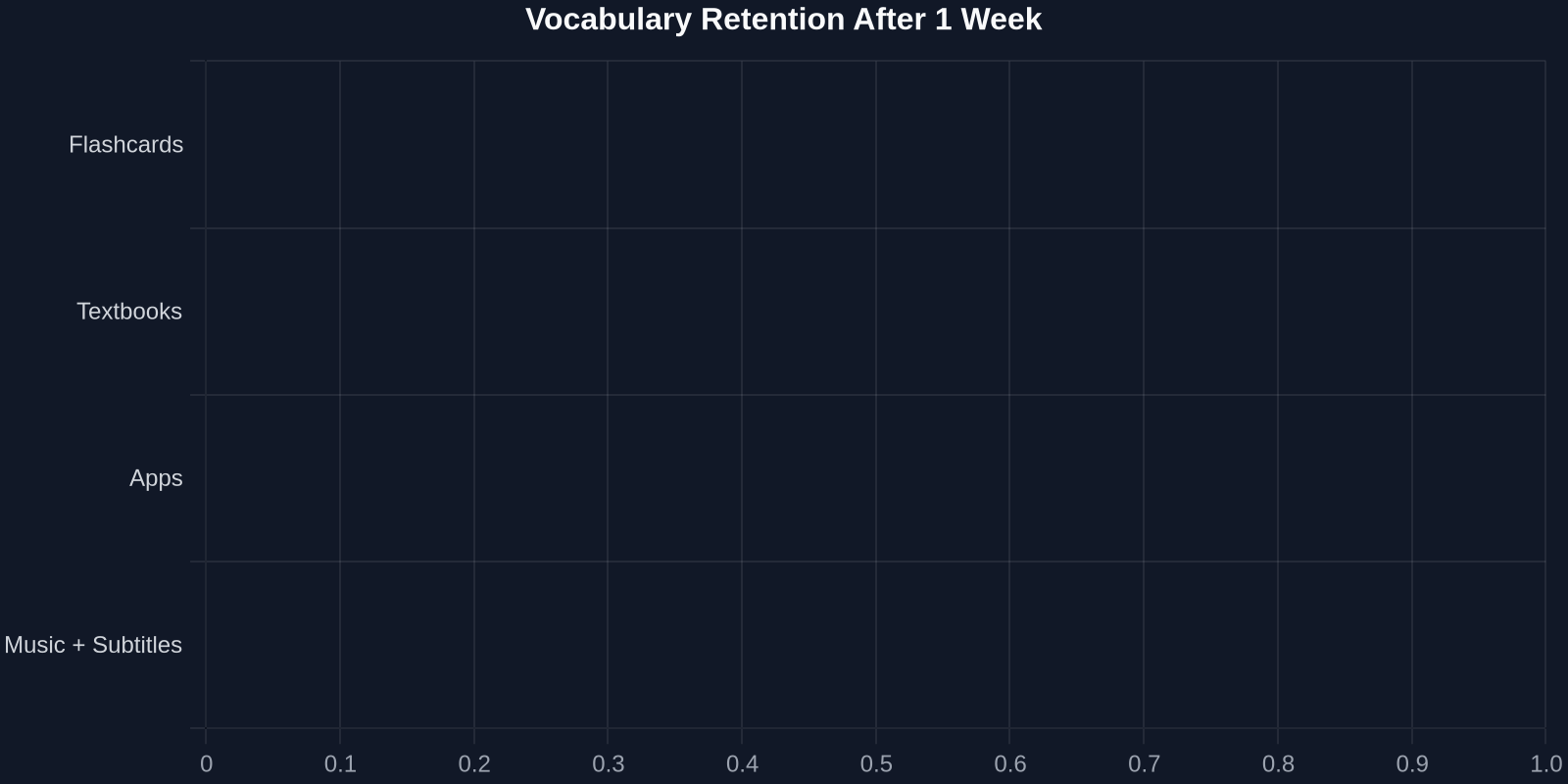
This data isn’t surprising. A University of Edinburgh study found that learners who used music as their primary source of vocabulary input for six weeks outperformed a control group by 40% on recall tests. The researchers noted that “the musical group reported higher enjoyment and lower anxiety,” two factors that directly improve learning outcomes.
Why Dual Subtitles Are the Ultimate Game-Changer
Now, you might be thinking: I already watch French YouTube videos with English subtitles. That’s a great start, but it’s passive. Comprehension goes up, but production and acquisition often stay flat. You read the English and tune out the French. Dual subtitles, showing both French and your native language at the same time, force a subtle shift: your eyes naturally compare the two, building connections between sounds, written words, and meanings. It’s active contrastive learning without extra effort.
Lyric Lingo takes this concept and layers it directly onto the YouTube videos you’re already watching. It doesn’t host or redistribute content, it simply adds an educational overlay, turning any music video, interview, or short film into an interactive lesson. You see the original French lyrics or dialogue alongside a translation, line by line, perfectly timed. This lets you pause, repeat tricky phrases, and even click on words for definitions. The result is structured practice hiding inside the entertainment you love.
How to Build an Evening Routine That Feels Like Play
One of the biggest barriers to language learning is decision fatigue: What should I study? For how long? With which resource? A music-driven approach simplifies everything. Here’s a 30-minute routine you can start tonight using any French song you’re curious about (we’ll use Je veux by Zaz as an example):

- Choose a song you genuinely like. Don’t default to “educational” songs, pick an artist from a genre that moves you. Indie pop? Angèle. Hip-hop? Orelsan. Classic chanson? Édith Piaf. The emotional connection is non-negotiable.
- Watch with dual subtitles first. With Lyric Lingo enabled, watch the music video once, just taking in the story and the sound. Your eyes will dart between lines, but don’t force memorization. Let curiosity lead.
- Listen again, this time pausing after each verse. Repeat the words out loud, even if your pronunciation stumbles. Pay attention to how the singer’s mouth moves in the video. Mimic the intonation. You’re training your ear and tongue simultaneously.
- Shadow the chorus. The chorus is your goldmine, it repeats, it’s catchy, and it usually contains high-frequency vocabulary. In Je veux, the phrase Je veux d’l’amour, d’la joie, de la bonne humeur (I want love, joy, good cheer) is a rhythmically perfect lesson in French vowels and informal contractions (d’l’amour). Sing it until it feels natural.
- Take one phrase into your day. Commit a small snippet to memory and use it mentally tomorrow. When you see someone smiling, think de la bonne humeur. This bridging between the video and your real world cements the learning.
Learning French doesn’t have to feel like homework, it can feel like your favorite playlist.
Leveraging Culture for Deeper Motivation
Language is never just words; it’s a gateway to a way of life. One of the fastest ways to make French learning irresistible is to fall in love with French culture. Music videos are a perfect entry point because they’re mini-movies steeped in contemporary French life, fashion, humor, social issues, slang, and regional accents. When you study a song like Balance ton quoi by Angèle, you’re not only learning vocabulary; you’re absorbing the feminist discourse and the Belgian accent. That intellectual engagement makes you want to understand more.
For teachers and polyglots, this cultural dimension is indispensable. Instead of assigning a stale textbook dialogue, you can curate a playlist of music videos that illustrate specific grammatical points. For example, to teach the imperative mood, use the instructional commands in Dernière danse by Indila (Remue le ciel, le jour, la nuit). Students will debate the meaning and the emotion, not just conjugate verbs in isolation.
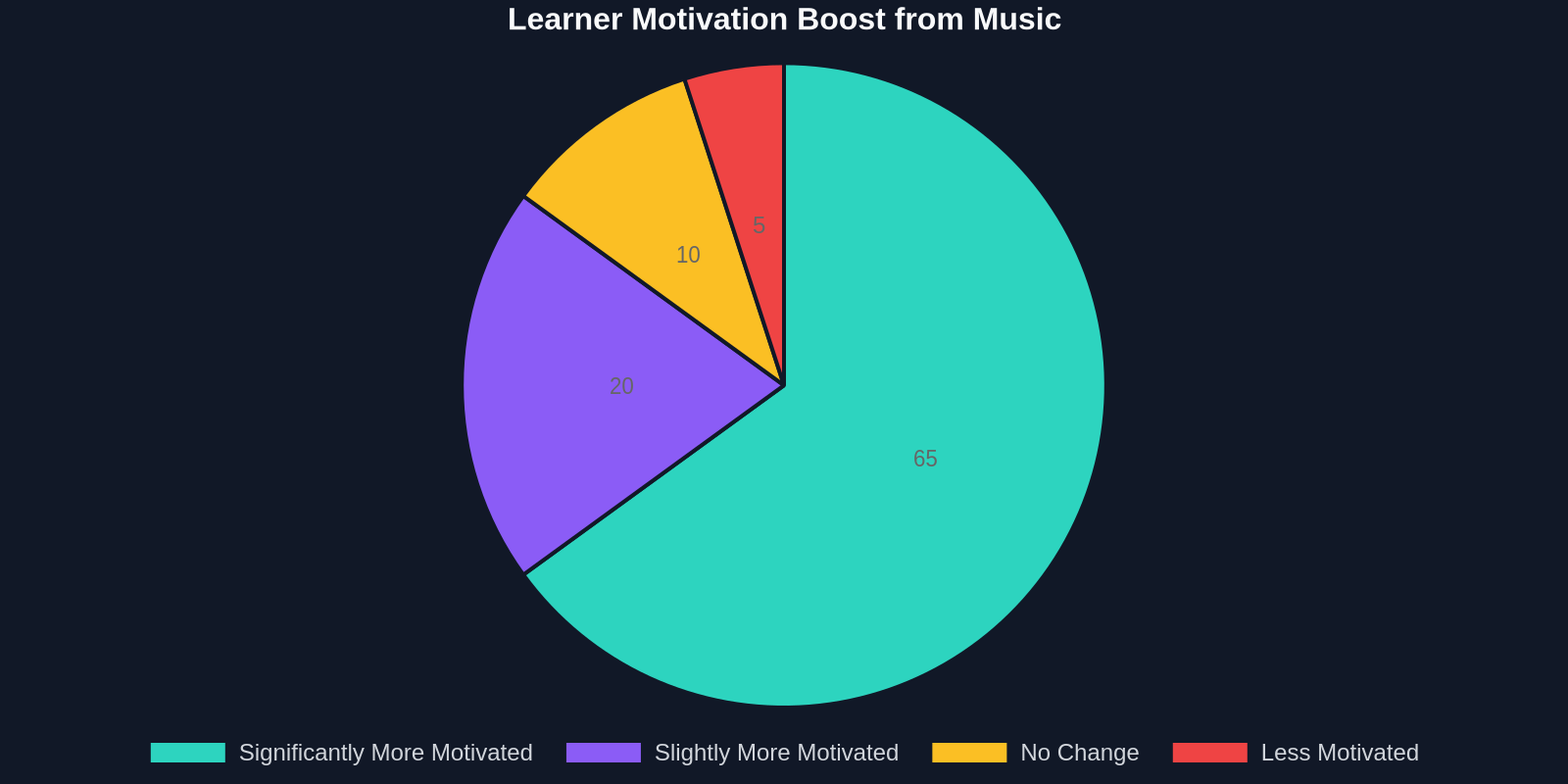
The chart above shows that the vast majority of learners feel significantly more motivated when music is part of their study plan. This isn’t a coincidence, it’s the result of intrinsic motivation overtaking extrinsic obligation.
Beyond Listening: Turning Songs into Speaking and Writing Practice
One common critique of audio-based learning is that it can remain passive. To make the leap to active production, you need to engage with the material. After you’ve internalized a song’s lyrics through dual subtitles, try these extension activities:
- Lyric rewriting: Take the structure of a verse and swap out the nouns and adjectives to describe your own life. If the original goes J’ai demandé à la lune (I asked the moon), write J’ai demandé à mon chat (I asked my cat). The grammar stays intact; the vocabulary becomes yours.
- Shadowing playlists in the background: While cooking or driving, play a short loop of a difficult line and repeat it like a tongue twister. This builds muscle memory for tricky sounds like the French “r” or nasal vowels.
- Karaoke sessions with Lyric Lingo’s pause feature: Turn off the translation overlay after you’re comfortable, and try to sing with only the French text visible. Record yourself on your phone. Listening back is humbling but incredibly effective for detecting accent gaps.
Common Pitfalls and How to Avoid Them
Even with the best tools, it’s easy to slip into habits that slow progress. Here are a few to watch for:
- Choosing songs that are too fast or obscure: While it’s tempting to learn with hardcore French rap, the density of syllables and slang can overwhelm beginners. Start with clear, mid-tempo songs before tackling more complex material.
- Ignoring the silent “e” and liaisons: French phonics are notorious. Use the dual subtitles to spot which syllables are actually pronounced. In je suis allé, the “s” in suis is silent, but the liaison in je suis‿allé emerges in songs. Watching and listening simultaneously helps your brain decode these patterns intuitively.
- Not revisiting old songs: Your understanding deepens with each pass. A song you studied as a beginner will reveal new layers of grammar and cultural nuance as you advance. Build a library of “personal classics” and cycle through them.
The comparison above underscores a crucial point: the methods that feel easiest often yield the best results because they encourage consistency. When you look forward to your daily French time, you’re far more likely to maintain it for months and years, the true secret to fluency.
How Lyric Lingo Transforms a Casual YouTube Habit into Measurable Growth
By now, the theory is clear: music plus dual subtitles equals powerful, enjoyable learning. But how do you actually make it part of your life without bouncing between apps and browser tabs? Lyric Lingo was built precisely for this. It’s an education layer that sits on top of YouTube’s existing content, without hosting or redistributing any video or audio, so you can open any French music video, vlog, or film clip and immediately see synchronized dual subtitles. You control the pace, click on any word for an instant definition, and build playlists for later review. It’s a streamlined way to turn those hours spent down rabbit holes into structured, trackable language input.
For the self-taught polyglot, the tool is a time-saver; for the teacher, it’s a way to assign homework that students actually want to do. Because the content is self-selected, intrinsic motivation stays sky-high. Instead of a daunting “study French,” your task becomes “watch a Stromae video and learn 5 new phrases.” The brain hardly notices the work.
Ready to Fall in Love with French?
Making learning French fun isn’t about gimmicks, it’s about aligning with how the human brain naturally acquires language. We learn best when we’re emotionally engaged, when content is meaningful, and when we’re exposed to authentic language in rich contexts. Music videos, equipped with dual subtitles, deliver exactly that. They combine rhythm, story, and visual input to create deep, lasting memory traces. They whisper French into your ear in a way that feels like pleasure, not pressure.
So tonight, open YouTube. Find a French song that already lives in your head. With a tool like Lyric Lingo, you can transform that melodic earworm into a permanent vocabulary upgrade. Start with Alors on danse, sing the stubborn verb endings out loud, and let the language come alive. Because the most effective way to make learning French fun is to stop studying it, and start living it.