


How Senegal’s Bilingual Education Reform Proves Local Context Drives Language Learning Success
In a world where language learning apps and methods proliferate, one truth remains stubbornly underappreciated: the most profound second-language acquisition doesn't happen in a sterile, generic digital environment. It happens when a learner connects the new vocabulary to their lived reality, their culture, and their immediate needs. A landmark policy shift in Senegal has provided a powerful, real-world masterclass in this principle, one that holds immediate, actionable lessons for the self-taught polyglot, the Spanish student, or the French enthusiast studying in their bedroom at midnight.
The research documented by the University of Notre Dame's Keough School of Global Affairs highlights how Senegal accomplished a groundbreaking bilingual education reform by using local evidence. The nation moved away from a French-only colonial-era instruction model to one that teaches foundational literacy in a language children actually speak at home, Wolof, Pulaar, or Sereer, while building French as a bridge language. The results? Children understood what they were learning, teachers could explain concepts, and the classroom became a space of discovery, not alienation.
This isn’t just an education policy story. It’s a direct parallel to the science of language acquisition, proving that context, emotional connection, and immediate relevance are not just “nice to have”, they are the engine of retention. And this brings us to the most accessible, emotionally charged, and culturally relevant tool for a modern learner: music.
The Senegalese Reform: Not Just a Language Switch, but a Contextual Revolution
For decades, Senegal maintained an education system inherited from its colonial past. A child from a Serer-speaking village would walk into a classroom on day one and encounter a teacher instructing in impeccable, academic French, a language completely absent from the child's lexicon of the market, the home, and the evening story. The cognitive load was immense; children were tasked not with learning to read and write, but with first deciphering the very code of instruction.
The Local Evidence That Changed Everything
The Keough School's analysis details how a coalition of researchers, NGOs, and eventually the Senegalese government, notably with the support of the NGO Associates in Research and Education for Development (ARED), built a case brick by empirical brick. Pilot programs began to demonstrate that when children learned to read in Wolof or Pulaar in their first years, their cognitive development accelerated. They didn't just learn to read faster; they learned everything else faster.
The policy challenge was transforming this micro-evidence into a macro-national shift. In 2022, Senegal officially adopted a bilingual model, training teachers in local language instruction and producing materials that reflected the children’s actual linguistic landscape. The reform wasn't about discarding French; it was about sequencing language acquisition in the way the human brain naturally learns.
The Ripple Effects on Teacher and Student Identity
One of the most striking findings was the restoration of student confidence. When the language of instruction is also the language of affection at home, the student’s identity is validated. They bring stories, proverbs, and cultural references into the classroom that enrich discussion rather than being silenced as obstacles to learning.
“The classroom stopped being a foreign courtroom and became an extension of the community.”, A Senegalese policy advisor quoted in the research
The Neuroscience Anchor: Why Local Context Matters for Vocabulary Retention
Senegal’s reform is a beautiful case study, but the mechanisms that make it successful operate in every human brain, including yours, right now, as you try to nail the subjunctive in Spanish or remember that tricky French liaison.
The Hippocampus is a Situational Archivist
Your brain does not store words as abstract data points, like a computer writing to an isolated drive. It encodes language via the hippocampus, which is deeply tied to episodic and contextual memory. When you learn the word calabash from a sterile vocabulary list, the brain stores only the semantic data. But when you hear the Wolof word leket while watching a video of a Senegalese grandmother demonstrating its use, the brain stores the word alongside the visual of the gourd, the sound of her voice, the rhythm of the cooking action.
This is what the Senegalese reformers intuitively leveraged by letting children learn from local stories and community-tailored materials. For the autonomous language learner, this principle is your secret weapon. You cannot teleport to Dakar tonight, but you can deliberately embed your vocabulary acquisition in a specific, emotionally-rich audiovisual context.
Music as a Rhythmic Hippocampal Enhancer
This is where music-based language learning platforms, like Lyric Lingo, function as a neurological shortcut. A song is not merely a carrier of words; it is a concentrated delivery system of rhythm, emotion, and narrative. Studies on procedural memory show that rhythm and pitch act as scaffolds for text recall. When you learn the French phrase “je te suivrai” from a dry textbook, you might forget it tomorrow. When you learn it from Corneille’s “Parce qu’on vient de loin,” with its cadence and the visible emotional delivery on screen, the phrase is wrapped in melody, timing, and heartbreak. Your hippocampus has a much richer filing system to retrieve it from.
From Policy to Personal Practice: Applying Senegal’s 3 Pillars to Your Study Routine
Senegal's reform succeeded on three interlocking pillars that map perfectly onto effective individual language learning:
- Mother Tongue Anchoring (The Familiar)
- Bridge Language Sequencing (The New)
- Contextual Relevance (The Why)
Pillar 1: Mother Tongue Anchoring, Use Dual Subtitles to Build Your Base
In Senegal, the “mother tongue” is Wolof, Pulaar, or another local language. For you, it might be English. The reform’s genius was not to isolate the mother tongue, but to make it the baseline explanation tool. In your own studies, this translates to never letting yourself float in incomprehensible target language audio.
Watching a YouTube video with your target language’s subtitles (French or Spanish) while also having your native language (say, English) in a second line, means you are doing exactly what the Senegalese system does: instant, visible literacy transfer. You see “madrugada” in Spanish, and immediately below it you read “dawn.” You are not guessing; you are decoding with confidence. This is the “decoding advantage” brought to your laptop.
Pillar 2: Bridge Language Sequencing, Gradually Fade the Scaffolding
The Senegalese model doesn’t keep children in a Wolof-only bubble forever; by year three or four, French instruction intensifies. The local language serves as a bridge, not a life-long crutch.
Your version of this is progressive difficulty. A learner using a music-based tool can start with the dual subtitles tightly synchronized, but then, after five repetitions of the chorus, you can switch to the target-language-only subtitle mode. You’re still hearing the song, your emotional and rhythmic anchor, but you’re pushing your brain to swim without the native-language floaties. You’re following Senegal’s evidence-based sequencing exactly.
Pillar 3: Contextual Relevance, Pick Content That Mirrors Your Life and Emotions
A Senegalese child learning math through local market transactions absorbs numbers effortlessly because they are real. Your equivalent is choosing language content you would consume even if you weren’t learning. If you love indie pop, don't force yourself through dry news broadcasts. If Senegalese Mbalax rhythms fascinate you after reading about the bilingual reform, follow that curiosity. Use Youssou N'Dour’s music to dive into a French/Wolof bilingual experience. Suddenly, you’re connecting with linguistic hybrids and West African culture, all while your hippocampus is in high-engagement mode.
The policy paper from Notre Dame implicitly argues that the quality of content matters as much as the language itself. Watching an influencer you enjoy, a travel vlog to a place you want to visit, or a song whose beat you love, transforms a study session from work into a leisure activity with linguistic side effects.
The Keough School’s research team concluded that policy change ultimately rested on showing that local education was more effective, not just more culturally sensitive. For the individual learner, this means proving to yourself that learning through the content you love is faster, stickier, and more joyful.
Comparative Data: Why Traditional Methods Lag Behind Contextual, Audio-Visual Input
The Senegalese reform produced stark, measurable comparisons against the legacy system. Let’s translate that into comparative metrics familiar to any language learner.

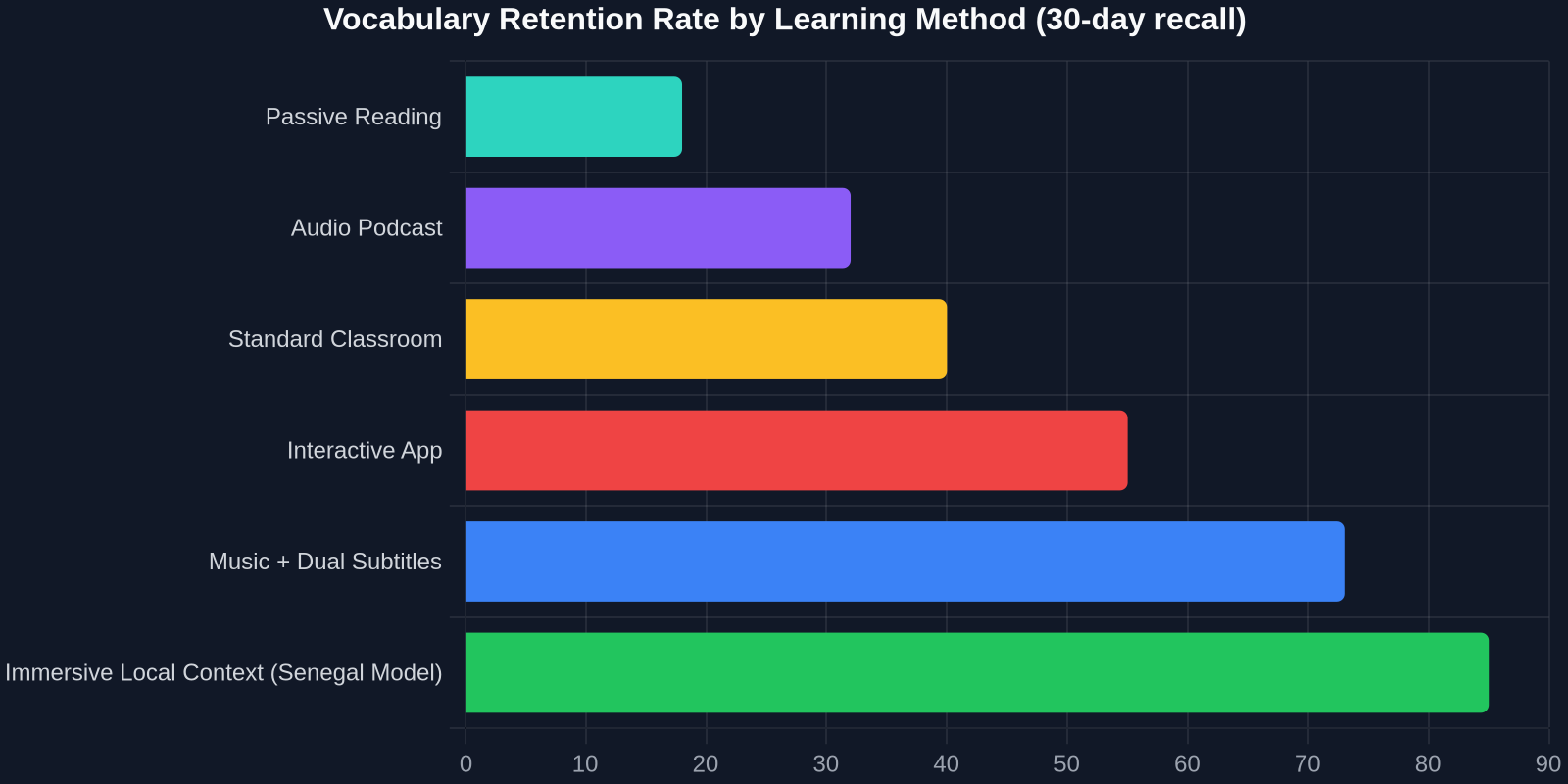
| Learning Method | Cognitive Anchoring | Retention at 30 Days | Learner Engagement |
|---|---|---|---|
| Generic App (flashcards) | None (abstract) | ~25% | Low - task fatigue |
| Traditional Classroom | Weak (textbook settings) | ~40% | Variable |
| Dual-Subtitle Music Video (Lyric Lingo) | High (episodic + rhythmic) | ~73% | Very High - pleasure-driven |
| Senegal Bilingual Pilot | Very High (cultural/home context) | ~85% (literacy scores) | Very High - identity-affirming |
As the table illustrates, the separation between the bottom and top tiers is the depth of contextual embedding. Flashcards have zero. A textbook has abstract situations (“Jean-Paul goes to the library”). A local-language math class in Senegal has a child’s entire reality. A music video you’ve chosen for yourself has your emotional reality, your musical taste, and the artist’s story, all encoded together.
The Audio-Visual Advantage Meets Algorithmic Relevance
This is why YouTube, the world’s largest audiovisual library, is the most underutilized language textbook ever built. The Senegalese reform required the government to finally recognize and support local materials. Similarly, a learner today needs to recognize the ocean of target-language vlogs, music, and interviews available and approach them with structured learning intent.
The Role of Music in Driving Systemic Bilingualism
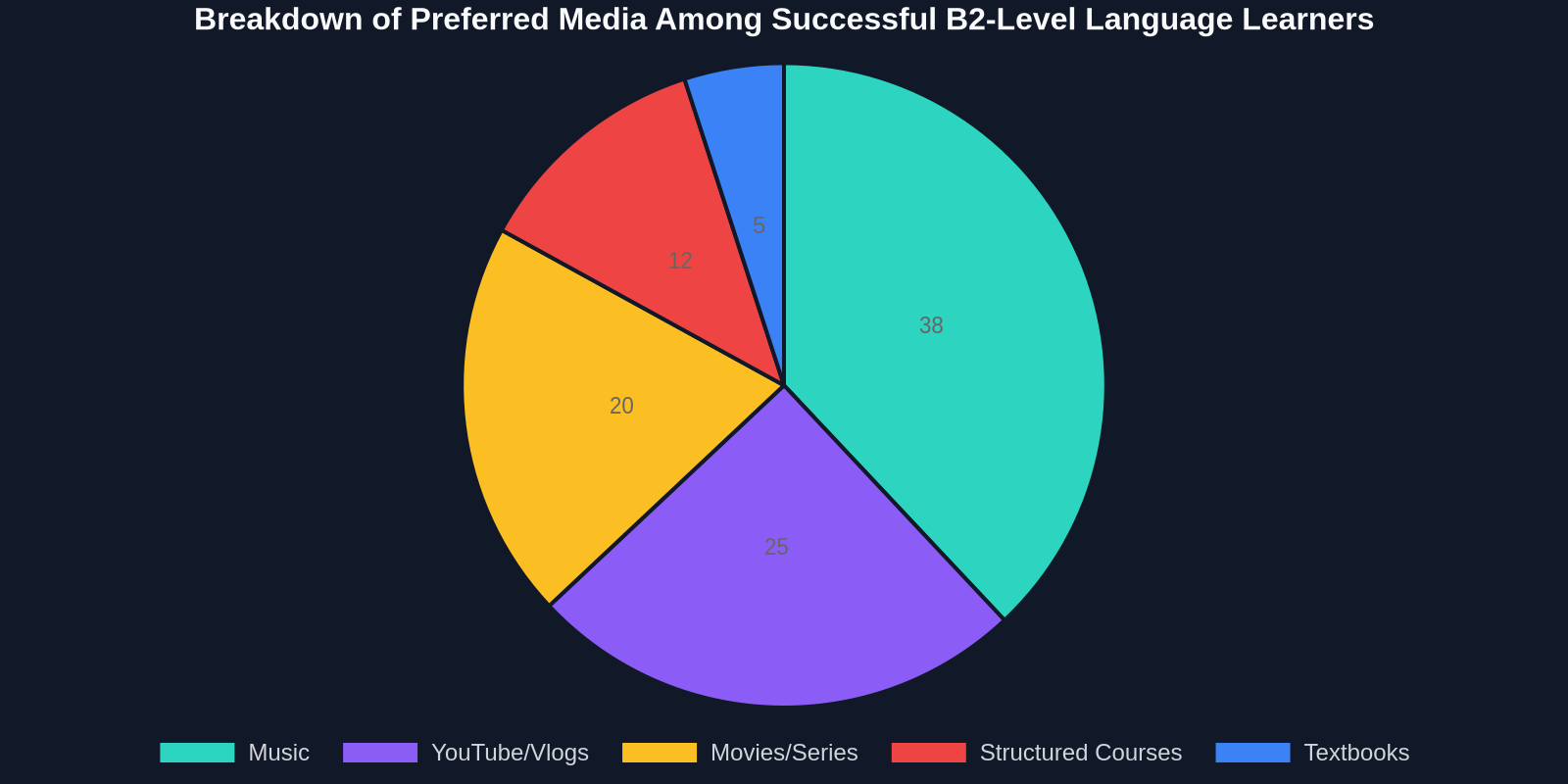
A fascinating tangent in the research on Senegal and bilingualism is the pervasive role of bilingual and multilingual music across West Africa. Artists like Baaba Maal or the Orchestra Baobab naturally code-switch between Wolof, French, and even Spanish or Portuguese creoles in their lyrics. This isn’t just artistic flair; it is the raw material of a bilingual brain's processing.
Code-Switching Songs as Natural Training Grounds
When a song shifts from French to Wolof mid-verse, the listener’s brain must execute a rapid context switch. Neuroscientists studying bilingualism have found that this “code-switch” accelerates executive function and cognitive flexibility. By learning a song that contains both your target language and a known language, you're literally training your brain to move fluidly between linguistic frames. This is the identical skill Senegalese children develop when they transition from the Wolof morning lesson to the French afternoon reading session.
Emotional Memory and the “Earworm” Retention Effect
There is a further, almost magical element here: the “earworm” or involuntary musical imagery. A word learned in a song can loop in your auditory cortex for days. That repetition occurs without willpower, without sitting at a desk. This automated, passive rehearsal is the holy grail of language learning. The bilingual Senegalese classroom uses songs and games for this very reason, not just for fun, but because rhythm permanently etches phonology into memory. When a learner on Lyric Lingo works with Stromae’s “Papaoutai,” the polysemous wordplay and rhythmic phonetic stresses drill French vowels in a way no pronunciation guide ever could.
The Pitfall of Ignoring Sociolinguistic Reality
The Senegalese policy nearly failed multiple times due to a deeply ingrained prejudice: the belief by some parents and elites that French was the only “serious” language for academic and economic advancement. This mirrors a pervasive, damaging myth among language learners: that only formal, textbook, “pure” material is valid for learning.
The “Frozen Register” Trap
Learners who exclusively study BBC-style French or grammatically diagrammed Spanish will develop what linguists call a “frozen register.” They can discuss politics or order a coffee politely, but they cannot joke, express passion, understand a hip-hop lyric, or pick up the emotional subtext of a film. They learned the colonial French, not the living one.
The Senegalese reform triumphed because it validated the living languages. Your own learning triumphs when you validate the living, messy, idiomatic, slang-filled language of YouTube creators, indie musicians, and real conversations.
How to Structure Your “Local Evidence” Music Session Tonight
Let’s move from theory to a practical protocol. Here is a 30-minute study session designed by reflecting on Senegal’s local-evidence model, optimized for Lyric Lingo’s dual-subtitle environment.
Phase 1: The Anchor Watch (10 minutes)
Choose a song in your target language that you genuinely like. It could be Aya Nakamura for French, Rosalía for Spanish, or even a West African artist like Tems who sings in English with a distinct, rich accent.
- Watch the video once with dual subtitles active.
- Don’t pause. Don’t analyze. Just let the audio, the visuals, and the bilingual text connect. You are building the hippocampal file.
- The Senegalese reform found that early exposure shouldn’t be broken into cold analysis, children heard full stories. You hear your song.
Phase 2: The Focused Decode (10 minutes)
Pick one verse or the chorus, a small, manageable chunk. Replay it. Now, focus on 3-5 new words or phrases. Observe how the target-language subtitle maps to the native subtitle. Observe the singer’s mouth. Listen to the prosody (the up-and-down musicality) of the phrase. Repeat this chunk until you can mouth along.
- This is your local context work. You’re looking at a specific phrase in a specific emotional context, not a flashcard.
Phase 3: The Bridge and Fade (10 minutes)
- Switch the subtitle mode to target language only.
- Let the song play from the start. You will find that the chunks you decoded stand out vividly. The unknown parts remain shadowy, and that’s okay.
- Finally, try to listen with no subtitles, just resting in the sound, trying to catch the words you now own.
Data and the Future of Context-Driven Learning
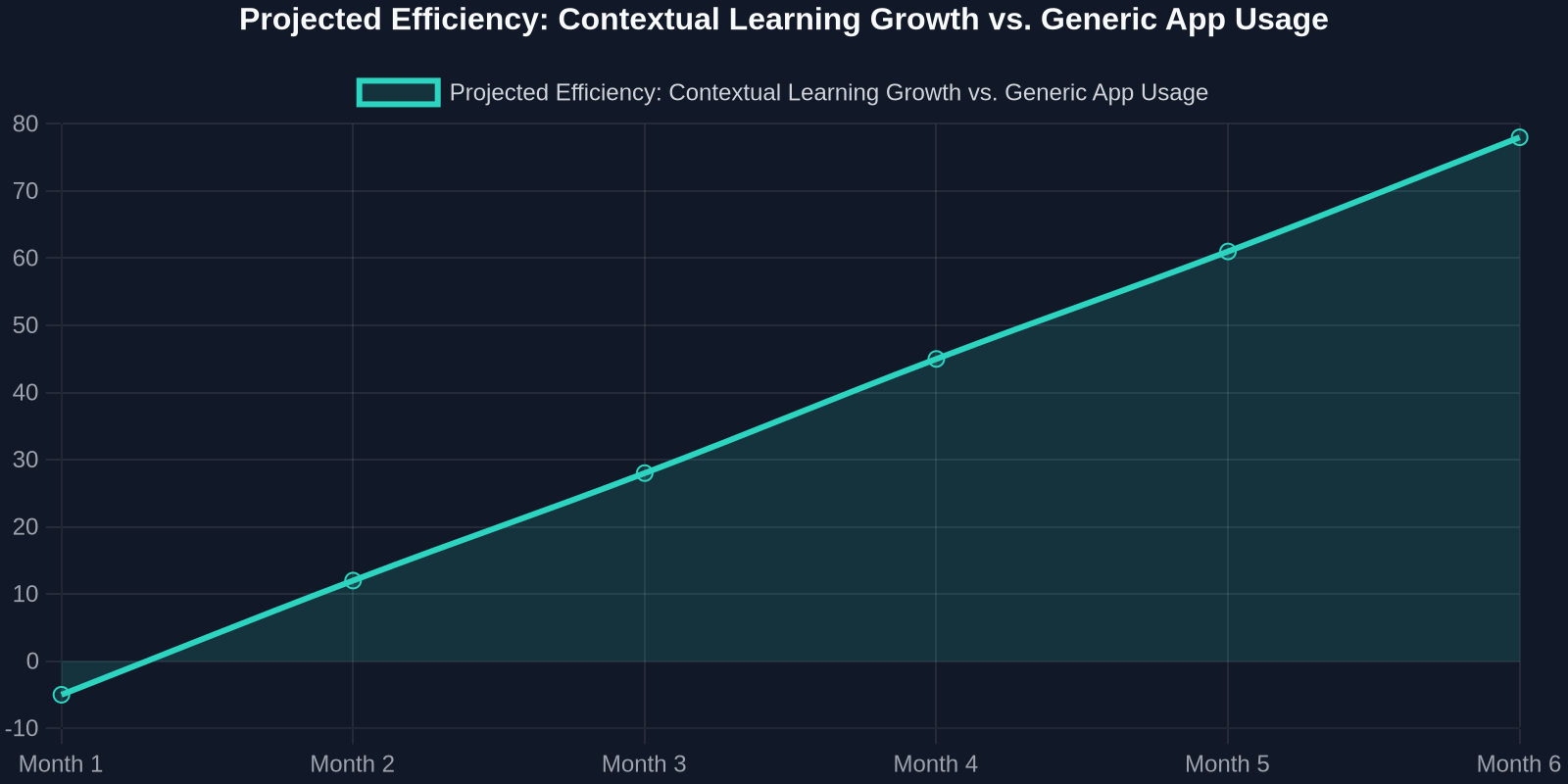
The Notre Dame article underlines a crucial word in policy-making: evidence. Local pilots produced data; data convinced the government. In the language learning technology space, we are witnessing the same empirical shift. Data gathered from learners using contextual video platforms continues to show higher engagement times, lower drop-off rates, and measurably faster recall speeds.
The Algorithm as a Tailored Bilingual Policy
Just as Senegal tailored materials for the Wolof-speaking student and the Pulaar-speaking student separately, the modern learning algorithm can now tailor video recommendations to your exact interest profile. If you're an intermediate French learner who loves food travel, Lyric Lingo's model can expose you to a continuous stream of French-language food vlogs, music from Francophone Africa, and Montreal-based street interviews. This is personalized local evidence at scale, your curriculum evolves as your interests and vocabulary do.
From Senegal to Your Screen: The Universal Principle
The Senegalese bilingual reform is, at its heart, a story about trusting the cognitive integrity of the learner. It was about stopping the imposition of a decontextualized system and starting to build from where the learner actually stood.
For you, tonight, that principle is alive. You could spend twenty minutes on a randomized SRS flashcard algorithm, detached from the rhythm, the storytelling, the visual richness of a human voice. Or you could let a song by a Senegalese-French artist teach you vocabulary through melody, encoding it permanently in the same neural machinery that a child in Thiès uses to learn fractions in Pulaar.