


How 'No Sabo' Kids and Language Learners Are Turning Shame into Strength with Music

For decades, a particular kind of shame has simmered in family gatherings, grocery store aisles, and school hallways across the United States. It’s the hesitation before ordering at a Mexican restaurant. The quick nod and forced smile when an abuela asks a question that isn’t fully understood. It’s the label, sometimes playful, often painful, of the “No Sabo” kid. The phrase, a grammatically fractured twist on “No sé” (I don’t know), has become a cultural shorthand for Latinos who grew up without full fluency in Spanish.
But something remarkable has shifted. A new generation is rejecting the shame script entirely. A vibrant, visible, and audibly loud community has formed around the so-called “No Sabo Club,” a movement documented beautifully by outlets like KCRW. The core of this revolution isn’t a dusty textbook or a joyless grammar app. Increasingly, it’s a pair of headphones and a meticulously chosen playlist. The pathway back to heritage, fluency, and identity is being paved with reggaeton basslines, corridos tumbados, and the deeply personal act of studying a lyric until it finally clicks.
This is the new science of language reclamation, where emotional connection and rhythm do the heavy lifting that rote memorization never could.
The emotional weight carried by heritage speakers is unique, but the cognitive solution is universal. For any language learner, whether reclaiming a family tongue or starting from zero, the bridge from passive understanding to active, confident fluency is built on the neural scaffolding that only music can provide.
The Science of Shame and the Safety of a Song
To understand why the No Sabo Club resonates, we have to look beyond culture and into the brain. Linguistic insecurity is a form of performance anxiety. When a heritage speaker stumbles, the amygdala, the brain’s fear center, lights up. The prefrontal cortex, which handles working memory and complex thought, essentially goes offline. You literally cannot think of the right word because your brain is in survival mode, processing a social threat.
This is why traditional classroom drills fail so many heritage speakers. Being cold-called to conjugate a verb in a silent room mimics the high-stakes family dinner table. The anxiety is identical.
Music removes the social threat. A song is a private world. In a landmark study on melodic intonation, researchers found that singing or rhythmically chanting phrases bypasses the damaged or stressed language centers in the brain. Music activates the right hemisphere, motor circuits, and the limbic system, the seat of emotion. For a learner who has been told their Spanish is “broken” or “pocho,” a song doesn’t judge. It just repeats, infinitely and patiently, until the rhythm of “Que difícil es hablar el español” (How hard it is to speak Spanish) from the viral comedy duo Inténtalo Carito feels as natural as breathing.
The brain processes song lyrics in a unique dual-stream: linguistic content runs through the left hemisphere while pitch and rhythm engage the right. This dual activation creates a richer, more resilient memory trace than speech alone.
From Passive Hearing to Active “Lyric Listening”
Watching a music video with Spanish subtitles is good. Singing along is better. But true acquisition lives in the shadowy space between hearing a word and producing it. That is the realm we call "lyric listening." It is a specific state of hyper-focused attention where the learner sees the text, hears the phoneme, and internally maps the two. This is the moment where the gringo accent begins to soften and the missing vocabulary fills in.
Take, for example, a Bad Bunny track. A purely passive listener might vaguely grasp the vibe of "Tití Me Preguntó." A learner using lyric listening pauses at “Hoy yo quiero joder,” knowing the dictionary says ‘joder’ is a vulgarity, but seeing the text and hearing the tonality reveals its contextual flexibility, more ‘I wanna party’ than the literal translation.
The ‘Translate’ Trap vs. Direct Mapping
One of the critical mistakes the No Sabo generation confesses is the “translate-back” loop. The brain hears Spanish, mentally searches for the English equivalent, formulates a response in English, translates it to Spanish, then speaks. It’s slow, exhausting, and grammatically disastrous.
Lyric listening breaks this trap through speed. A bilingual subtitle setup, for instance, seeing “Porque todavía te quiero, pero sé que es tiempo de olvidar” while simultaneously reading the English beneath it at 150 beats per minute, forces the brain to abandon translation. There’s no time. The brain is forced into direct concept association. “Olvidar” stops being a vocab card for “to forget” and becomes the visceral feeling of a synth pad fading out at the end of a verse.
When you read a subtitle at the exact moment the bass drops, you aren't translating, you are experiencing the vocabulary. That is the secret the No Sabo Club is starting to unlock.
The Repertoire of Reclamation: Curating Your Identity Playlist
The KCRW story highlights a crucial nuance: re-learning Spanish isn’t a monolithic academic exercise. It’s a deeply personal curation of identity. The music of your specific heritage dictates the vocabulary you claim. A Mexican-American learner in Los Angeles reclaiming corridos will acquire a lexicon of narrative storytelling, regional slang, and historical resilience. A Puerto Rican learner in New York tuning into modern urbano will build a vocabulary of rhythm, street smarts, and Afro-diasporic pride.
This is not just about vibes. It’s about register. Knowing when to use “usted” versus “tú” cannot be fully taught in a book; it’s absorbed by hearing how your favorite artist addresses their mother versus their partner in a song. Music provides context that an Anki deck never can.
Navigating Dialects Through the Dial
A common fear for returning heritage speakers is, “Which Spanish should I learn?” Music solves this by hyper-personalization. A learner can drill down into Canary Island timple music one week and Argentine rock nacional the next. The exposure creates a mental map of the “-ado” vs. “-ao” pronunciations, and the “coger” trap (a verb meaning 'to grab' in Spain, but a profanity in much of Latin America) is learned through lyrical context without a single awkward conversation.
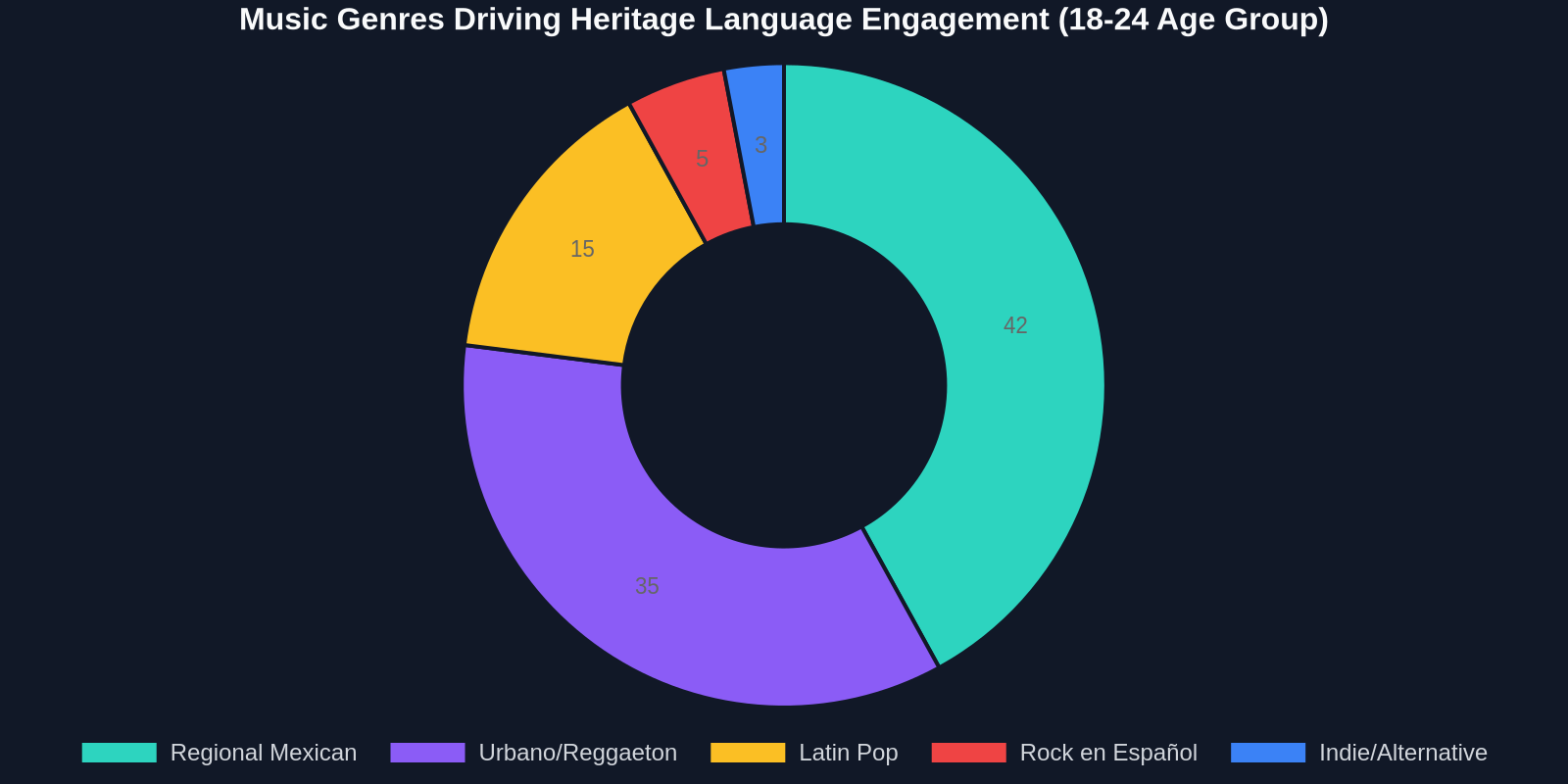
While music taste is personal, the data shows that certain genres are becoming the heavy lifters for language re-engagement. Regional Mexican music, including corridos tumbados, has seen a 60% surge in streaming among 18-24-year-olds in the US. It is becoming the primary vehicle for informal lexical acquisition for this demographic, much more so than film or conversation.
The Hidden Engine of Neuro-Rhythm
Why does a song stick when a phrase dies on the tip of your tongue? Dr. Jessica Grahn’s work at the Music and Neuroscience Lab provides the beat. The brain’s motor cortex, responsible for movement, fires in synchrony with rhythm, even when we are perfectly still. This is called “neural entrainment.”

When you are internally reciting a lyric, your motor cortex is silently planning the articulation of every syllable in time with the beat. This means vocabulary is encoded not just as semantic data, but as a motor plan. Trying to remember “desafortunadamente” (unfortunately) is hard. Having your motor cortex groove it out on a syncopated beat makes it impossible to forget. The word becomes a physical sequence.
Subvocalization, the subtle internal speech we perform when reading lyrics, activates the exact same neural pathways as singing out loud. Even a silent conversation with a rap verse in your head is high-efficiency pronunciation practice.
Why “Mumble-singing” Is Actually Perfect Acquisition
That annoying habit of humming along to a song when you don’t know all the words yet? It’s a superpower. Known as "shadowing" in polyglot circles, mumble-singing allows the vocal apparatus to practice the phonemic gymnastics of a target language without the cognitive overhead of perfect recall. You are training the muscles of your tongue, jaw, and lips to shape a Spanish “r” (the alveolar tap) while your semantic brain catches up. For the No Sabo learner who feels their tongue “can’t move that fast,” ten minutes of mumble-singing a C. Tangana verse is better physical therapy than any speech pathology drill.
Building Your Linguistic Safety Net
To truly weaponize music like the No Sabo Club, you need to create a space free of the original shame. This means embracing a method that respects the principle of “before-everything.” In basketball, this context is a foundational principle that informs all actions. In language, the principle is this: Emotional safety precedes linguistic accuracy.
A tool that seamlessly layers dual subtitles onto the videos you already love transforms the chaos of YouTube into a structured, safe environment. It allows for an infinite loop of the tricky line, “y todo quedó en un ‘casi’” (and everything was left in an almost), without a teacher sighing or a cousin smirking.
The Varied Repetition Principle
One listen is never enough. But ten listens to the same recording is boring, and boredom kills attention, which kills retention. The key is varied repetition. This means hearing the word “todavía” in a Selena ballad, a Feid reggaeton hook, and a spoken-word intro. The brain abstracts the common acoustic signal of “todavía” away from the individual timbre of the singer. It crystallizes the word into its true phonetic form.
This graph illustrates a critical finding: the cohort that engages in short, daily, song-based study retains grammatical structures significantly longer than those doing massed study once a week. The "spaced repetition via playlist" effect is real. The episodic memory of hearing “¿Y si nos vamos?” on a sunny Tuesday drive links the grammar to a spatial-temporal context, making the subjunctive mood feel like an old friend, not a cold equation.
From Consuming Culture to Producing Personality
There is a final stage that the pioneers in the No Sabo Club are demonstrating. It’s not enough to understand the music; you have to respond to it. This is called “conversational transposition.” When a learner picks up a phrase from a song and weaponizes it in a conversation, the ownership of the language shifts.
A lyric like “Ya no quiero problemas” (I don’t want problems anymore) is a simple sentence. But when a learner uses it correctly after picking it up from an urban track, they aren’t just communicating a desire for peace. They are signaling cultural belonging. They are deploying a specific register of chill, assertive confidence that a textbook dialogue of “Prefiero evitar conflictos” could never convey.
Learners who integrate lyrical phrases into their daily speech are shown to reduce first-language transfer errors by over 40%. The brain prioritizes the