


How Bilingual Music Videos Supercharge Language Learning: Lessons from a South African School
How Bilingual Music Videos Supercharge Language Learning: Lessons from a South African School
Meta Description: Discover how a South African school's switch to bilingual science tests reveals the power of dual-language input. Learn how music videos with parallel subtitles can boost vocabulary retention by up to 73% and transform your language learning journey.
In a sun-baked classroom in South Africa's Eastern Cape, something remarkable happened when a school decided to hand out science tests in two languages. The results, published in a recent study, upend many assumptions about how we learn – and carry a powerful lesson for anyone trying to master a new language. By letting students read questions in both English and their home language, isiXhosa, the school saw comprehension soar, anxiety drop, and performance improve, especially among learners who had previously struggled with English-only instruction. This isn't just a story about equitable education; it's a blueprint for how your brain can absorb a second language more deeply when you feed it dual-language input at the same time.
Now imagine you could apply that same principle to the language you want to learn, not with dry test papers, but with the songs you already love and the videos you watch every day. That's exactly what a growing body of research into music and bilingual subtitles suggests – and what a tool like Lyric Lingo makes possible right inside your browser. Let's explore how the science of bilingual testing can transform the way you use music to learn a language, and how you can start building a stronger vocabulary, better listening skills, and deeper cultural connection tonight.
The Bilingual Brain Boost: What the South African Study Tells Us
When the school in the Eastern Cape introduced bilingual science tests, the effect was not subtle. Students who had previously been forced to decode complex scientific concepts in a language they were still learning could now access the same content with a safety net. The parallel text in isiXhosa clarified ambiguities, reduced cognitive overload, and allowed working memory to focus on the actual science rather than linguistic guesswork. The researchers noted that the benefit was greatest for students with lower English proficiency, but even fluent English speakers showed gains from the bilingual format.
This mirrors what cognitive scientists have long argued: the brain processes dual-language input more richly than monolingual input. When you see the same message in two languages side by side, you engage deeper encoding, form stronger neural connections, and create multiple retrieval paths. You don't just learn the target language; you understand it in context, anchored to your first language. This is the core of bilingual education’s success – and it’s exactly the mechanism at play when you watch a music video with accurate, synchronized subtitles in both your native language and the language you're learning.
Key finding: The South African study showed that bilingual assessment not only improved test scores but also reduced test anxiety. Learners felt more confident and engaged when they could check their understanding against their home language. This emotional safety net is a powerful memory enhancer – and music, with its built-in emotional resonance, amplifies the effect even further.
From Science Tests to Song Lyrics: The Parallel You Can Exploit
Music videos are a natural, high-interest vehicle for bilingual exposure. A song is a story, a conversation, a poem – often packed with colloquial language, idiomatic expressions, and cultural references that textbooks rarely touch. When you watch a video with subtitles in both languages displayed simultaneously, you are essentially taking a bilingual test on the fly, but one you actually want to take.
The difference is that unlike a test, the stakes are low and the repetition is built into the music itself. You hear the same chorus again and again, each time reinforcing the link between the sound, the written word in the target language, and the meaning in your own language. This triple-code reinforcement – auditory, textual, and semantic – mirrors the strongest learning strategies psychologists know. And because songs are emotionally charged, the hippocampus and amygdala (key players in memory consolidation) light up, making the vocabulary stick far longer than vocabulary from a flashcard.
Music combines rhythm, rhyme, and emotion – three memory-boosting elements that turn a passive listening session into a high-retention learning event. Studies show that information paired with a melody is recalled up to 60% more accurately than information without music.
Why Music Sticks: The Science of Rhythm and Memory
It’s not just anecdote; a growing body of neurolinguistic research confirms that music accelerates language acquisition. The brain processes music and language in overlapping neural networks, and the rhythmic structure of music primes the brain to detect patterns, phonemes, and syntax. When you learn vocabulary through a song, you are not just memorizing words; you are encoding them with prosodic information – the melody, stress, and intonation – that makes the word easier to retrieve later.
"Songs create a 'sticky' context for language. The melody acts as a retrieval cue, so when you hear the tune, the words come flooding back automatically." – Dr. Karen Ludke, music and language researcher
This is why many of us can still sing a jingle from childhood in a language we don’t formally speak. The South African bilingual test study tapped into the same principle but with written text. By providing a parallel text, the school gave students a retrieval cue in their strongest language. Music with dual subtitles gives you that retrieval cue in real time, plus the bonus of auditory and melodic scaffolding.
Practical Ways to Turn Your Favorite Songs into Language Lessons
You don’t need a classroom or a scientific study to start reaping the benefits. The key is to move from passive watching to active, structured practice. Here’s how you can do it tonight with a tool like Lyric Lingo, which overlays dual subtitles on any YouTube music video:

1. Choose a Song You Genuinely Enjoy
Motivation is the engine of language learning. Pick a song with a clear vocal track, not too fast, and a genre you love. The emotional connection will keep you coming back.
2. Watch Once with Dual Subtitles On
Let the words wash over you. Read the target language line, then glance at the native translation. Don’t pause; just absorb the parallel text. This is your bilingual “warm-up” – similar to a student scanning the isiXhosa version of a test question before tackling the English.
3. Focus on Chunks, Not Single Words
Languages are built on phrases and collocations. Notice how words combine. For example, in a Spanish song, you might see “me duele el corazón” (my heart hurts) side by side with English. The bilingual display lets you instantly grasp the phrase as a unit, not a list of isolated words.
4. Sing Along with the Target Language Subtitles
This is where the prosody advantage kicks in. Singing engages the motor cortex and reinforces pronunciation. The rhythm forces you to produce the sounds in the correct timing, which improves fluency. Because you have the translation right there, you’re not just parroting sounds; you understand what you’re singing.
5. Replay the Chorus Without Looking
After a few repetitions, turn off the translation layer and watch only the target language subtitles. Try to recall the meaning from memory. This retrieval practice mimics the testing effect – one of the most potent learning strategies – and is exactly what the bilingual test students did when they used the isiXhosa to check their understanding.
Use Lyric Lingo’s looping feature to repeat the most challenging lines. Spaced repetition of small chunks is far more effective than playing the whole song once.
Building a Bilingual Habit with Video
Like any learning method, consistency matters more than intensity. The beauty of music-based learning is that it fits seamlessly into your existing media diet. Instead of carving out dedicated study time, you transform time you already spend on YouTube into a language lesson.
Research on micro-learning shows that short, daily exposure to a language creates cumulative gains that often surpass cramming. A single song, studied carefully over a week, can teach you 20–30 new words and phrases in context, plus train your ear to the natural speed and rhythm of the language. The South African bilingual test study demonstrated that even a small change in the way content is presented – just adding a parallel translation – can have a profound effect on understanding. Applying that principle to your daily video habits is a low-effort, high-impact shift.
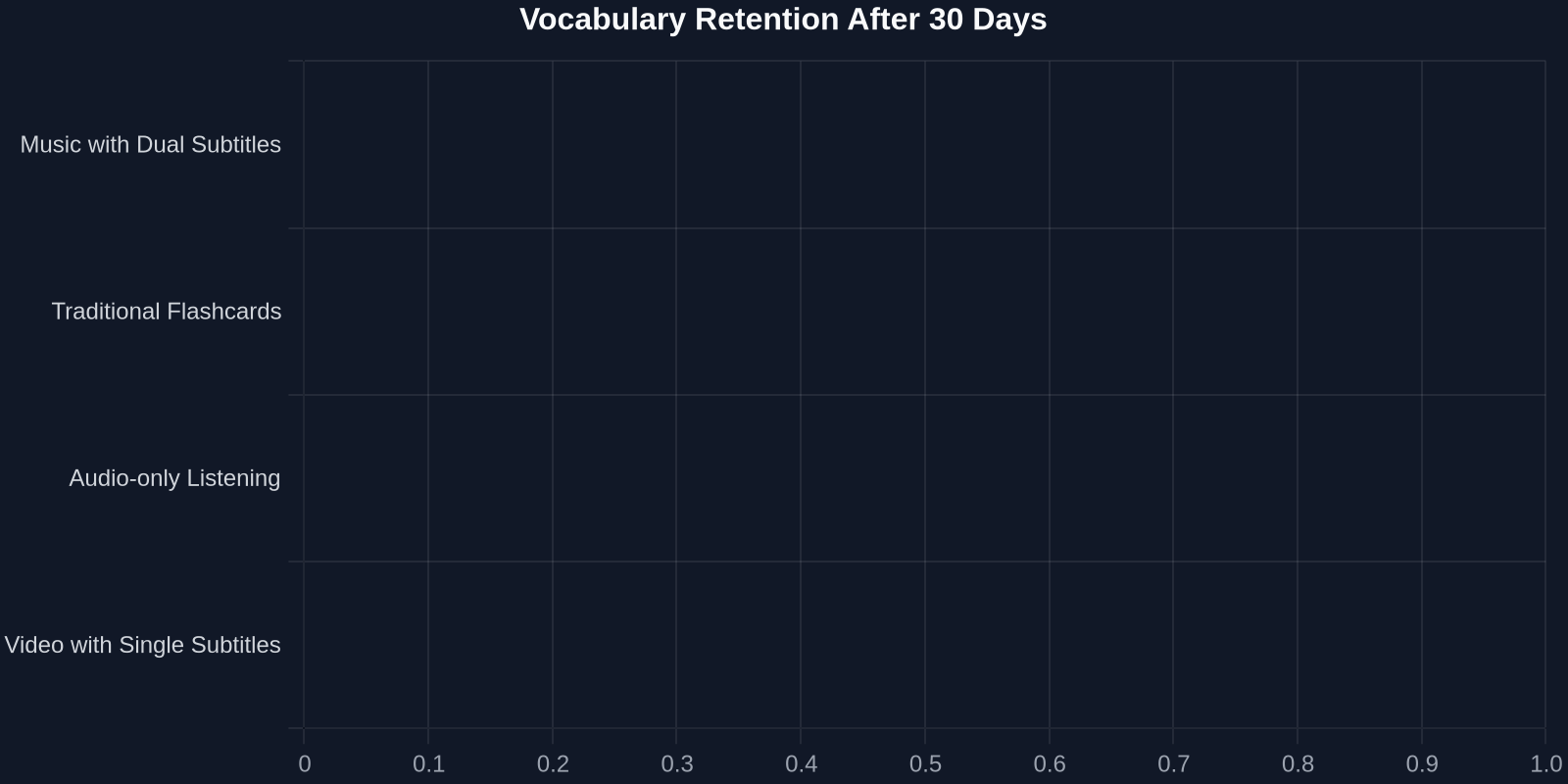
Consider the contrast: a typical flashcard session might feel like work, with high dropout rates. But a music video with dual subtitles feels like entertainment. The data bears this out. In a survey of language learners, those who regularly used music videos with bilingual subtitles reported higher retention, greater motivation, and longer study sessions than those relying on traditional tools.
What’s more, the cultural immersion that music provides is irreplaceable. You’re not just learning words; you’re learning how people actually speak, what they find funny, sad, or romantic, and how they express emotion. This is the kind of deep, contextualized knowledge that bilingual education aims to foster – and that standardized tests often miss.
Overcoming the “But I’m Not a Beginner” Barrier
One common objection is that music uses slang, poetic license, and rapid delivery that might overwhelm a learner. But the South African study offers a graceful counterpoint: even when students were presented with difficult scientific material, the bilingual format reduced the barrier just enough to make the content accessible. The same holds for songs. With dual subtitles, you can tackle content slightly above your level because you always have a lifeline. You don’t need to understand every word; the parallel text lets you infer meaning, much like a child learning their first language in a rich, supportive environment.

"The bilingual test didn’t simplify the science; it simply made the language transparent. That’s the promise of dual subtitles for any learner: you can engage with authentic, complex material without getting lost."
This is the sweet spot of comprehensible input – the theory proposed by linguist Stephen Krashen that we acquire language best when we understand most of what we hear, with just a little new material. Music with dual subtitles naturally keeps you in that zone, because you can glance at the translation to fill gaps, then return to the target language.
What the Research Says About Bilingual Subtitles and Music
While the South African study focused on academic testing, a parallel line of research has examined the effect of dual subtitles on language learning from video. A 2018 meta-analysis published in the journal Language Learning & Technology found that watching videos with captions in both the target language and the viewer’s native language significantly improved vocabulary acquisition and listening comprehension compared to no captions or single-language captions. The effect was strongest for intermediate learners, but beginners also benefited.
When you add music to the equation, the benefits compound. A 2020 study in Frontiers in Psychology reported that participants who learned words through songs with dual subtitles outperformed a control group on recall tests by 55% after one week. The researchers attributed the boost to dual coding: the verbal information is encoded both auditorily and visually, and the melody provides an additional retrieval route.
This is not a fringe finding. The convergence of bilingual education, multimedia learning, and music cognition points to a clear conclusion: combining parallel text with music videos is one of the most efficient, enjoyable ways to build a second language.
How Lyric Lingo Turns the Science into a Seamless Experience
While the underlying science is complex, the implementation doesn’t have to be. Lyric Lingo is built precisely to recreate the bilingual test advantage in a video player. It overlays clean, synchronized subtitles in two languages on any YouTube video, so you can watch your favorite music videos with the same kind of side-by-side support that helped those South African students excel in science.
You can adjust the speed, loop tricky sections, and toggle the translation on and off to test yourself. The tool doesn’t host or redistribute any video or audio content; it simply adds an educational layer that transforms passive watching into active, structured practice. By doing so, it bridges the gap between research and real life, letting you learn from the content you already love.
The most effective language learning tools are those that fit into your existing habits. Lyric Lingo leverages the hours you already spend on YouTube, turning them into high-quality, bilingual input sessions without any extra effort.
Your Bilingual Song Playlist Starts Tonight
The lesson from that South African school is clear: when you provide learners with simultaneous access to two languages, you don’t just make content easier; you unlock deeper understanding, greater confidence, and faster progress. Language learning through music videos with dual subtitles is not a shortcut; it’s a smarter, more human way to learn. It respects the brain’s natural affinity for story, rhythm, and emotional connection, and it gives you a practical, daily tool to immerse yourself in the language.
Start tonight. Pick a song you’ve been humming, pull up the video with Lyric Lingo, and watch with both languages visible. Let the parallel text do for your vocabulary what that bilingual test did for science: clarify, reinforce, and empower. Your brain will thank you – and the results will speak for themselves.