


Focus on Sounds to Learn a Language Faster: The Science Behind Sound-First Learning

What if the secret to learning a new language faster isn't in your eyes, but in your ears? For decades, language learners have been handed textbooks, vocabulary lists, and flashcards. Yet a growing body of research, including a compelling new study highlighted by The Guardian, points to something simpler and more natural: focusing on the sounds of a language before anything else.
The study suggests that learners who tune their ears to the phonetic contours, rhythm, and melody of a new language gain measurable advantages in comprehension, pronunciation, and retention. For anyone who has ever struggled to roll a Spanish "r" or master the nasal vowels of French, this is more than an academic finding, it's a practical invitation to change how you study, starting today.
In this guide, we'll break down the science behind sound-focused language learning, explore proven techniques like shadowing, and show how music, the most accessible sound source on the planet, can become your most powerful study tool.
The Sound-First Hypothesis: What the Research Reveals
The core idea behind sound-focused language learning is simple: language is first and foremost an auditory phenomenon. Before humans ever wrote a single word, they spoke. Our brains evolved to process speech sounds with extraordinary precision, and tapping into that evolutionary machinery may be the fastest route to fluency.
The research covered in The Guardian underscores a crucial point: learners who prioritize listening and sound discrimination early in their studies build stronger phonological foundations. This means they don't just recognize words, they hear the subtle distinction between sounds that can change a word's meaning entirely. In Spanish, for example, the difference between "pero" (but) and "perro" (dog) hinges on a trilled "r" that many English speakers initially miss. In French, the difference between "dessous" (underneath) and "dessus" (on top) lives in two vowel sounds that sound nearly identical to untrained ears.
When learners train their ears first, these distinctions become easier to hear, and therefore easier to produce. The result is a virtuous cycle: better listening leads to clearer speaking, which boosts confidence, which encourages more practice.
Why Your Ears Are the Fastest Route to Fluency
There's a reason babies don't start learning language with grammar books. From birth to roughly age one, infants are entirely sound-focused learners. They absorb the rhythm, intonation, and phonetic patterns of their native language long before they understand a single word. This "silent period" isn't passive, it's an intense period of sound mapping that lays the neural groundwork for everything that follows.
Adult learners can tap into this same brain machinery. Research on neuroplasticity shows that the auditory cortex remains adaptable throughout life, meaning adults can still train their brains to hear and process new sounds. The key is exposure: the more high-quality, comprehensible audio you hear, the faster your brain builds the neural pathways needed to process the new language automatically.
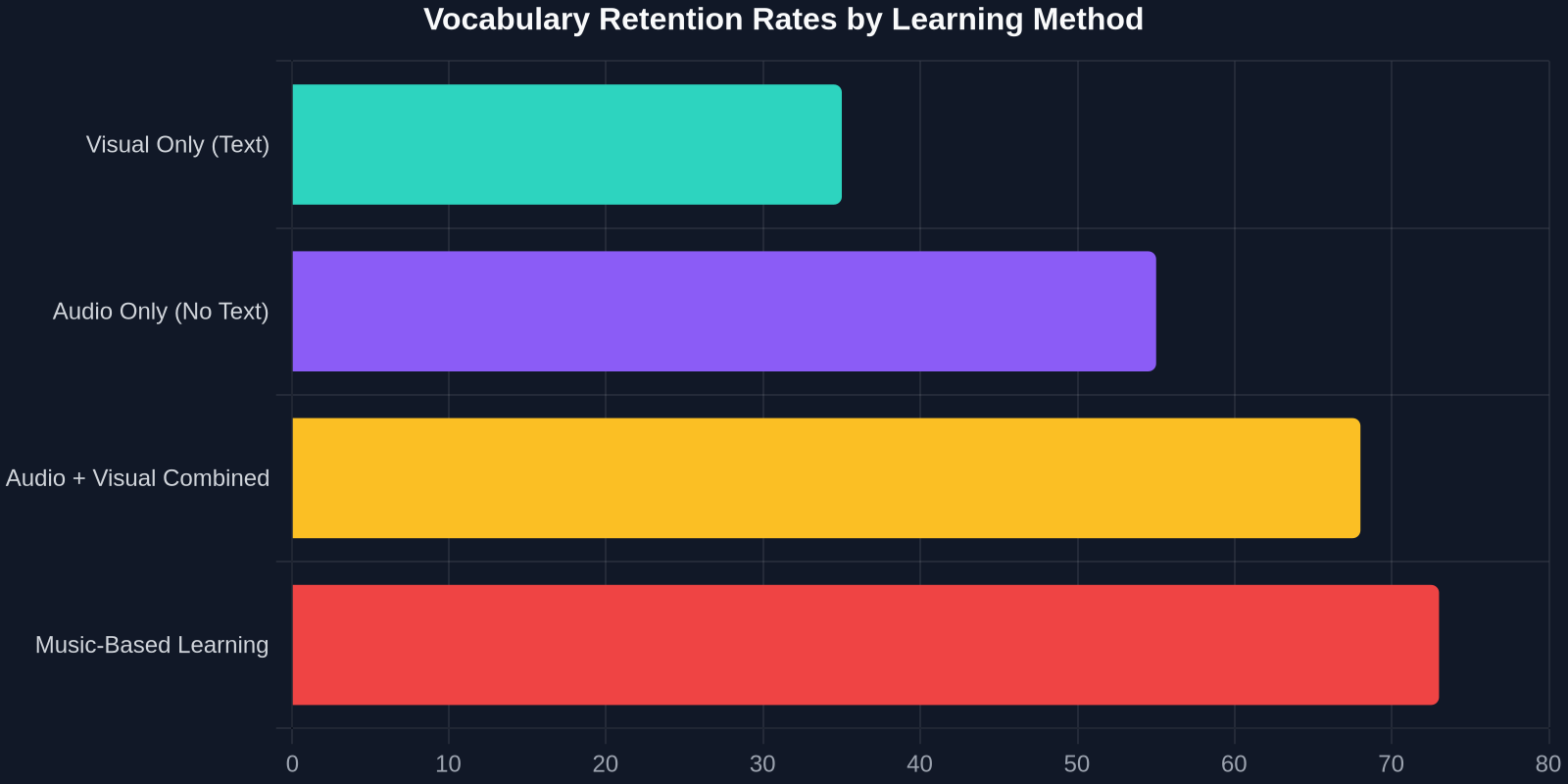
This statistic reflects a consistent finding across decades of research: the brain encodes information more deeply when it arrives with emotional resonance and rhythmic structure. Music, with its predictable patterns and emotional pull, is uniquely suited to this task. When you learn the Spanish phrase "No puedo vivir sin ti" from a song, you're not memorizing words, you're absorbing a feeling, a melody, and a memory, all at once.
How the Brain Processes Foreign Sounds
When you hear a foreign language, two major brain regions spring into action. The auditory cortex processes the raw sound input, while the left temporal lobe, home of Wernicke's area, decodes meaning. In language learners, the inferior frontal gyrus (Broca's area) also activates, helping to plan and produce speech sounds.
What's remarkable is how quickly these regions can change with practice. A landmark study from the University of Helsinki found that participants who listened to foreign sounds for just 15 minutes per day showed measurable changes in brain activity within three weeks. The brains of motivated learners literally begin to reorganize around the new sounds they're hearing.
This doesn't mean you should abandon reading and writing entirely. But it does suggest that audio input should lead, especially in the early stages of learning.
The Shadowing Technique: Sounds in Action
Among the most effective sound-based techniques is shadowing, a practice championed by language coaches worldwide. The concept is simple: listen to native audio and repeat it out loud almost immediately, copying the sounds, rhythm, and melody as closely as you can.
The shadowing technique dates back to the late 20th century, when linguist Alexander Arguelles popularized it as a way to develop native-like pronunciation and listening fluency. But its roots go deeper, it's essentially how children learn to speak, mirroring the sounds they hear from parents and caregivers.
"Shadowing isn't about understanding every word. It's about training your mouth and ears to work together, to hear a sound and reproduce it without the delay of conscious translation."
What makes shadowing so powerful is its cognitive load. When you shadow, you're not pausing to translate or analyze grammar. You're engaging in a near-instantaneous loop of listening and producing that bypasses the slow, analytical parts of your brain. Over time, this loop becomes faster and more automatic, the hallmark of true fluency.
A Step-by-Step Shadowing Protocol
Here's how to shadow effectively, using any song, podcast, or video you choose:
Step 1: Listen without speaking. Play 30–60 seconds of native audio and simply listen. Let the rhythm and melody wash over you without trying to understand every word.
Step 2: Shadow with audio only. Play the same segment again, this time speaking along in real time. Don't worry about precision, just keep your voice moving with the native speaker's rhythm.
Step 3: Shadow with subtitles on. Now add subtitles in the target language. Read along while you speak, letting the written words reinforce the sounds you're producing.
Step 4: Shadow without subtitles again. Turn the subtitles off and shadow one final time. You'll notice how much more naturally the sounds flow now that your brain has mapped them to both audio and text.
Step 5: Record yourself. Use your phone to record a few lines, then compare your pronunciation to the original. You'll hear the gaps, and hearing is the first step to fixing.
The beauty of shadowing is its flexibility. You can do it with a YouTube video, a podcast, or a song you love. Ten minutes per day is enough to notice improvements within two weeks.
Music as Your Language Accelerator
Of all the sound sources available to language learners, music may be the most powerful. Songs combine melody, rhythm, emotion, and repetition in a package that's designed to be listened to over and over. That's not just a nice bonus, it's a cognitive feature.

Research on musical mnemonics shows that information paired with melody is recalled more accurately and for longer periods than information learned through speech alone. This is why you can still sing a jingle from a commercial you heard ten years ago, but you can't remember the article you read last week. Music creates a retrieval cue, a hook that makes the information easier to access later.
For language learners, this means every song in your target language is a densely packed vocabulary lesson hiding in plain sight. The Spanish ballad "Bésame Mucho" teaches imperative forms and romantic vocabulary. The French classic "La Vie en Rose" is a masterclass in vowel sounds and the poetic register. English songs like "Shape of You" are packed with colloquial contractions and natural speech patterns.
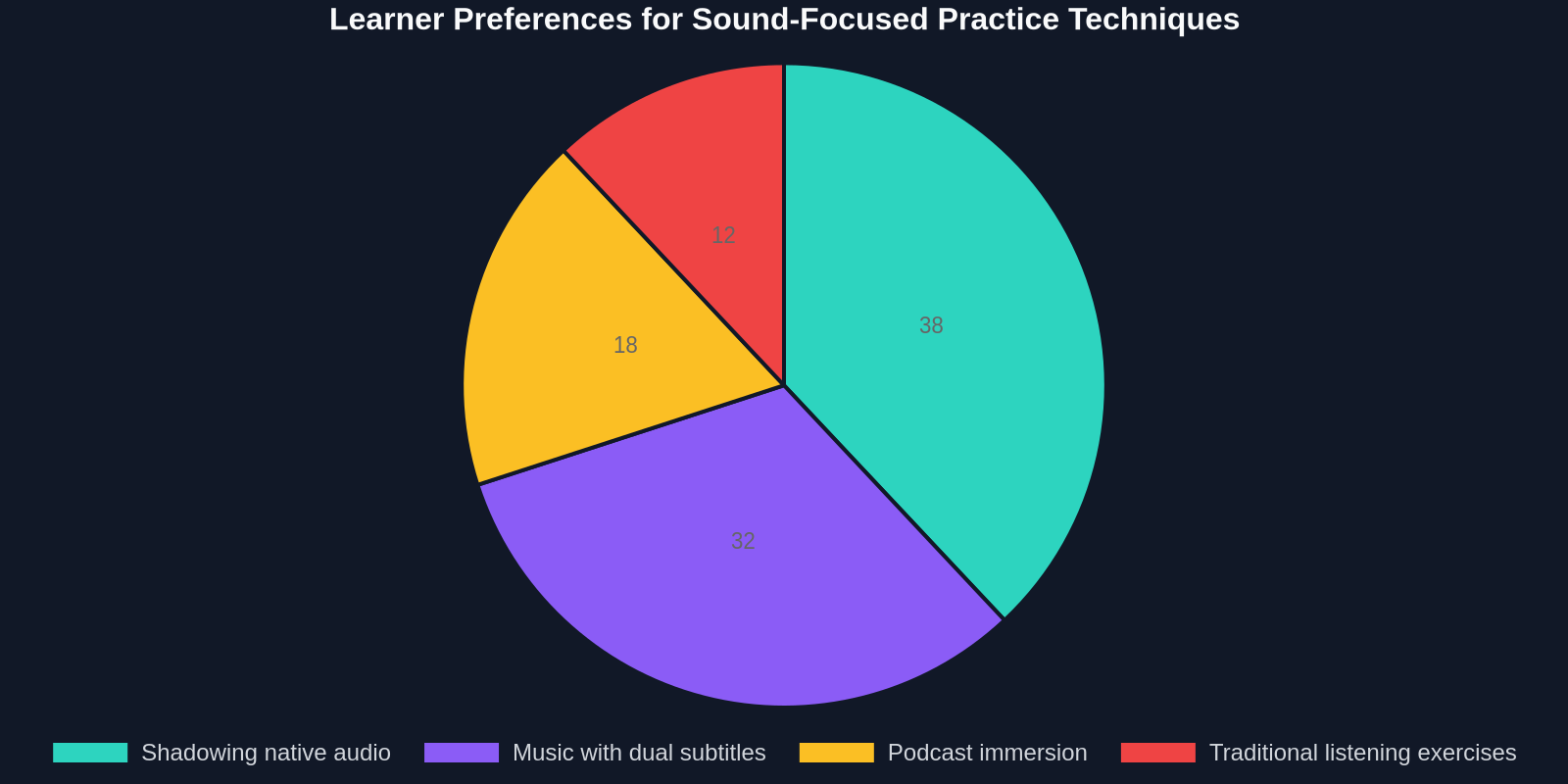
When you listen with dual subtitles, target language on one line, your native language on the other, you transform passive listening into active comprehension. You see the words, hear the sounds, and connect both to meaning in real time.
Why Rhythm Improves Retention
Rhythm isn't just a musical property, it's a memory scaffold. Your brain uses rhythm to predict what comes next, which is why you can fill in the next word of a song you've heard only once or twice. This predictive processing is exactly what language learners need: the ability to anticipate, to fill gaps, to keep the flow of comprehension moving even when a word is unfamiliar.
The rhythmic patterns of Spanish, French, and English differ significantly. Spanish has a syllable-timed rhythm, giving each syllable roughly equal duration. French has a similar structure, with stress falling consistently at the end of phrases. English, by contrast, is stress-timed, meaning stressed syllables occur at regular intervals regardless of how many unstressed syllables fall between them. Hearing these rhythms through music trains your brain to process the language's natural cadence, something textbooks can never fully convey.
From Passive Listening to Active Practice
There's a critical difference between hearing and listening. Hearing is passive, sound waves hitting your eardrums. Listening is active, your brain processing, analyzing, and storing that sound for later use. Too many language learners mistake one for the other, believing that hours of background music or Netflix without subtitles will magically teach them the language.
The research is clear: active engagement with audio produces dramatically better results than passive exposure. This means listening with intent, pausing to repeat phrases, shadowing along with native speakers, and explicitly connecting sounds to their written forms.
| Method | Retention | Effort Required | Time to Results |
|---|---|---|---|
| Flashcards | Medium | High | 2–4 weeks |
| Passive listening | Low | Low | 6–12 months |
| Sound-focused shadowing | High | Medium | 1–2 weeks |
| Music with dual subtitles | Very High | Low–Medium | 1–2 weeks |
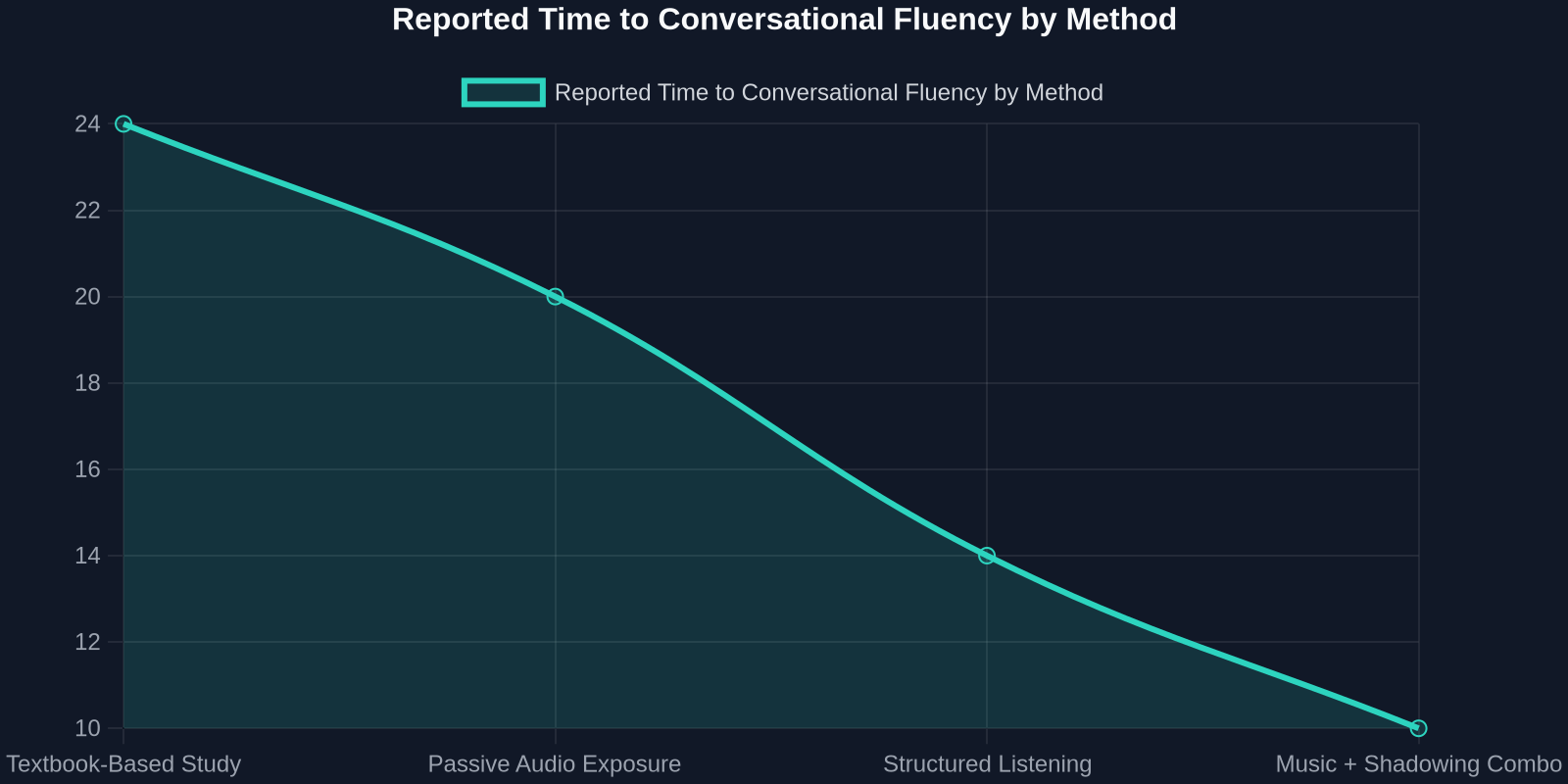
The table above tells a clear story: methods that combine audio with active engagement outperform those that isolate skills. Flashcards have their place, but they cut vocabulary off from its natural sound context. Passive listening is soothing, but it's not study. Shadowing and music-based learning hit the sweet spot, they're engaging, effective, and sustainable.
A Five-Step Routine for Sound-Based Learning
Try this weekly routine to build a sound-first study habit:
Monday, Explore. Choose a new song in your target language. Listen once without looking at lyrics. Write down any words or phrases you think you heard.
Tuesday, Read. Listen again with dual subtitles. Highlight 10 new words or phrases. Say each one out loud slowly, focusing on the sounds.
Wednesday, Shadow. Play the song and shadow the vocals for 15 minutes. Don't worry about perfect pitch, focus on matching the vowel sounds and rhythm.
Thursday, Record. Record yourself singing or speaking a section of the song. Compare it to the original. Note any sounds that feel awkward.
Friday, Review. Play the song one more time. How many of the highlighted words do you now recognize instantly? Which sounds feel more natural?
This routine takes less than 30 minutes per day and builds a compounding vocabulary base. By the end of a month, you'll have encountered 40–50 new words in meaningful context, and you'll have trained your ear in the process.
Where Lyric Lingo Fits In
This is precisely the gap that Lyric Lingo was designed to fill. Lyric Lingo is an education layer for YouTube that shows dual subtitles, target language on one line, your native language on the other, so you can study from the music and videos you already watch. There's no need to seek out special learning content; the songs that already soundtrack your life become your classroom.

Here's what makes this approach uniquely aligned with sound-first research: when you watch a Spanish song with dual subtitles on Lyric Lingo, you're not choosing between hearing and reading, you're getting both simultaneously, with the sound leading and the text reinforcing. This mirrors exactly what the research on sound-focused learning recommends: audio input with visual scaffolding, not visual input with audio as an afterthought.
"The goal isn't to study more. It's to study smarter, to transform the passive hours you already spend watching videos into structured listening practice."
The dual-subtitle format is particularly powerful for the sound-to-text mapping that helps learners connect what they hear to what they see. When a French singer stretches a vowel over two syllables, you see the spelled word on screen and can match the written form to the performed sound. When a Spanish rapper drops syllables in fast speech, you see how the written phrase contracts in real time.
Common Sound-Learning Mistakes to Avoid
Even well-intentioned learners make mistakes when shifting to a sound-first approach. Here are the most common pitfalls, and how to avoid them:
Mistake 1: Waiting for "perfect" audio. Learners often avoid noisy cafe conversations or fast-paced songs because they're hard to understand. But that imperfection is exactly where growth happens. Your brain needs training in real-world audio conditions, not just pristine textbook recordings.
Mistake 2: Reading subtitles in your native language only. If you only read the translation, you're reinforcing the habit of translating in your head rather than processing the target language directly. Look for dual subtitles or, when possible, target-language subtitles after your first listen.
Mistake 3: Ignoring pronunciation. It's tempting to focus on vocabulary and grammar because they feel more tangible. But if you can't hear the sounds correctly, you'll never produce them correctly. Pronunciation is not a finishing touch, it's foundational.
Mistake 4: Making it a chore. The fastest way to kill sound-based learning is to force yourself through material you hate. If you hate a song, find another one. The whole point is to learn from content you genuinely enjoy.
Getting Started Tonight
You don't need a new textbook, a new app, or a new course. Tonight, you need one thing: a song in your target language and a willingness to listen closely.
Open YouTube. Type the name of a song you already love, but search for it in your target language. A Spanish cover of a song you know. A French ballad. An English song you've heard a hundred times but never truly listened to. Play it once. Then open Lyric Lingo and watch it with dual subtitles. Listen for the sounds. Read the words. Say a phrase out loud.
That's the entire assignment. Fifteen minutes. One song. A small step that, repeated daily, becomes a language-learning habit with compounding returns.
The research is clear, and it points in one direction: sound comes first. The sooner you train your ears, the faster your mouth will follow. And with music as your vehicle, the journey doesn't feel like work at all, it feels like listening to your favorite song.
Which, as it turns out, is exactly the point.