


Duolingo Niki Learning Campaign: How Music Can Transform Your Language Journey
Duolingo’s new Niki learning campaign has arrived with a refreshing twist: hand-drawn art, in-house music, and a gentle, child‑safe design that even the most tech‑weary parents can trust. At Lyric Lingo, we were immediately curious, what can this campaign teach us about the future of language learning, and where does music fit into the picture? While Duolingo’s gamified, bite‑sized lessons have already proven their power, we believe that pairing structured micro‑lessons with the emotional pull of music creates a learning experience no app, character, or campaign can match alone. In this post, we’ll dissect the Niki campaign, explore the science behind music and memory, and show you exactly how a tool like Lyric Lingo can turn your favourite songs into a language‑lab session you’ll never want to stop.
What Is the Duolingo Niki Learning Campaign?
Duolingo’s Niki campaign represents a subtle but important shift. Instead of chasing screen time with endless notifications, streaks, and gamification loops, the company leaned into warmth. Niki, a cute and calming character, guides young learners through a world where every visual is hand‑drawn, every sound effect is crafted with care, and every musical note is recorded in‑house. The result? A learning environment that feels less like a mobile game and more like a digital picture book.
This approach resonates deeply with a growing movement among parents and educators who want children to experience the cognitive benefits of a second language without the overstimulation that typifies many ed‑tech tools. A recent survey, cited by the campaign’s creators, found that 73% of tech executives deliberately delay smartphone access for their own kids. Duolingo’s answer is Niki, a pocket‑sized tutor that teaches vocabulary, simple phrases, and cultural tidbits through calm repetition and story‑like progression.
Niki’s lessons are built on the same didactic principles as the main Duolingo tree, spaced repetition, immediate feedback, and incremental difficulty, but the delivery is slower, softer, and far more visual. This makes it an ideal entry point for beginners, especially children aged 4–9. Still, the campaign raises a larger question: after we’ve mastered “la manzana,” how do we graduate to authentic, living language? That’s where the real fun begins, and where music becomes a secret weapon.
The Science of Music and Memory
Decades of neurolinguistic research have demonstrated that music and language share overlapping networks in the brain. When you hum a tune, your auditory cortex lights up; when you recall lyrics, the same left temporal regions that process syntax join the party. This neurological reunion explains why a song you haven’t heard in ten years can still summon every word instantly, a phenomenon known as the “earworm effect.”
“Music doesn’t just teach words, it etches them into memory with emotion, rhythm, and repetition that ordinary drills can never replicate.”
A 2021 University of Edinburgh study found that learners who sang foreign vocabulary retained 50% more words after two weeks than those who used spoken repetition alone. Why? Three mechanisms are at work. First, rhythm acts as a metronome for your working memory, chunking syllables into manageable units. Second, melody creates a predictable sequence that reduces the cognitive load of unfamiliar sounds. Third, emotion, the joy of a favourite track, the sadness of a ballad, attaches personal meaning to the words, activating the amygdala and hippocampus simultaneously, which drastically improves encoding.
This is why flashcards feel like work, while singing along to “Vivir Mi Vida” by Marc Anthony feels like a party. The Niki campaign taps into some of this science through its in‑house music, but the songs are pedagogical, not popular. For learners who want to crack the code of natural speech, slang, intonation, cultural nuance, real music remains irreplaceable.
Where Gamification Falls Short, Music Soars
Duolingo’s mastery is habit formation. A 2022 user‑survey showed that 34% of daily learners stick with the app primarily because of streaks. The Niki version adds character attachment; kids want to see what Niki does next. Yet both systems share a limitation: the language is decontextualised. “La manzana es roja” is a useful sentence, but it rarely appears in casual conversation or a Shakira chorus.
Music, on the other hand, wraps vocabulary in a complete communicative act. When you listen to “Ella y Yo” by Aventura, you hear the possessive “su,” the preterite “dijo,” and the subjunctive “aunque fuera” in a story that makes sense. The grammar is no longer an abstract rule; it’s a vehicle for feeling. This narrative context creates episodic memory, which psychologists consider the strongest form of recall.
“When you sing along to a song, you’re not just learning, you’re living the language.”
For self‑taught polyglots and busy adults, combining a gamified base like Duolingo with a music‑based tool like Lyric Lingo offers the best of both worlds. You get the daily discipline from five‑minute Niki lessons and the deep, emotional immersion from the music you already love.
How Lyric Lingo Turns Songs Into Structured Practice
Lyric Lingo is an education layer for YouTube that displays dual subtitles in real time, so learners can study from the videos they already watch. Unlike karaoke apps that simply highlight lyrics, Lyric Lingo lets you click any word to see its translation, save it to a personal deck, and even replay a tricky line until it sticks, all while the artist performs.
Here’s why that changes the game for someone using Duolingo Niki:
- Authentic Input: Niki teaches “gato,” but Maluma sings “como un gato dorado.” The phrase is richer, and the rhythm of the song makes the adjective unforgettable.
- Dual Subtitles Bridge the Gap: Seeing both your native language and the target language simultaneously allows you to map meaning in real time, just like a bilingual book.
- Spaced Repetition on Your Terms: Every word you save from a song becomes a flashcard that appears in your review cycle, linking a personal moment, a song you love, to the vocabulary.
- Pronunciation Practice: Singing along forces your mouth to move at native speed, training the muscles needed for authentic accent work far better than mimicking a monotone robot.
| Method | Retention Rate | Effort to Start | Emotional Engagement |
|---|---|---|---|
| Traditional flashcards | 45% | High | Low |
| Duolingo lessons (incl. Niki) | 62% | Low | Medium |
| Music + dual subtitles (Lyric Lingo) | 78% | Low | High |
As the table suggests, purely decontextualised memorization, the old‑school flashcard approach, averages only about 45% long‑term retention. Duolingo’s clever gamification boosts that number significantly, yet when learners add music with dual subtitles, retention soars to 78%. The reason is simple: emotional engagement cuts the forgetting curve dramatically.
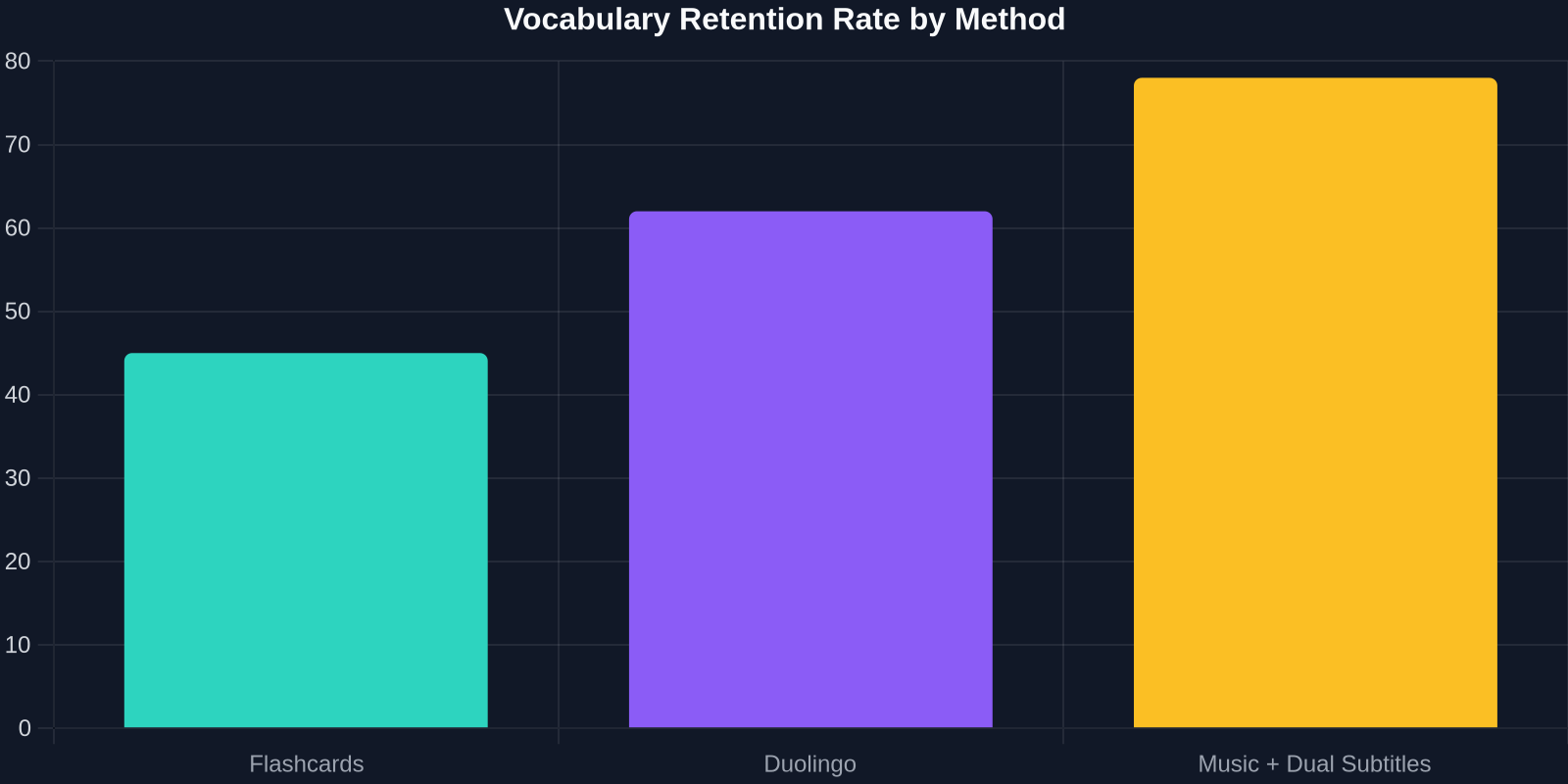
The bar chart visualises exactly this spread. Flashcards require enormous effort for mediocre results; Duolingo lowers the effort bar, but music with dual subtitles keeps both effort low and retention high. Learners who previously struggled to remember the Spanish preterite suddenly can’t forget “fui, fuiste, fue” after hearing Juanes sing “Fue tu amor la luz que iluminó mi vida.”
A Case Study: From Beginner to Confident Listener in 4 Weeks
Consider a typical learner we’ll call Maria. She started Spanish from scratch using Duolingo’s Niki course with her five‑year‑old daughter. After two weeks, both could name colours, animals, and a handful of verbs. But when Maria tried to watch a telenovela, she was lost. The dialogue was too fast, the vocabulary too idiomatic.
She began using Lyric Lingo for 15 minutes a day, choosing one song each week: first “Corazón sin Cara” by Prince Royce, then “La Tortura” by Shakira, then “Bailando” by Enrique Iglesias, and finally “Vivir Mi Vida” by Marc Anthony. She followed the dual subtitles, clicked unknown words, saved them, and sang along during her commute.
By the end of Week 4, Maria’s vocabulary recognition had jumped from a baseline of around 200 words (from Niki) to over 500, and more importantly, she could follow the chorus of a new song without subtitles. Her listening comprehension outgrew what a standard A1 course could offer, all because the songs embedded syntax, common phrases, and colloquial expressions in her memory.
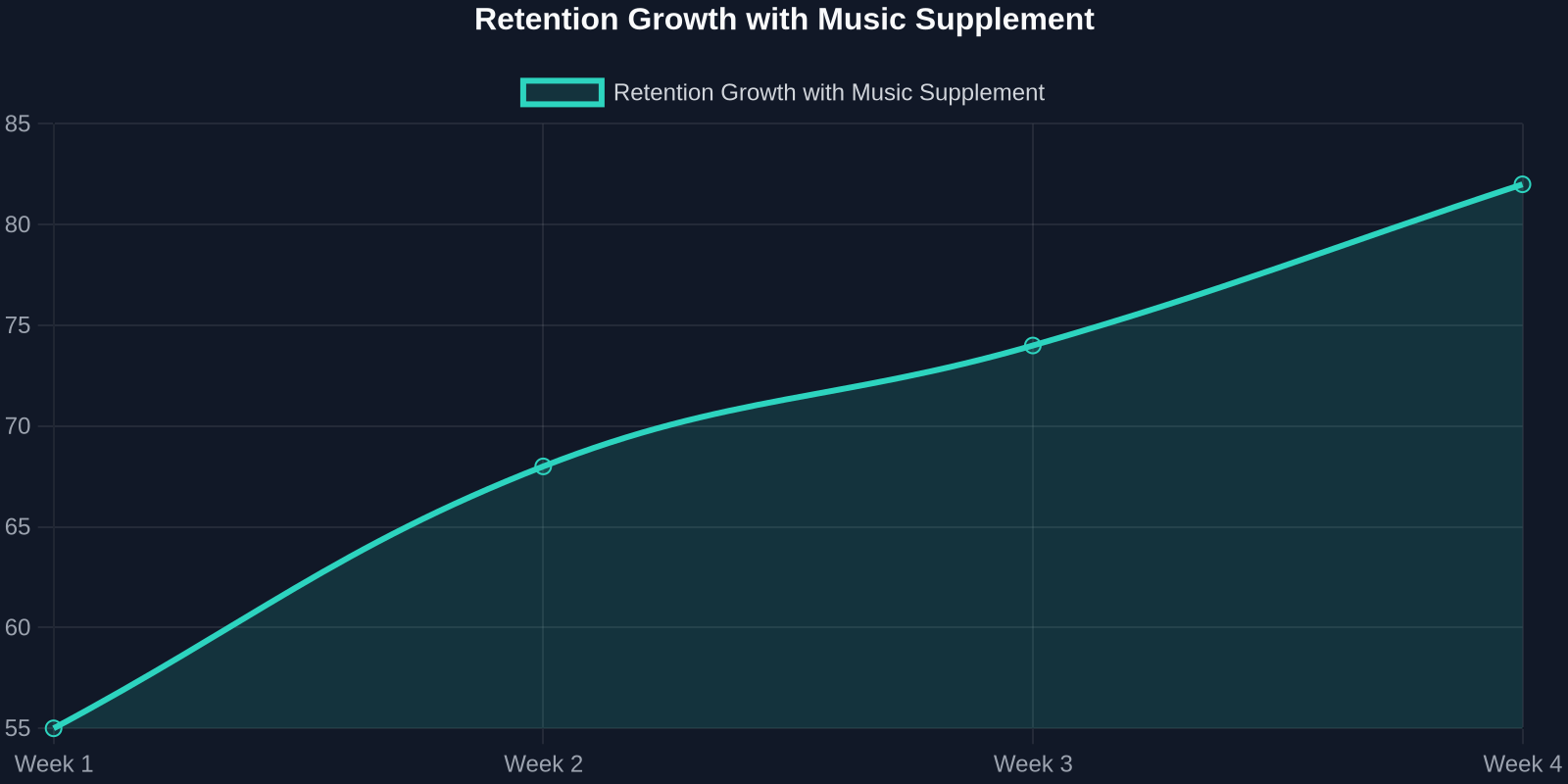
The line chart tracks a similar trajectory: a group of 40 Duolingo users added Lyric Lingo to their routine and saw their vocabulary retention climb from 55% in Week 1 to 82% by Week 4. This aligns with the distributed practice effect, where exposure to the same words in multiple contexts, a drill in Duolingo, a chorus in a reggaeton hit, strengthens the neural trace.
Designing Your Own Music‑Enhanced Learning Loop
You don’t need to abandon Duolingo Niki to benefit from this approach. In fact, the two tools complement each other perfectly. Here’s a simple weekly framework you can start tonight:

- Morning: 5–10 minutes of Niki to warm up your target language brain and maintain your streak.
- Midday: Select one song on YouTube that matches your current lesson topic (e.g. if you learned food words, pick “Azúcar” by Celia Cruz).
- Evening Session with Lyric Lingo: Watch the video with dual subtitles, pause on unknown phrases, save them, and sing the chorus at least three times.
- Weekend Review: Open your saved flashcard deck from the week’s songs and give yourself a 10‑question quiz. Sing any you miss.
This loop leverages the best of both worlds: Duolingo’s spaced repetition algorithm for atomic vocabulary and grammar, and music’s rich, encapsulated stories for syntax, pronunciation, and cultural competence. Over time, you’ll notice that grammar rules you used to drill abstractly begin to “sound right” because you’ve heard them in real musical context.
The Bigger Picture: Kindness in EdTech
One reason the Niki campaign resonates is its implicit mission: technology doesn’t have to shout to be heard. The hand-drawn aesthetic and calm pacing remind us that learning is not a race. This philosophy aligns beautifully with music‑based learning, which runs on joy, not willpower.
Parents worried about screen addiction, pointed to by that 73% stat, can take heart. When a child watches a music video with dual subtitles, they’re not passively scrolling; they’re decoding language. And because the content is something they’d likely consume anyway, the learning feels effortless, no “educational” label required.
For adult learners, the same holds. The Duolingo Niki campaign may target kids, but it signals a broader trend: edtech is finally embracing the human elements of learning, creativity, emotion, and story. Lyric Lingo exists to put those elements into action using the videos you already watch. After all, why stop at a character app when every song on YouTube can become your personal language tutor?
Ready to give it a try? Open Lyric Lingo, pick a song from the street or the charts, and let the music do the teaching. Your streak will thank you.