


Do You Need a 'Good Ear' to Learn a Language? What the Research Really Says (And How Music Changes Everything)
You've heard it before. Someone at a party effortlessly mimics a French accent, identifies a song key by ear, or repeats an unfamiliar Spanish phrase perfectly after one listen. "She just has a good ear for languages," people say. The implication? Language ability is something you're born with, and if you weren't, you're out of luck.
But here's the good news emerging from recent research: a "good ear" is not a fixed trait. It's a trainable skill. And one of the most powerful tools for developing it is something you probably already use every day: music with lyrics.
A 2026 study highlighted by Phys.org explores the relationship between auditory skills and language learning success. The findings? People with stronger auditory processing abilities do tend to learn languages faster. But the study also points to something more actionable: auditory skills can be improved through targeted practice, and music is one of the most effective training grounds.
Let's unpack what a "good ear" actually means, how you can train yours, and how combining music, dual subtitles, and intentional listening can transform your language learning journey from frustrated repetition to enjoyable, measurable progress.
Here's what we'll cover:
- What cognitive science says about auditory processing and language acquisition
- Why music is a uniquely powerful tool for training your ear
- Practical techniques to improve your listening skills tonight
- How dual subtitles turn passive listening into active learning
- Common mistakes that sabotage your listening progress
The 'Good Ear' Myth: What Research Actually Shows
For decades, language learners have been divided into two camps: those who "pick up accents easily" and those who struggle to distinguish unfamiliar sounds. But cognitive science is increasingly clear: this division is more nurture than nature.
The 2026 study referenced by Phys.org examined how individual differences in auditory processing, the brain's ability to perceive, analyze, and interpret sound, predict language learning outcomes. Participants with stronger auditory discrimination skills showed faster vocabulary acquisition and more accurate pronunciation. But critically, the researchers emphasized that auditory processing is malleable.
This finding aligns with a growing body of research. A 2025 systematic review in the Journal of Speech, Language, and Hearing Research examined 25 controlled studies of new adult hearing aid users and found that structured auditory training improved speech perception significantly, evidence that even adult brains adapt to new sound patterns when given deliberate practice.
The implication for language learners is profound: your listening ability is not a ceiling; it's a starting point. With the right techniques, anyone can improve their ear.
What 'Good Ear' Actually Means: Breaking Down Auditory Skills
When researchers talk about a "good ear," they're referring to a cluster of specific skills, not a single magical ability. Understanding these components helps you train each one deliberately.
1. Phonetic Discrimination
This is the ability to hear differences between similar sounds. In Spanish, for example, can you distinguish between "pero" (but) and "perro" (dog)? In French, between "dessous" (under) and "dessus" (above)? Learners with strong phonetic discrimination pick up these distinctions faster.
2. Prosodic Sensitivity
Prosody refers to the rhythm, stress, and intonation patterns of speech. Every language has its own musicality. English speakers stress certain syllables (COM-pu-ter, not com-PU-ter), while Japanese uses pitch accent, and French flows with relatively even stress. People with a good ear intuitively grasp these patterns.
3. Auditory Working Memory
This is your brain's ability to hold and manipulate sounds temporarily. When you hear a new word and repeat it back, you're using auditory working memory. Stronger capacity here predicts faster vocabulary learning, and it's highly trainable.
4. Sound-to-Symbol Mapping
In reading and writing, you need to connect sounds to letters or characters. Languages with transparent orthographies (like Spanish, where letters consistently map to sounds) are easier than opaque ones (like English, where "ough" has at least six pronunciations).
| Skill | What It Means | How Music Trains It | Example |
|---|---|---|---|
| Phonetic Discrimination | Hearing differences between similar sounds | Distinguishing notes, timbres, and lyrics | Hearing 'pero' vs 'perro' in Spanish |
| Prosodic Sensitivity | Grasping rhythm, stress, intonation | Following melody, rhythm, and phrasing | Matching French syllable flow |
| Auditory Working Memory | Holding sound sequences in mind | Remembering melodies and lyric lines | Repeating a new phrase accurately |
| Sound-to-Symbol Mapping | Connecting sounds to written forms | Reading lyrics while listening | Seeing 'll' as /y/ in Spanish |
The good news? Every single one of these skills can be strengthened. And music is uniquely positioned to train all of them simultaneously.
Why Music Is the Ultimate Ear-Training Tool
Music and language share deep cognitive roots. Both involve processing complex sound sequences, extracting meaning, and responding emotionally. In fact, neuroimaging studies show that music and language processing activate overlapping brain regions, particularly in the left hemisphere's auditory cortex and the right hemisphere's prosody centers.
This overlap explains why musicians often excel at language learning. They've spent thousands of hours training their auditory discrimination, working memory, and pattern recognition, skills that transfer directly to new languages.
But you don't need to be a trained musician to benefit. Simply engaging with music in your target language, actively listening, following lyrics, and singing along, provides a structured auditory workout.
The Memory Connection: Rhythm, Repetition, and Emotion
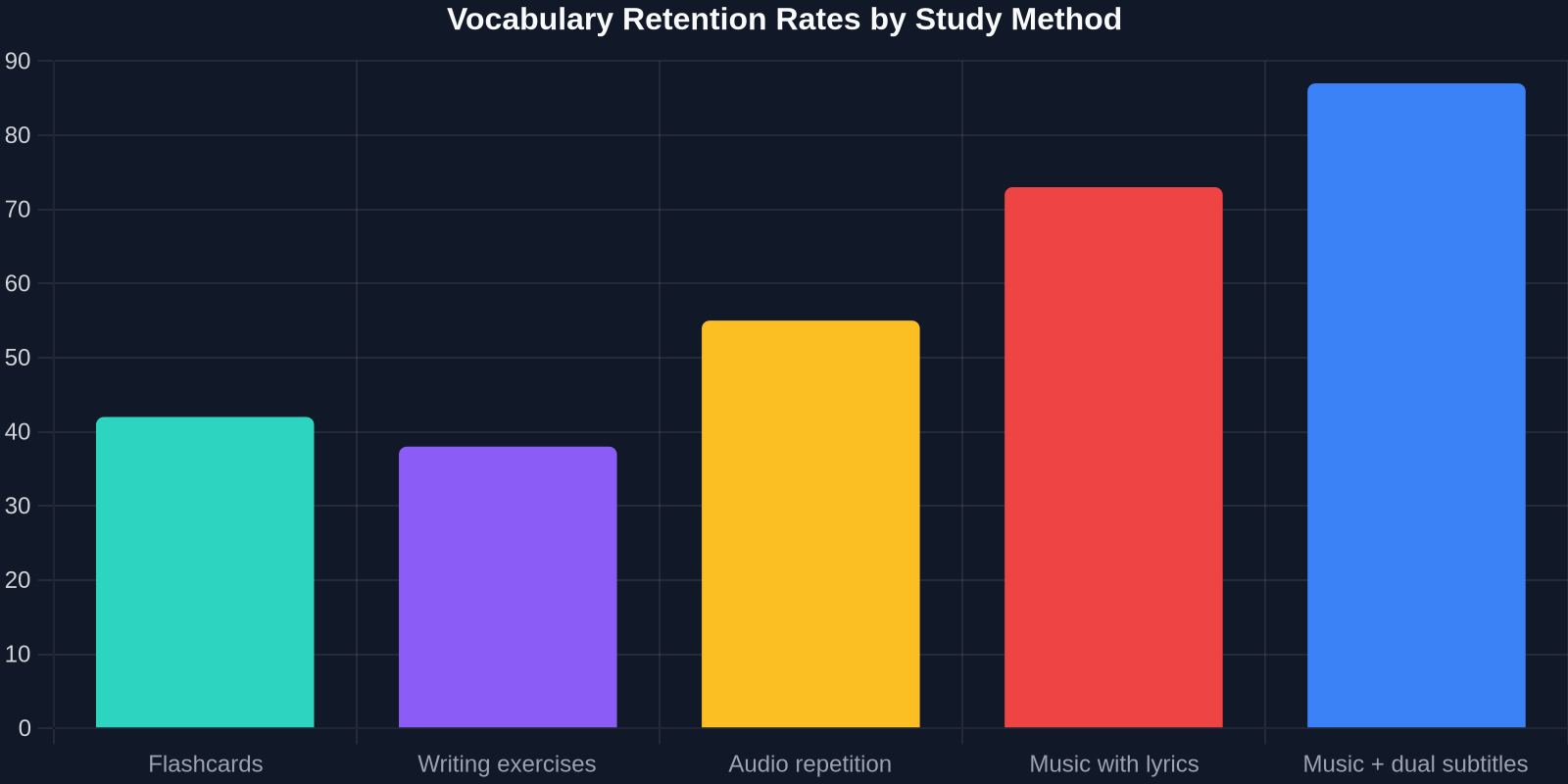
Why do you remember song lyrics from years ago but forget vocabulary flashcards within days? Three factors make music a memory supercharger:
- Rhythm: The regular beat of music provides a temporal scaffold for information. Words set to rhythm are encoded more robustly in memory than spoken words.
- Repetition: Songs naturally repeat choruses, hooks, and phrases. This spaced repetition, encountering a word multiple times in varied contexts, is exactly what cognitive science recommends for long-term retention.
- Emotion: Music triggers emotional responses, and the brain prioritizes emotionally salient information. When a song moves you, the vocabulary within it gets tagged as important.
"When you learn vocabulary through music, you're not just memorizing words, you're embedding them in a web of rhythm, melody, and emotion that your brain is wired to retain."
The Prosody Advantage: Music Teaches You the 'Feel' of a Language
Every language has a unique musical signature. Spanish has a syllable-timed rhythm, each syllable gets roughly equal duration. French has a more flowing, connected quality with liaison (linking sounds between words). English uses stress-timed rhythm, where stressed syllables occur at regular intervals regardless of how many unstressed syllables fall between them.
Music amplifies these features, making them easier to perceive and internalize. When you listen to a French song, you hear the natural rhythm of the language exaggerated by the melody. When you follow Spanish lyrics, you feel the even syllable flow. This exposure trains your prosodic sensitivity, the skill that helps you sound natural when speaking.
How to Train Your Ear: 5 Evidence-Backed Techniques You Can Try Tonight
Ready to improve your listening skills? Here are five practical techniques that combine research on auditory training with the power of music. You can try the first one tonight with any song in your target language.

1. Dual-Subtitle Active Listening
This is the technique that tools like Lyric Lingo are built for: watching music videos with subtitles in both your target language and your native language simultaneously. This dual input provides instant feedback, helping you connect unfamiliar sounds to their meanings without breaking flow.
Here's the step-by-step:
- Choose a song you genuinely enjoy in your target language
- First, watch with both subtitles visible. Let your eyes guide your ears as you connect sounds to words.
- Second, cover your native language subtitle. Try to recall meanings from context and melody.
- Finally, try singing along, matching pronunciation as closely as possible.
The key is repetition with variation. Each pass through the song exercises different skills, sound recognition, vocabulary recall, and pronunciation production.
2. Shadowing with Songs
Shadowing is a technique where you speak along with audio, matching the speaker's rhythm, intonation, and pronunciation as closely as possible. It's been used by interpreters and language learners for decades.
With music, shadowing becomes more challenging and more rewarding. Songs are faster than speech, have extended vowels, and require breath control. But practicing shadowing with a favorite song can dramatically improve your prosodic sensitivity and pronunciation.
Try this: Pick a slower song in your target language. Listen to one line, pause, and repeat it exactly as you heard it, matching not just the words but the melody, rhythm, and emotional tone. Record yourself and compare.
3. Minimal Pair Drills with Lyrics
Minimal pairs are words that differ by only one sound, like "ship" and "sheep" in English. These are notoriously difficult for learners whose native languages don't distinguish those sounds.
Music helps because lyrics often feature these challenging contrasts in memorable contexts. When you find a song line with a minimal pair, pause and practice deliberately:
- Spanish: "pero" vs. "perro" (but vs. dog)
- French: "dessous" vs. "dessus" (under vs. above)
- English: "ship" vs. "sheep" (boat vs. animal)
The musical context makes the distinction more salient, helping your brain establish new phonetic categories.
4. Dictation Challenges
Dictation, writing down exactly what you hear, is a powerful listening exercise. With music, you can make it fun:
- Choose a song you've never heard before in your target language
- Listen without subtitles and write down every word you can catch
- Reveal the lyrics and check your accuracy
- Note which sounds or words you missed, these are your training targets
This technique reveals your listening gaps precisely, so you know exactly what to practice.
5. Lyrical Spaced Repetition
Spaced repetition is a proven memory technique where you review information at increasing intervals. Instead of flashcards, use song lines.
When you learn a new phrase from a song, write it down with its meaning. Review it after one day, then three days, then a week. Each time, try to recall it from the melody, not just as a standalone phrase. The musical association provides an additional retrieval cue that strengthens memory.
The Science of Listening: How Your Brain Processes New Sounds
To understand why these techniques work, it helps to know what happens in your brain when you hear a new language.
The Native Language Bottleneck
As infants, we're born with the ability to distinguish all speech sounds across human languages. But by about 12 months, our brains begin specializing, prioritizing sounds from our native language while filtering out those we don't need. This is efficient but creates a "bottleneck" for adult learners: when you hear a sound that doesn't exist in your language, your brain may literally not register it.
Music helps reopen this bottleneck. Because music is processed through similar auditory pathways but isn't subject to the same linguistic filters, it can train your brain to attend to sound distinctions you've been ignoring.
Neuroplasticity and Adult Learners
Until recently, scientists believed that adult brains were relatively fixed, that language learning ability declined sharply after childhood. Modern neuroscience has overturned this view.
Adult brains remain plastic, capable of forming new neural connections, throughout life. What changes is how adults learn best. Children acquire language implicitly, through exposure. Adults need more deliberate practice, but they compensate with superior analytical skills, metacognition, and self-directed learning strategies.
This is why structured tools like dual subtitles are so effective for adults: they combine implicit exposure (listening to music) with explicit instruction (seeing translations), leveraging both learning systems simultaneously.
Real-World Results: What Learners Report When They Use Music
The research on music and language learning is promising, but what do learners actually experience?

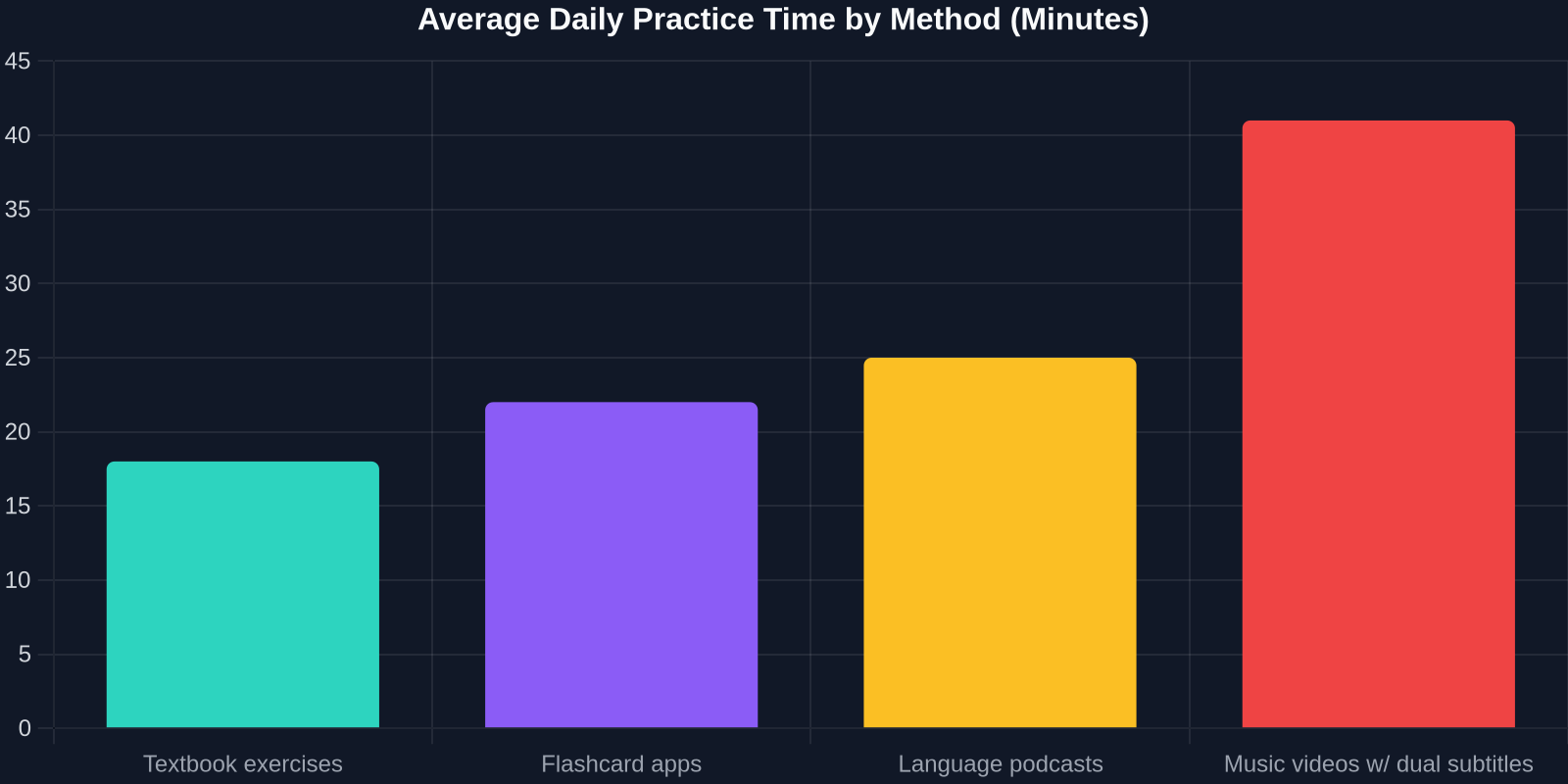
The most common benefit reported by learners is consistency. Traditional study methods, textbooks, grammar drills, and flashcards, require willpower and discipline. Music-based learning feels like entertainment, so learners do it more often and for longer periods.
This "Trojan horse" effect matters more than any single technique. Language learning is a volume game: the more hours of quality exposure you get, the faster you progress. If music makes those hours enjoyable, you'll accumulate them without burnout.
"The best language learning method is the one you'll actually do every day. Music removes the friction between intention and action."
Case Study: The Karaoke Effect
Consider the karaoke learner, someone who practices Spanish by singing along to Bad Bunny or Rosalía. They're not just memorizing words; they're internalizing:
- Pronunciation: The exaggerated vowels and consonants of singing force clearer articulation
- Connected speech: How words link together in natural flow
- Colloquial expressions: The slang and informal language that textbooks rarely cover
- Cultural context: The emotional and social meanings embedded in the music
This holistic learning, sound, meaning, culture, and emotion in one package, is hard to replicate through traditional methods.
Common Mistakes That Sabotage Your Listening Progress
Even with the right techniques, certain habits can undermine your progress. Avoid these common pitfalls:
Mistake 1: Relying on Subtitles in Your Native Language Only
Watching 100 hours of Spanish videos with English subtitles will improve your reading speed in English, not your Spanish listening. Your brain takes the path of least resistance. To train your ear, you need target-language subtitles, or better, dual subtitles that let you verify without replacing the target audio.
Mistake 2: Progressing Too Fast
Jumping from beginner songs to fast rap or regional accents is a recipe for frustration. Your auditory system needs progressive challenge. Start with slower, clearer songs and gradually increase difficulty as your ear adapts.
Mistake 3: Skipping Pronunciation Practice
Listening and speaking are deeply connected. If you can't produce a sound, you'll struggle to perceive it. Regular shadowing and singing along are essential, they close the loop between input and output.
Mistake 4: Treating Music as Background Noise
Having target-language music playing while you work or drive is pleasant but nearly useless for learning unless you're actively attending to the lyrics. Your brain's attention filter will prioritize the task at hand and relegate the music to white noise.
Mistake 5: Ignoring Your Emotional Responses
If a song doesn't move you, don't force it. Emotional engagement is crucial for memory encoding. Choose music that resonates, whether it's the melody, the lyrics, or the artist's style. Your personal connection to the material will accelerate retention.
Building a Music-Based Learning Routine
Ready to put this into practice? Here's a sustainable weekly routine built around music and dual-subtitle listening:
Daily (15-20 minutes)
- Choose one song in your target language
- Watch with dual subtitles (native + target) using a tool like Lyric Lingo
- Focus on catching one new word or phrase per line
- Sing along with the chorus
Weekly (2-3 sessions, 30-45 minutes)
- Do a full dictation challenge with a new song
- Practice shadowing with a slower song, recording yourself
- Review your new vocabulary using lyrical spaced repetition
Monthly (1 session, 60 minutes)
- Revisit all songs from the month
- Test yourself: can you understand each song without subtitles?
- Note which sounds or phrases still trip you up
- Adjust your playlist difficulty accordingly
What the Research Means for Your Learning Journey
The 2026 study on "good ear" learners delivers two clear messages:
- Yes, auditory skills matter. Learners who can discriminate sounds, perceive prosody, and hold auditory information in working memory will learn languages faster.
- And no, you're not stuck. These skills are trainable, and music is one of the most effective and enjoyable training tools available.
The learners who seem to have a "natural gift" have often simply accumulated more hours of auditory training, through music, through attentive conversation, through deliberate listening practice. You can do the same.
Conclusion: Your Ear Is a Muscle, Not a Lottery Ticket
The next time someone tells you they're "just not good at languages," remember this: auditory processing is a skill, not a fixed trait. And like any skill, it improves with the right kind of practice.
Music offers a uniquely powerful training ground. It combines rhythm, repetition, and emotion, the three ingredients that cognitive science identifies as key to memory and skill acquisition. With dual-subtitle tools, you can turn your favorite songs into structured language lessons that feel like entertainment.
Your "good ear" is waiting to be developed. Start tonight: pick a song you love in your target language, turn on both sets of subtitles, and listen actively. That's not just fun, that's training.
Ready to train your ear with music you already love? Lyric Lingo's dual-subtitle player turns any YouTube music video into an interactive language lesson. Choose your native language and target language, and start turning passive listening into active learning, one song at a time.
References & Further Reading
- People with a "good ear" are better language learners, Phys.org (2026)
- Le, E., et al. (2025). Conversational AI and Learner Receptivity. Journal of Educational Technology.
- Austin, L., et al. (2025). Auditory Training for New Hearing Aid Users: A Systematic Review. Journal of Speech, Language, and Hearing Research, 68(4).
- Patel, A. D. (2014). Can nonlinguistic musical training change the way the brain processes speech? European Journal of Neuroscience, 39(12).
- Schön, D., et al. (2008). Songs as an aid for language acquisition. Cognition, 106(2).