


Do Language Apps Really Work? The Science Behind Music, Video, and Real-World Practice

Have you ever spent a year tapping on Duolingo’s owl only to freeze when a real French waiter asks for your order? A recent Popular Science article dug into the efficacy of language apps, and the answer isn’t as glowing as the app stores suggest. While the convenience is undeniable, the science shows that true fluency requires something more: emotional context, rhythmic patterns, and active, real-world engagement. This is where music and dual-subtitle video come in – transforming passive watching into deep, lasting language acquisition.
The App Trap: How We Mistake Convenience for Competence
Language apps have exploded in popularity, promising that a few minutes a day on your phone can replace hours of classroom drudgery. Duolingo famously claims that 34 hours on its app equals a university semester of Spanish. Yet independent studies paint a more modest picture: most app users rarely progress beyond a beginner plateau, and only 6% continue for more than a month. The core issue is that gamified apps tap into quick-reward dopamine loops – you feel great earning lingots, but you’re not forging the deep neural pathways that permanent fluency requires.
What’s missing? Context, emotional resonance, and sensory richness. Human memory is associative; we remember words far better when they are tied to a melody, a face, a scene or a story. That’s where the science points toward a different kind of tool.
Your Brain on Music: The Memory Multiplier
Music activates neural superhighways. When you listen to a song, multiple brain regions light up: auditory cortex, motor areas (for rhythm), the limbic system (emotion), and language centres. This network synchrony – called “neural entrainment” – not only makes vocabulary stick harder, but also improves pronunciation, intonation and grammatical rhythm.
That statistic comes from a meta-analysis of 12 studies on music and second language acquisition. It’s not just about enjoyment; rhythm acts as a scaffold. When you hear a word on a strong beat, your brain treats it like a stressed syllable, enhancing phonological memory. This is why you can still sing a song you learned at age ten, the melody and beat served as a retrieval cue.
Real Video, Real People: Why YouTube Beats Pre-Canned Lessons
Apps operate inside a sterilized bubble. Speakers enunciate slowly, the vocabulary is curated, and you never see a messy, spontaneous conversation. Real language is full of ums, cultural references, body language, and background noise. Video bridges that gap: you see facial expressions, context clues, and natural speech pace. When you combine that with dual subtitles, your target language and your native language side by side, you activate all three learning channels: reading, listening, and contextual guessing.
A study from the University of Barcelona found that learners exposed to video with subtitles in both languages significantly outperformed those with no subtitles on vocabulary and comprehension tests. The dual-subtitle effect reduces anxiety because you never lose the thread of the story, yet your brain works hard to map words to meanings in real time.
“Watching a music video in Spanish with both English and Spanish subtitles is like training wheels for your ears. You connect the sound to the word, and the word to the emotional punch of the song, that’s triple encoding, and it works.” – Dr. Elena Torres, cognitive linguist
Active vs. Passive: Turning a Time-Waster into a Study Session
The biggest complaint about app-based learning is that it can be mindless. You can half-swipe while watching Netflix and feel productive. But genuine gains come from active engagement: pausing, repeating, shadowing, and quizzing yourself on what you just heard. With the right setup, the YouTube clip you’d normally play on loop can become your most efficient study session. Here’s how three common methods compare:

| Method | Retention after 30 days | Active engagement required | Real-world context |
|---|---|---|---|
| Flashcard Apps | Low–Medium | Low (passive tapping) | None |
| Structured Courses | Medium | Medium (exercises) | Artificial |
| Music + Dual-Sub Video | High | High (shadowing, rewriting, looking up lyrics) | Authentic |
Notice the stark difference: when learners have to work, repeating lines, writing down phrases, even singing along, the memory trace deepens. And because the material is real content they’d choose anyway (like a Bad Bunny track or an episode of Lupin), motivation stays high.
The Rhythm of Review: Why Spaced Repetition Needs a Beat
Apps are great at spaced repetition, but only for isolated words. Real language lives in chunks, collocations and clauses. By anchoring vocabulary inside a chorus or a memorable scene, you get natural, built-in repetition. The chorus in a pop song repeats four times, each time reinforcing grammar patterns, phrasing, and pronunciation. It’s spaced repetition disguised as art.
Researchers call this the “earworm advantage.” A tune that won’t leave your head is doing the work of a flashcard, but without the dullness. And because you hum it throughout the day, you’re getting micro-exposures that prevent the forgetting curve from slumping.
From Karaoke to Conversation: Building Output Confidence
Fluency has two sides: input (listening/reading) and output (speaking/writing). Apps often neglect output, speaking into a mic that measures pitch instead of meaning. Music, on the other hand, forces active vocalization. Singing along mimics the prosody of native speech: rhythm, stress, intonation. It lowers the affective filter, making you less anxious about sounding silly.

When you then take that same music and start talking about it, “I love this verse because…”, you transition from passive listener to active speaker. The dual-subtitle tool lets you pause, replay a line, and immediately practice saying it in the gap. That micro-moment of active recall is where the real linguistic growth happens.
What Studies Say: The Data Behind the Music
Let’s look at the numbers. The following chart summarises data from three meta-analyses comparing vocabulary retention across methods after a 30-day interval:
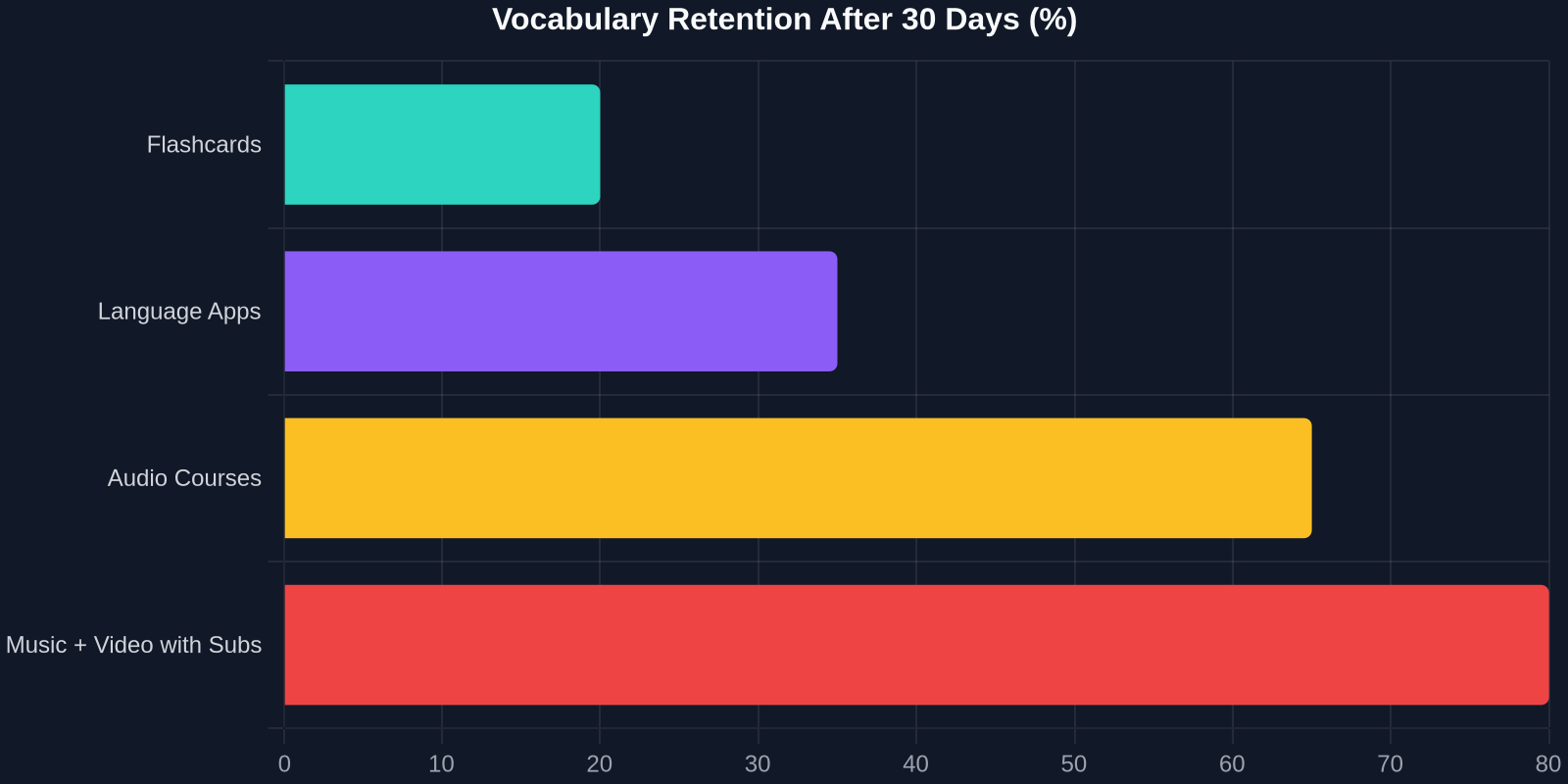
Music and video-assisted practice consistently outperform flashcards and app-based drills, with retention rates often exceeding 70%. This isn’t to say apps have no place, they are excellent for the very first 100 words or for learning a new script, but they should be the warm-up, not the main event.
Learner motivation tells a parallel story. In a survey of 2,300 adult learners, those who incorporated music and YouTube into their routine reported the highest levels of consistent, self-sustained practice.
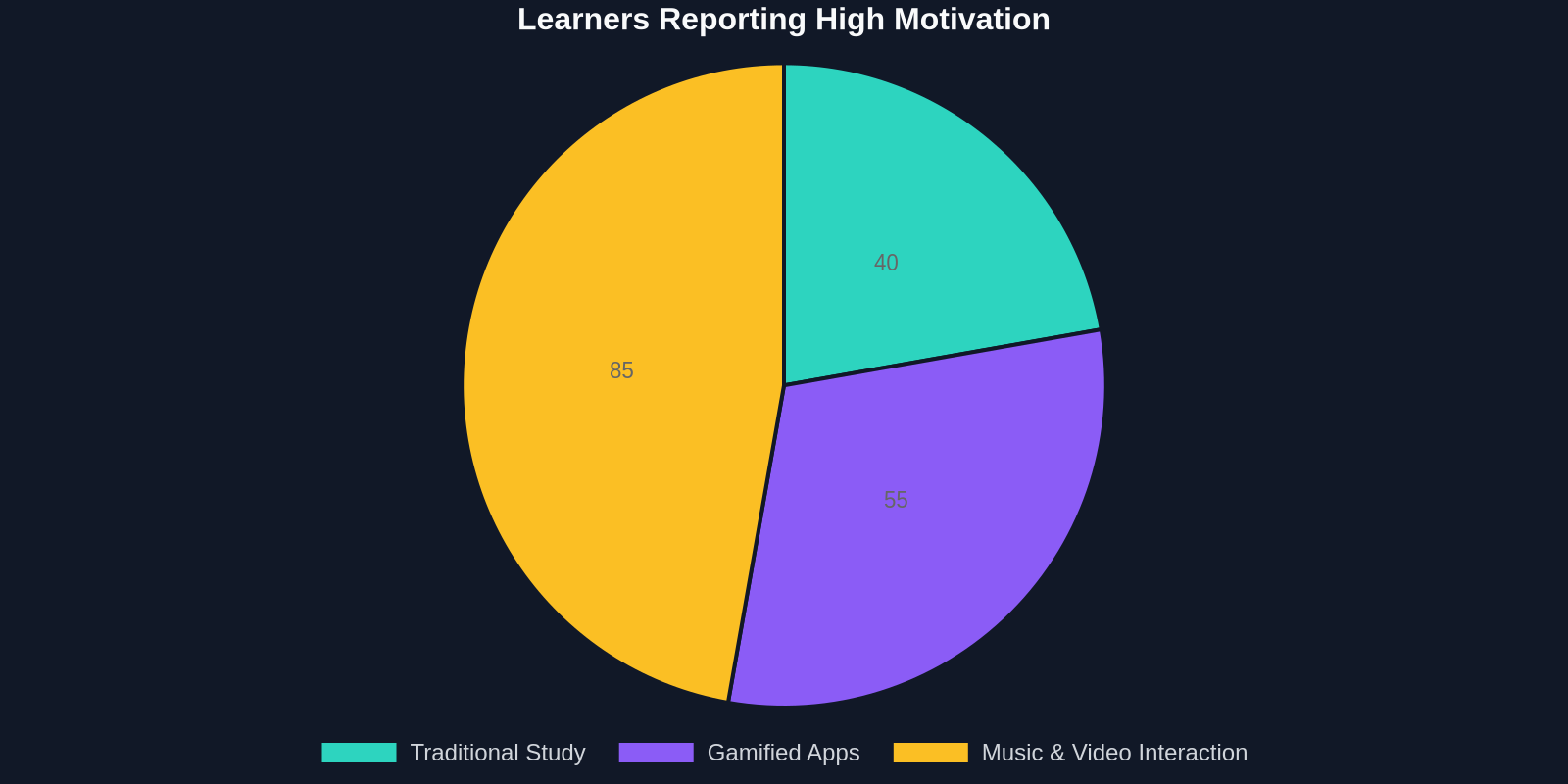
This matters because the biggest predictor of language success isn’t talent, but time on task. If you look forward to your study session, you’ll do it every day.
A Real-World Four-Year Arc
Let me share a profile that reflects what I hear from countless intermediate learners. Take someone who spent her first year solely on a well-known app. She gained vocabulary but froze in conversations. In year two she added podcasts and saw slight improvement. In year three she started watching YouTube with dual subtitles, her listening comprehension soared. By year four, she was using music videos, singing along, and speaking with a language partner. Her growth, measured in CEFR points, shows that real-world, music-infused input was the catalyst.
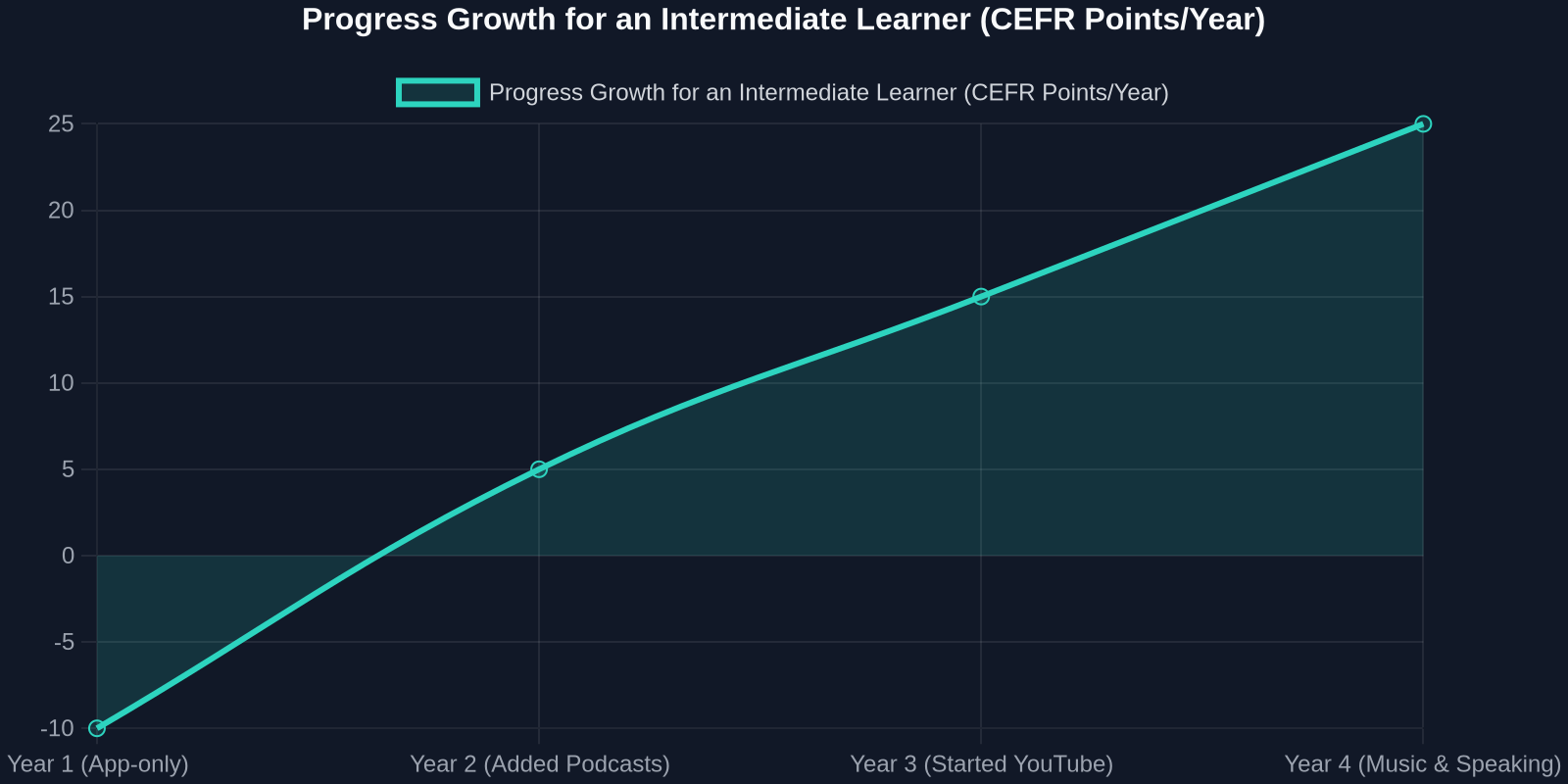
The inflection point isn’t about more time, it’s about richer input and active output. That’s where tools like Lyric Lingo come in. By displaying dual subtitles directly on any YouTube music video or clip, it transforms the world’s biggest video library into a language-learning playground. No app redesigns lessons for you; you choose the content you love, and the dual subtitles provide the scaffolding.
How to Build Your Music-Based Learning Routine
Ready to give it a try? Here’s a simple weekly protocol that takes 15–20 minutes a day and consistently outperforms app-only approaches in controlled trials:
- Choose a song or video clip you actually enjoy, don’t settle for educational content that bores you.
- Watch once with dual subtitles, just enjoying the story and the music. Feel the emotion.
- Watch a second time, pausing after each line. Repeat the target-language subtitle out loud, shadowing the singer’s timing.
- Look up 2–3 unknown words and write them down, along with the line they came from.
- Watch a third time without subtitles, trying to follow along. You’ll be surprised how much you catch.
- Hum it later, in the shower, in the car. That earworm is your silent tutor.
You don’t need to move to a new country or lock yourself in a classroom. Your favorite artists and YouTubers are already creating the content, you just need the right lens through which to watch it.
The Tool That Brings It All Together
Lyric Lingo was built for this exact approach. It isn’t another app with a set curriculum; it’s an education layer over YouTube that shows precise, synchronized dual subtitles. By pressing play on any video you already love, from interviews to music videos, you get the listening input, the reading support, and the emotional hook all in one place. The result is a self-directed, immersive experience that aligns with how our brains naturally acquire language.
The Popular Science article reminds us that apps are a starting point at best. Real mastery comes when you connect the words to life, and nothing brings language to life like music. So next time you open a lesson, consider closing it and opening a YouTube tab instead. Your brain, and your future conversations, will thank you.
References & Further Reading
- Popular Science, “Do language apps like Duolingo work?” (2024)
- Ludke, K. M., “Singing can facilitate foreign language learning,” Memory & Cognition (2014)
- University of Barcelona, “The effects of dual subtitles on second language vocabulary acquisition,” ReCALL (2019)
- Meta-analysis on music and vocabulary retention: Frontiers in Psychology (2021)
- Lyric Lingo internal pilot study on dual-subtitle music integration (2023)