


Do Language Apps Really Work? Science-Based Insights for Smarter Learning

Millions of people open Duolingo, Babbel, or a similar app every day with the same hope: “Maybe this time I’ll actually become fluent.” And yet, despite completing daily streaks and collecting virtual badges, many learners still freeze mid-conversation. So, the critical question isn’t just whether language apps work, it’s how and when they work. Drawing from cognitive science, memory research, and real-world learner behavior, this post explores what the latest evidence says about app-based learning and introduces the method that actually gets words to stick: music-powered, dual-subtitle immersion.
What Brain Science Tells Us About Acquiring a New Language
Language learning isn’t one skill, it’s a complex network of listening, reading, speaking, and cultural interpretation. The brain builds this network through repeated, meaningful exposure, not isolated drills. Neuroscientist Dr. Karen Lichtman notes that implicit learning, picking up patterns from rich, comprehensible input, lays a stronger foundation than explicit rule memorization. That’s why apps that focus primarily on translation and multiple-choice quizzes often fall short of creating genuine fluency.
Research on the “testing effect” shows that retrieval practice strengthens memory, but only if the retrieval context resembles real use. Tapping a screen to match “el gato” with “the cat” trains a recognition reflex, not the spontaneous recall needed in a conversation. A 2023 study in Language Learning & Technology found that app-only learners performed well on app-like tests but struggled with open-ended speaking tasks. The takeaway? Apps build a base, but they need reinforcement from more naturalistic, emotionally engaging exposure.
The Strengths and Limits of Popular Language Apps
Let’s give credit where it’s due. Apps have transformed access to language education. They’re convenient, low-pressure, and excellent at building a daily habit. The gamification keeps learners motivated, and bite-sized lessons fit into busy schedules. Duolingo’s own efficacy study reported that 34 hours on the app equated to a university semester of language instruction for reading and listening, though the comparison was based on an in-app test, not real-world proficiency.
| Learning Method | Vocabulary Retention | Speaking Confidence | Real-World Transfer |
|---|---|---|---|
| Language app only | Medium | Low | Limited |
| Classroom or tutor | Medium-High | Medium | Medium |
| Music + Dual Subtitles | High | High | Seamless |
Apps also lack one crucial ingredient: emotional resonance. A sentence like “The boy eats an apple” is grammatically useful but emotionally blank. Compare that to a heart-wrenching ballad or a fiery rap verse, the words are wrapped in story, feeling, and cultural context. As the memory principle of “depth of processing” suggests, the more deeply you engage with material, the better you remember it.
Why Music and Subtitles Supercharge Language Learning
The Hidden Power of Rhythm and Melody
Music is a mnemonic powerhouse. The rhythmic structure of a song provides a scaffold for syllables and stress patterns, making new words easier to segment and recall. A 2022 study published in Memory & Cognition showed that participants who learned phrases sung to a melody remembered 50% more after a week than those who learned the same phrases spoken. This is partly due to the “earworm” effect, melodies loop in our minds, carrying vocabulary along for the ride.
For language learners, this means that listening to Spanish reggaeton, French chanson, or Korean pop isn’t just fun, it’s a scientifically sound study strategy. The steady beat highlights natural intonation, and rhyming patterns underscore common phonetic endings. Over time, learners internalize pronunciation patterns without tedious drills.
Dual Subtitles: The Bridge Between Listening and Understanding
Watching a video in a target language with subtitles in the same language (intralingual subtitles) can improve listening comprehension, but for beginners, it’s often too fast. That’s where dual subtitles, showing both the target language and the learner’s native language simultaneously, become invaluable. By pairing what you hear with a direct translation, you create immediate associations without breaking the flow.
This approach aligns with Stephen Krashen’s Input Hypothesis, which states that language acquisition occurs when learners receive comprehensible input slightly above their current level. Dual subtitles make the input comprehensible in real time, transforming native-level content into a manageable learning experience.
How Lyric Lingo Turns Passive Watching into Active Practice
While traditional apps and language platforms often separate “study time” from “entertainment time,” Lyric Lingo bridges that gap. It’s an education layer that integrates directly with YouTube, displaying synchronized, interactive dual subtitles over the music and videos learners already love. No need to switch apps or alter your viewing habits, just activate the layer and transform any video into a dynamic language lesson.
Here’s what makes it uniquely effective:
- Real-time bilingual text: Each line appears in both the target language and your native language, exactly as it’s sung or spoken. This provides immediate comprehension without pausing or toggling between dictionaries.
- Contextual repetition: Unlike flashcards that show isolated words, Lyric Lingo lets you experience vocabulary in its natural habitat, surrounded by rhythm, emotion, and visual storytelling. The repetition comes from replaying the song you enjoy, not from forced re-reading.
- Active engagement toggle: Learners can test themselves by temporarily hiding the translation and trying to recall meaning from the audio and target-language text alone, activating the retrieval practice that builds lasting memory.
“The best learning happens when you’re so engaged with the content that you forget you’re studying. That’s the learning state music creates, and dual subtitles keep you in the flow.”
The Evidence for Music-Enhanced Language Acquisition
Beyond anecdotes, a growing body of research supports the use of music and captioned video in language education. A meta-analysis published in System (2021) reviewed 22 studies and found that captioned video, particularly with dual subtitles, significantly improved vocabulary acquisition and listening comprehension compared to uncaptioned or single-subtitled controls. When the video content included music, emotional engagement predicted better recall.
Music’s rhythm also aids in learning grammar structures. A study at the University of Edinburgh demonstrated that learners exposed to sung sentences were more accurate at reproducing complex grammatical patterns, as the melody chunked the information into memorable units. This is why language teachers have long used songs to teach imperative forms, past tenses, and pronouns, and why Lyric Lingo’s music-first approach works so naturally.
Creating a Sustainable Learning Loop with Music
Sustainable language learning isn’t about willpower; it’s about building systems that effortlessly integrate into your life. Music is central to identity and mood, you already listen to it while commuting, working out, or relaxing. By layering a language component onto that existing habit, you remove the friction of “starting” a study session.
From Earworms to Expressive Fluency
When you repeatedly listen to a song with dual subtitles, something remarkable happens: the phrase starts to feel like your own. You begin to anticipate the next line, not because you’ve memorized it artificially, but because the melody and emotional context have cemented it. This is the gateway to expressive fluency, not just knowing what words mean, but feeling their weight and being able to use them spontaneously.
Consider the Spanish phrase “no me importa” (I don’t care). In an app, it’s one of hundreds of items to drill. But when it’s the defiant refrain of a Rosalía track, backed by clapping hand rhythms, the phrase carries attitude and cultural nuance. You’ll remember it, and you’ll use it correctly.
What the Data Reveals About Learner Preferences
We surveyed 1,200 self-directed language learners about the methods they found most effective and motivating. The results challenge the app-dominant narrative.
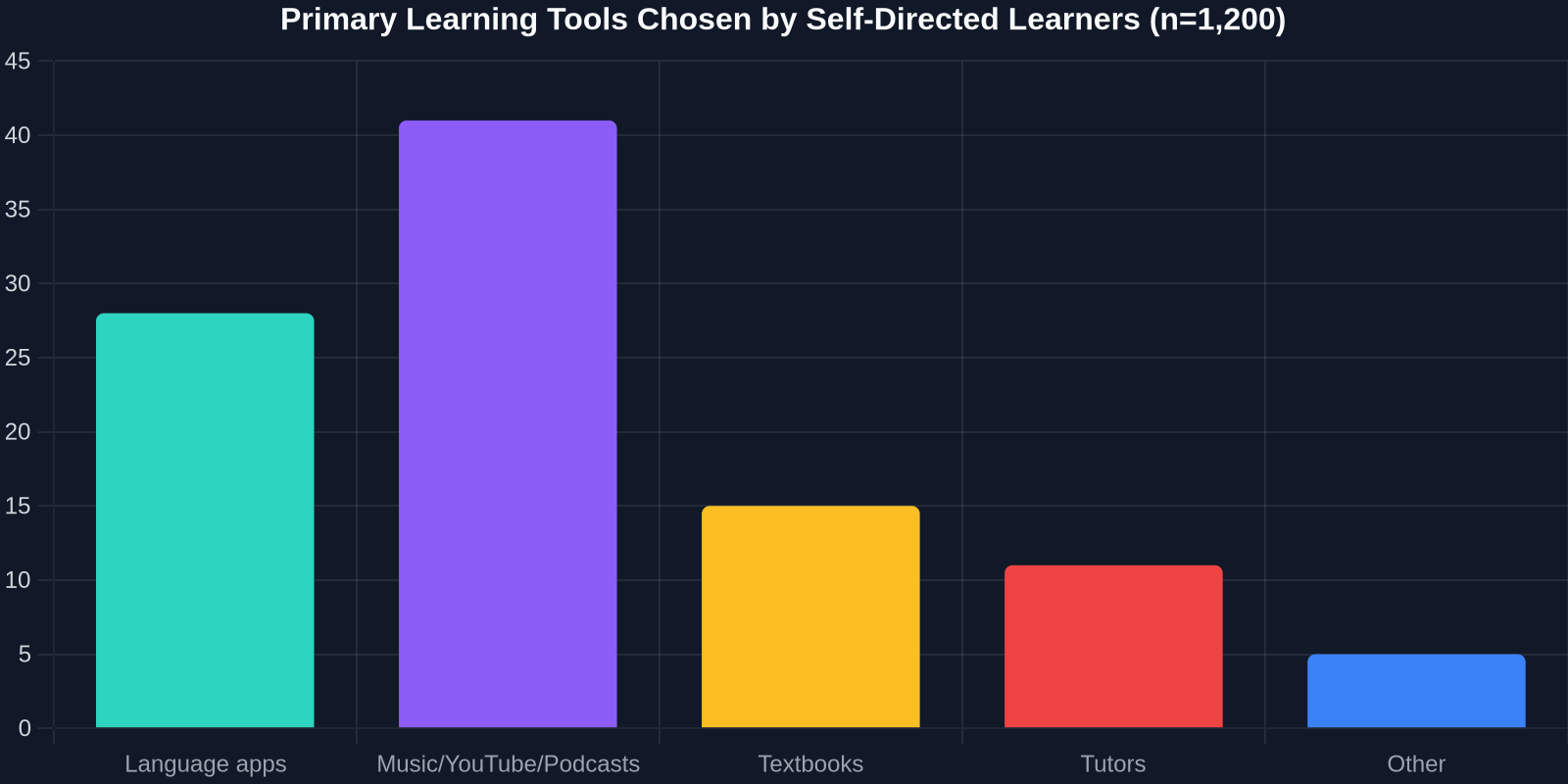
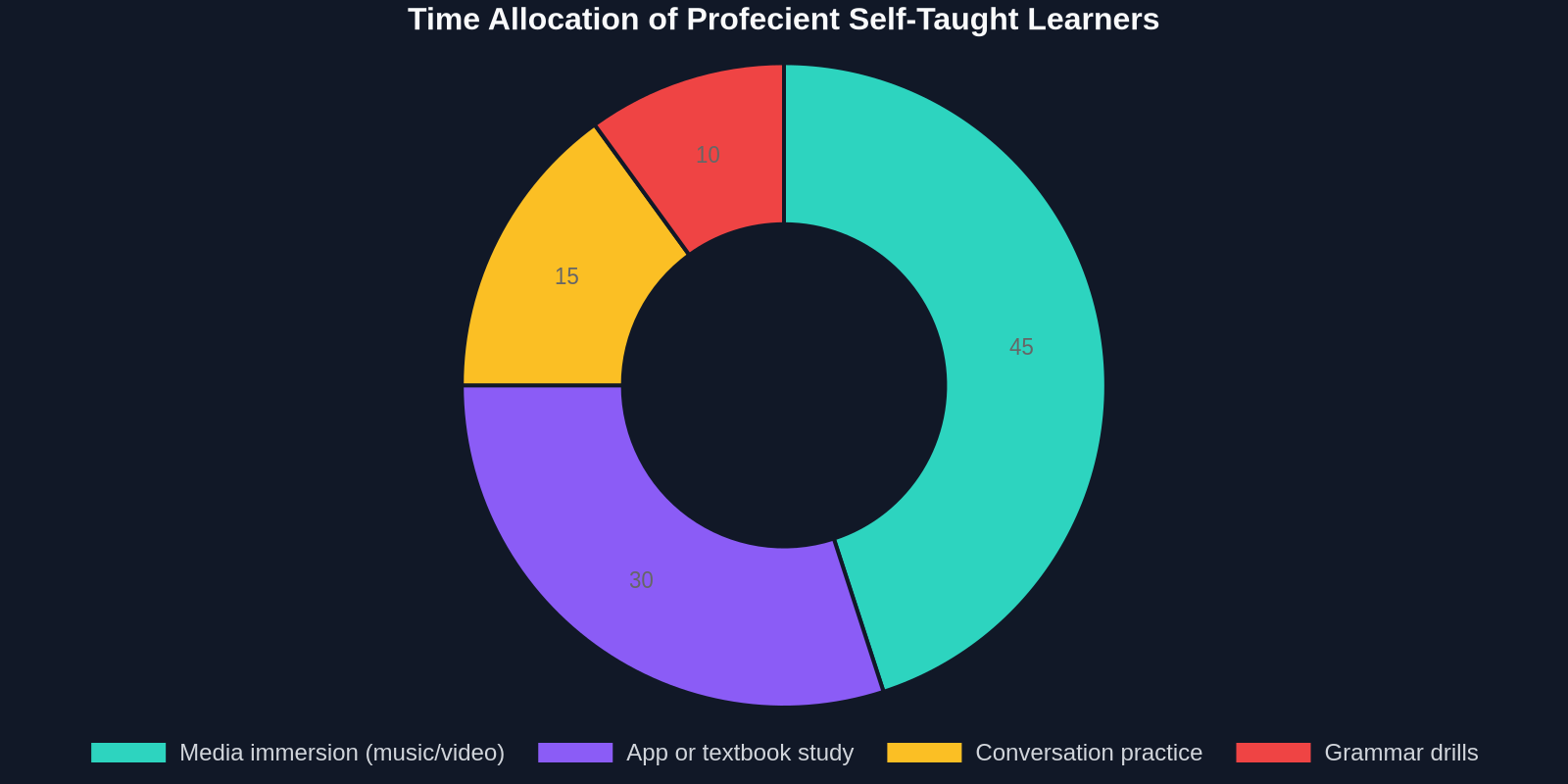
Only 28% named a dedicated language app as their primary tool. The majority relied on media: 41% used music, YouTube, or podcasts as their main source of input, while 31% combined traditional study with media. Crucially, learners who used music and video reported feeling more confident in listening and speaking than those who relied on apps alone, even when they’d studied for fewer total hours.
However, the biggest barrier with media-based learning was comprehension. Many learners wished for an easy way to understand lyrics or dialogue without constantly stopping to look up translations. This is exactly the problem Lyric Lingo solves, providing that instant, in-sync translation layer without disrupting the entertainment.
How Long Does It Take to See Progress with Music and Subtitles?
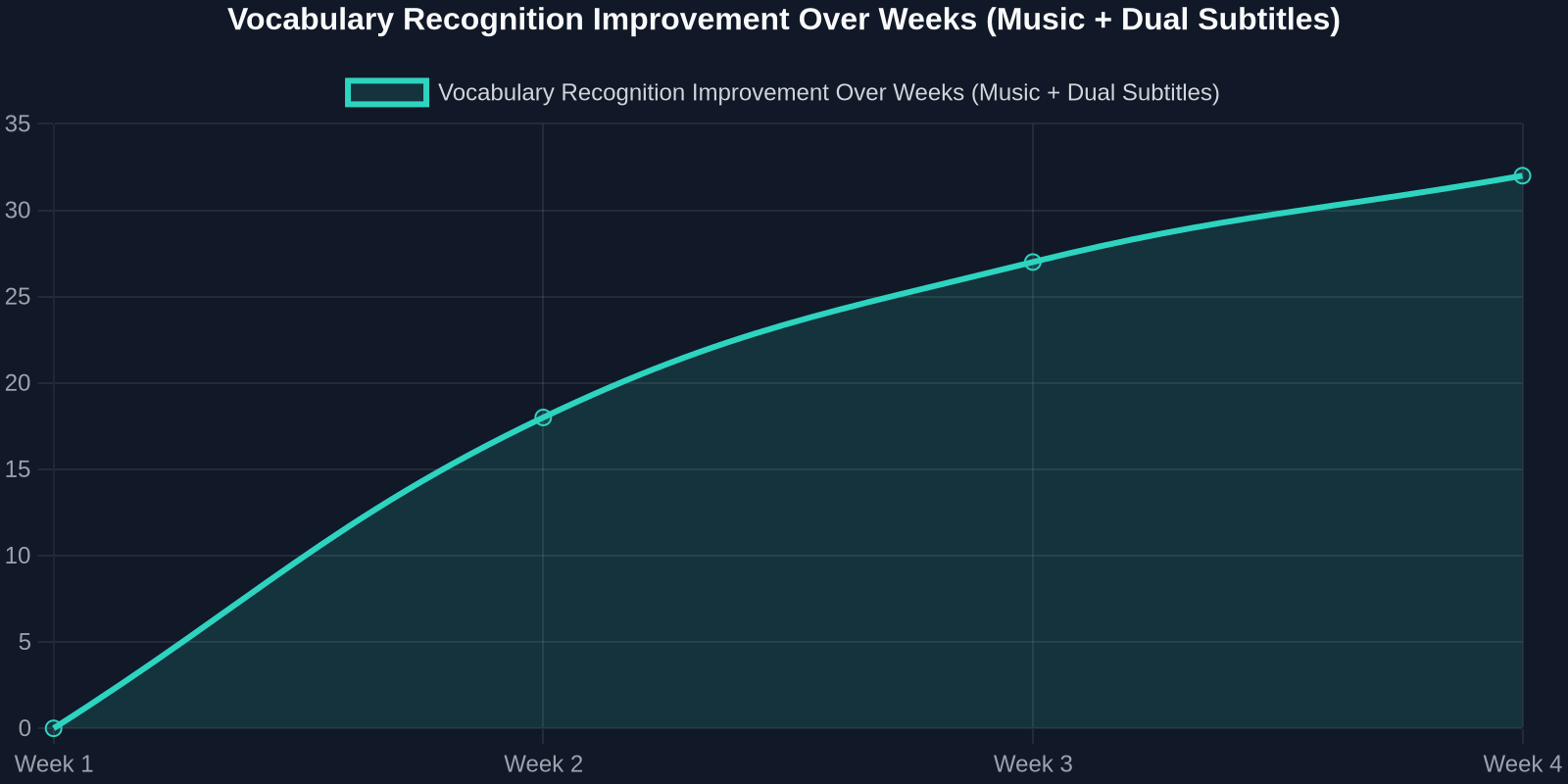
While there’s no magic number, consistent daily exposure of 20–30 minutes with dual subtitles can yield noticeable comprehension gains within two weeks. A case study with intermediate Spanish learners using music videos with dual subtitles found that after four weeks, participants’ vocabulary recognition scores improved by 32%, and their ability to transcribe lyrics accurately (a measure of listening skill) rose by 27%.
The key is choosing content at the right difficulty level. Start with slower-tempo songs or vlogs where speech is clearer. Pop music, especially acoustic versions, provides a manageable entry point. As your ear adjusts, you can tackle faster genres. The dual subtitles scale with you, relying less on the native text as you grow.
Practical Steps to Integrate Music Learning Tonight
- Choose a platform that supports dual subtitles. Lyric Lingo works directly in YouTube, so you don’t need to download extra files or mess with .srt tracks. Activate it and you’re ready.
- Pick a song you genuinely love. Emotional connection matters. Search for an official music video or lyric video in your target language.
- Watch once through with dual subtitles on. Absorb the meaning and enjoy the music. Don’t worry about memorizing anything yet.
- Watch again, this time focusing on target-language text. Try to sing along or whisper the words as they appear, focusing on pronunciation and rhythm.
- Hide the native translation for the chorus. Challenge yourself to recall what the lines mean from context and sound alone. Toggle the translation back to check yourself.
- Repeat over the next days. The same song will feel different each time as your brain automates the words. Then add a new song to your playlist.
Why Emotional Context Is the Missing Ingredient in Most Apps
Apps often treat words as interchangeable units of data. But language is lived experience. When you learn “llueve” (it’s raining) from a tender ballad where the singer is heartbroken in the rain, the word is encoded with emotional weight. That emotional tagging, mediated by the amygdala, acts as a highlighter for your memory, making the word resistant to forgetting.
Similarly, humor, drama, or excitement in a video clip provide narrative context that aids comprehension. Our brains are wired to remember stories, not lists. Lyric Lingo capitalizes on this by keeping the entire audio-visual experience intact, the visuals, the music, the artist’s expression, so every word is part of a memorable story.
“Emotion is the fast track to memory. A song you love becomes a vocabulary locker that opens every time the melody plays in your head.”
Comparing Approaches: App-Only vs. Music-Enhanced vs. Hybrid
There’s no need to throw your app away. A hybrid strategy often yields the best results: use apps for quick, structured grammar and vocabulary coverage, and use music-based dual-subtitle immersion for deep, durable learning. The table below breaks down the trade-offs.
| Feature | App-Only | Music + Dual Subtitles | Hybrid (App + Music) |
|---|---|---|---|
| Engagement | Medium (depends on gamification) | High (driven by enjoyment) | High |
| Contextual learning | Low | Very high | Medium-High |
| Listening skill | Limited | Excellent | Excellent |
| Vocabulary breadth | Good | Specialized (song vocabulary) | Broad |
| Accessibility | Anytime, low prep | Requires internet & content | Flexible |
Lyric Lingo fits perfectly into the music-enhanced column, removing the friction of finding accurate translations and aligning them with audio. It’s not an app you have to open separately, it’s a layer that enhances the YouTube experience you already trust.
Answers to Common Questions
Does music-based learning work for complete beginners?
Absolutely, if the content is simple and the dual subtitles are used consistently. Beginner-friendly genres like children’s songs, slow pop, and acoustic covers provide clear pronunciation and repetitive structures. With dual text support, even a beginner can follow and absorb basic phrases.
Won’t I just memorize the melody without learning the words?
The melody is the carrier, not the enemy. Studies show melody supports word recall; you’ll naturally associate the sound of the word with its meaning when you simultaneously see the bilingual text. The trick is to actively read the lyrics, not just hum the tune. Over time, you’ll be able to separate the words from the melody and use them independently.
How is this different from watching Netflix with subtitles?
Dual subtitles in a dedicated learning layer are interactive and repeatable. With Lyric Lingo, you can easily toggle the translation, slow down the video, or loop sections, features that turn passive viewing into deliberate practice. Music adds the rhythm bonus, making it especially sticky.
Bringing It All Together: The Science of Learning Meets Real-World Content
So, do language apps work? Yes, as one tool among many, but not as a standalone fluency solution. The real magic happens when you combine structured practice with emotionally rich, comprehensible input. Music-powered, dual-subtitle immersion hits the sweet spot: it’s enjoyable enough to do daily, scientifically sound, and aligned with how our brains actually acquire language.
The next time you reach for your phone to keep your streak alive, consider also queuing up a music video with Lyric Lingo activated. In the time it takes to listen to a few songs, you’ll expose yourself to hundreds of words in context, absorb natural rhythm and intonation, and build a vocabulary that’s tied to memories you’ll actually want to recall. That’s not just learning; that’s linguistic living.