


Breaking Language Barriers: How Kenosha’s Community Program and Music Videos Create Fluent Speakers
In an unassuming corner of Wisconsin, a quiet revolution is taking place. Volunteers in Kenosha County have launched an ambitious initiative to connect English and Spanish speakers, proving that the most effective language learning doesn’t happen behind a desk, it happens between people. The new program, highlighted recently by local news, pairs native speakers of both languages in structured conversation sessions, breaking down walls one dialogue at a time. But while community-driven language exchange is powerful, the learners who will progress fastest are those who supplement these live interactions with daily, emotionally charged input. That’s where music enters the picture. At Lyric Lingo, we’ve seen how dual-subtitle YouTube videos turn catchy songs into immersive language labs. Together, the Kenosha model and music-based practice offer a complete blueprint for going from hesitant speaker to confident communicator.
The Kenosha program, which operates out of local libraries and community centers, was born from a simple observation: Spanish and English speakers live side by side, yet often remain linguistically divided. By organizing informal “intercambio” sessions where each person spends half the time speaking their target language and half helping their partner, the program accelerates fluency through real-world practice. Organizers report that many learners arrive nervous, stumbling over verb conjugations, but leave sessions visibly more confident and eager to return. This mirrors what second-language acquisition researchers have long known, interactionist approaches that combine comprehensible input with meaningful output are far more effective than silent study. But the classroom of daily life can be slow to expose learners to the full richness of a language’s sound system, idiomatic expressions, and cultural depth. Music bridges that gap instantly.
Why Community Practice Alone Isn’t Enough
Intercambio groups are invaluable. They lower the affective filter, that invisible barrier of anxiety that blocks language acquisition, by creating a supportive, low-stakes environment. When a Kenosha volunteer gently corrects your gender agreement or helps you navigate the subjunctive, you internalize the correction far more deeply than you would from a textbook. Yet the typical 60-minute weekly session doesn’t provide the volume of input needed for true mastery. According to linguistic research, an adult needs roughly 2,000 hours of active engagement to reach professional proficiency in a Category I language like Spanish. Weekly conversation clubs can chip away at that number, but they can’t come close on their own.
This is where music becomes the ultimate supplement. A three-minute song packs dozens of new vocabulary items, complex grammatical structures, and authentic pronunciation models into a digestible, repeatable format. When you watch that song with dual subtitles on Lyric Lingo, you’re not just hearing words, you’re seeing them mapped to your native language in real time, and because the music triggers an emotional response, your brain treats the information as worth remembering. It’s like having a personal tutor who’s both a native speaker and a hit songwriter.
How Music Rewires Your Brain for Language
Neuroscientific studies consistently show that music and language share overlapping neural circuits. The same areas that process syntax in sentences also track harmonic progression in chords. Rhythm, pitch, and melody all contribute to what linguists call the “phonological loop,” a component of working memory that repeats sounds to hold them in short-term storage. When you tap your foot to a Shakira track or hum along with a Manu Chao chorus, you’re literally rehearsing the intonation and stress patterns of native speech without any conscious effort.
Notice that music-based learning rivals live conversation in retention, yet it requires far less logistical effort. You can listen on your commute, while cooking, or during a ten-minute work break. And using a tool like Lyric Lingo, which layers dual subtitles directly onto YouTube videos, turns that casual listening into active study. Every line of lyrics becomes a mini-lesson in vocabulary, grammar, and culture.
The Kenosha Program in Action: A Model for Blended Learning
Let’s look more closely at the Kenosha exchange and see how music can amplify its effects. Participants in the program come from diverse backgrounds: some are recent immigrants eager to improve their employment prospects, others are long-time residents who want to better communicate with neighbors. Volunteers include retired teachers, college students, and even high schoolers fulfilling service hours. Each session follows a gentle structure, free conversation for 20 minutes in Spanish, then 20 minutes in English, often guided by a theme or a short article. Organizers report that attendees quickly bond over shared interests; a common one is, naturally, music. One volunteer mentioned that when a participant brought up the song “Vivir Mi Vida” by Marc Anthony, the whole group lit up, exchanging interpretations of the lyrics and laughing over misheard lines. That moment, unstructured and joyful, was likely more instructive than any worksheet.
“When someone hears a song they love in their target language, the language stops being a school subject and starts being a key to a culture they want to enter.”
Imagine enhancing that dynamic with a tool that shows the song on-screen with both Spanish and English subtitles in perfect sync. Participants could watch the video during a session, pause to discuss tricky phrases, and then continue the conversation using the vocabulary they just absorbed. After the exchange, each learner could review the same song at home, this time focusing on the lines that gave them trouble. This is exactly the blended learning loop that Lyric Lingo enables.
From Group Conversations to Solo Listening Sessions
A recurring challenge in community programs is the gap between meeting days. Without daily exposure, newly acquired words and patterns fade quickly. The spaced-repetition principle tells us we need to encounter a new word 6–8 times in meaningful contexts before it sticks. A weekly intercambio might give you one or two exposures; a five-day playlist of music videos can provide tens. By selecting songs that align with the themes discussed in the group, family, food, travel, emotions, you can create a self-reinforcing curriculum that connects social learning with personal practice.
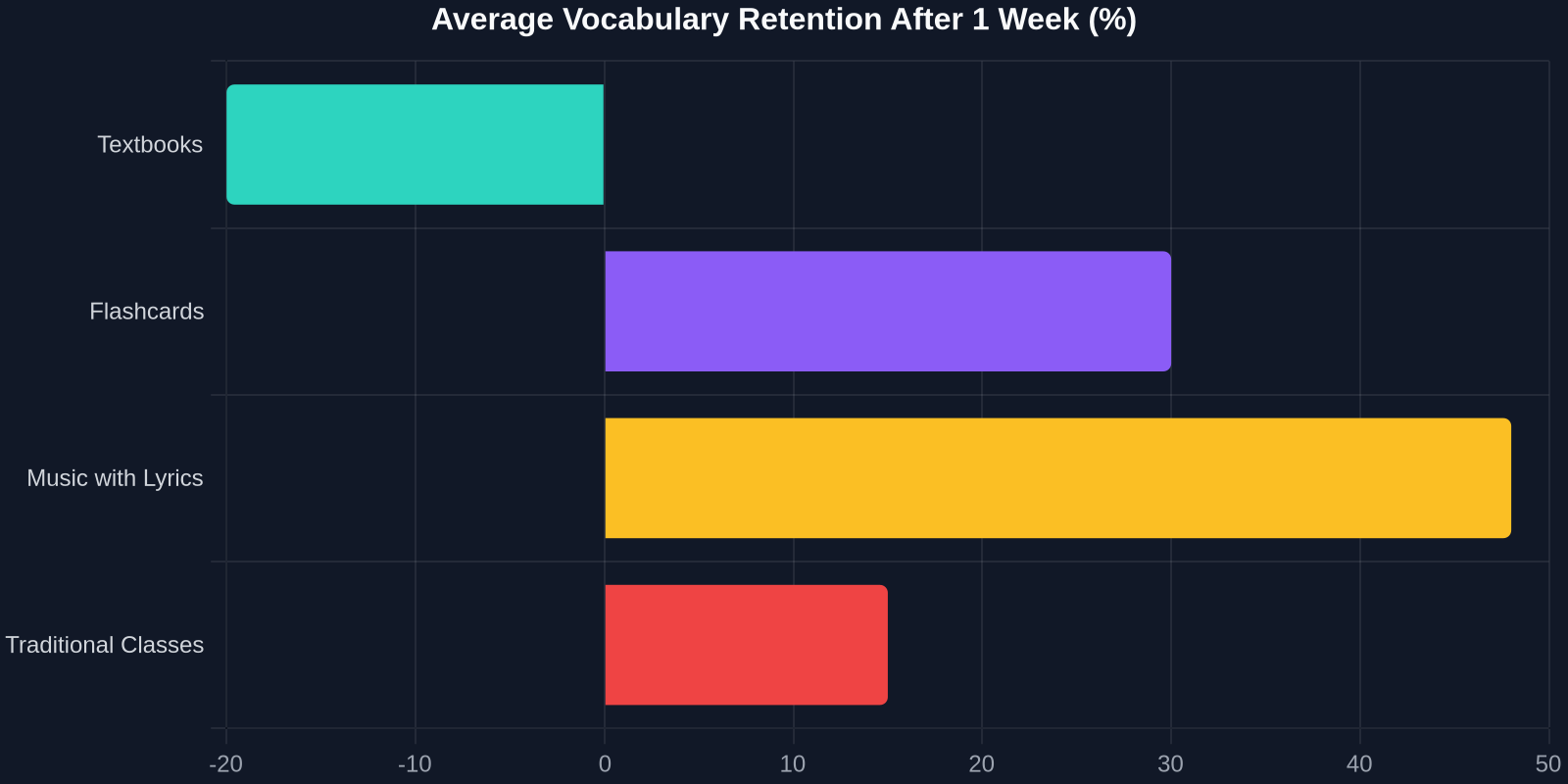
As the chart shows, music-based methods outperform both flashcards and textbooks by a wide margin. The reason is simple: music embeds words in an emotional and narrative frame. Your brain doesn’t just store the word “llorar” (to cry); it associates it with the swelling sadness of a ballad by Natalia Lafourcade or the raw grief of a Juan Gabriel classic. That emotional tag makes the word instantly retrievable when you need to express similar feelings in conversation.
Why Bilingual Subtitles Are a Game-Changer
Traditional methods often treat reading and listening as separate skills. You might read a Spanish novel with a dictionary at hand, then listen to a podcast where you catch only 30% of the words. Dual subtitles merge these streams. When you hear “Me gustas cuando callas” and simultaneously see “I like you when you are silent” on screen, your brain forms a direct pathway between the L2 sound and the L1 meaning, bypassing the slow translation step that plagues intermediate learners. Over time, you’ll start to hear the Spanish and understand it without mentally converting to English, the holy grail of fluency.
Lyric Lingo was built precisely for this. It doesn’t host or redistribute any video or audio; it simply overlays synchronized captions on YouTube’s vast library of music, allowing you to watch the videos you already love while studying effectively. The subtitles are time-coded to each line, so you never lose your place, and you can click on any word for an instant definition. This turns a passive activity (watching a music video) into an active, data-driven study session without killing the fun.
Practical Strategies to Combine Community and Music
For English or Spanish learners inspired by the Kenosha program, here’s a step-by-step weekly plan that blends face-to-face practice with music study.

Step 1: Attend Your Local Language Exchange
Whether it’s the Kenosha intercambio or a similar group in your area, commit to at least one in-person session per week. Go with a small notebook. During the conversation, jot down words or phrases you struggled to express. These become your personal vocabulary list.
Step 2: Find a Thematic Song
Back home, open YouTube and search for a popular song in your target language that touches on the same theme. For example, if you discussed daily routines, try “Un Día Normal” by Juanes. If the conversation revolved around love and relationships, dive into “Eres Tú” by Mocedades. Activate the Lyric Lingo layer to display subtitles in both languages.
Step 3: Active Listening Session
Watch the video three times. First, just listen and read the native-language subtitles to get the gist. Second, focus on the bilingual subtitles and pause frequently to repeat phrases aloud. Third, try to anticipate the translation before the English subtitle appears. The repetition cements the vocabulary from your conversation into long-term memory.
Step 4: Bring the Song Back to the Group
Next week, mention the song to your conversation partner. Share what you learned, ask about unfamiliar idioms, and maybe even play a snippet. You’ll not only reinforce your own knowledge but also enrich the group’s cultural exchange.
The Cultural Bridge: Understanding, Not Just Translation
Language fluency is never just about swapping words. The Kenosha program’s true strength lies in its cultural bridging. When an English speaker learns the Spanish phrase “entre casa y iglesia” (literally “between house and church”), they discover it means something akin to “dressed up but not too fancy”, a window into the cultural norms of a Spanish-speaking community. Music amplifies this cultural learning. Reggaetón, for example, is full of Puerto Rican slang like “janguear” (to hang out) or “perreo” (a style of dance). A learner who masters these terms through Daddy Yankee tracks not only builds vocabulary but also gains an insider’s understanding of a vibrant subculture.
“Cultural fluency can’t be taught by a textbook. It’s absorbed through the stories, jokes, and heartbreaks poured into songs.”
Similarly, English learners exploring the American songbook can move beyond classroom English and into the vernacular. When you hear Billie Eilish sing “I’m the bad guy,” you encounter a modern idiom that no grammar book will explain. Dual subtitles make these cultural references transparent, turning casual viewing into cultural competency training.
Overcoming the Intermediate Plateau with Music
Many learners hit a frustrating wall around the B1 level. They can handle basic transactions and simple conversations but struggle to understand native media without subtitles. The Kenosha program offers a ladder over this plateau by pushing learners to discuss real-life topics, but progress can still slow because the language of casual chat is limited. Music introduces richer vocabulary, poetic structures, and faster, more natural speech rates. Listening to a fast-paced rap verse by Residente or a rapid-fire English punk track forces your brain to parse sounds at native speed. Even if you don’t catch every word, the training improves your phonemic awareness, the ability to distinguish between similar sounds, which is critical for listening comprehension.
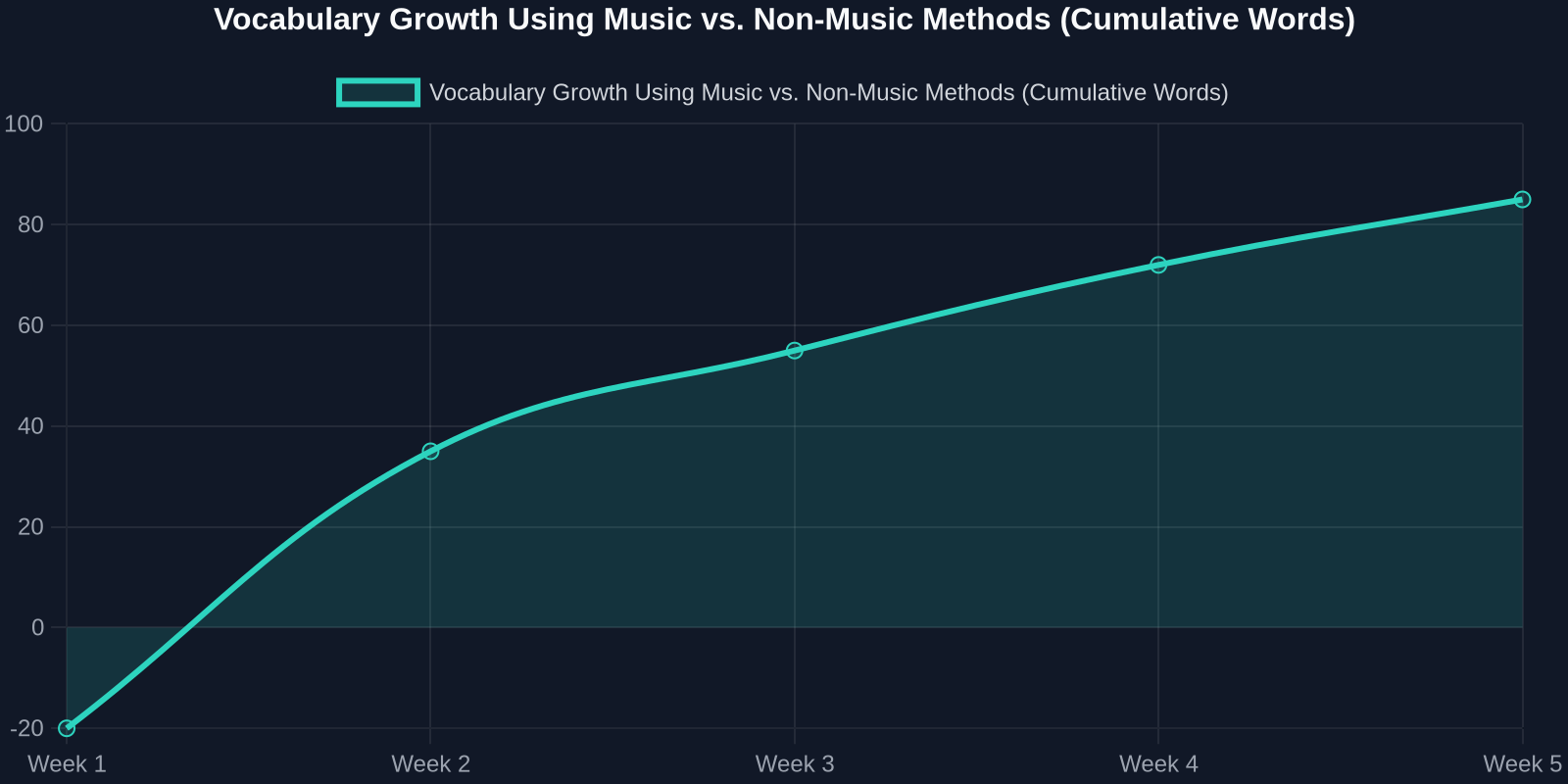
This chart demonstrates a typical learner trajectory. The group that adds daily music review to their conversation practice continues to climb week after week, while the conversation-only group eventually loses momentum without sufficient input. After five weeks, the music group knows nearly twice as many new words and, more importantly, can recall them faster in spontaneous speech.
Building a Lifelong Habit, Not a Chore
One secret the Kenosha organizers understand well is that language learning must be joyful to be sustainable. Attendance at their intercambios is high because people look forward to the social connection, not just the linguistic benefit. In the same way, music keeps you coming back. You won’t need a reminder to listen to your favorite album. And because Lyric Lingo integrates seamlessly with YouTube, you can study while enjoying the videos you’d watch anyway, dance along to Shakira, rock out with Maná, or cry to Adele, all while the tool quietly builds your second-language skills in the background.
The Kenosha program proves that when communities invest in language learning, lives are changed. It breaks isolation, opens economic doors, and fosters empathy. But the learners who will truly excel are those who take that ethos home with them, letting music keep the language alive in their ears between every meeting. They are the ones who will find themselves humming a tune and suddenly realizing they understood every word, without having to think about it.
Start Your Musical Language Journey Tonight
Whether you’re an English speaker hoping to master Spanish or a Spanish speaker navigating English, the recipe is clear: combine the warmth of a community like Kenosha’s with the immersive power of music. In your next conversation session, ask your partner what songs they love. Then go home, fire up YouTube with Lyric Lingo, and watch those songs come to life with dual subtitles. Pause, repeat, sing along. In just a few weeks, you’ll notice that the words from last night’s ballad spill into today’s small talk, and that the phrases you once labored over now flow like a familiar melody.
Breaking language barriers doesn’t require a plane ticket or an expensive course. It starts with a conversation and a song. The Kenosha volunteers have already shown us what’s possible. Now it’s your turn to press play.