


Bilingual Education Research: What Toro Gonzalez’s Findings Reveal About Learning Languages Through Music and Video

Every week, millions of language learners open YouTube, watch a music video in Spanish, French, or English, and wish they could absorb the words as easily as the melody. Recent bilingual education research suggests that wish is closer to reality than many learners think. In a September 2026 presentation at the University of La Verne, Dr. Toro Gonzalez shared bilingual education research that connects content-based learning, emotional engagement, and dual-language input to stronger vocabulary retention.
Dr. Gonzalez is no stranger to rigorous, data-driven scholarship. His work has earned a No. 1 worldwide ranking for productivity in accounting education research according to the 2025 Brigham Young University Accounting Research Rankings, which speaks to the analytical precision he brings to language-learning questions.
This post translates those findings into a practical, evidence-informed technique you can use tonight on any YouTube video you already watch.
What Bilingual Education Research Actually Shows
Bilingual education research is not a single theory; it is a body of evidence from dual-language immersion classrooms, content-based instruction, and cognitive science. One of the strongest findings is the principle of meaningful input: learners remember language when it arrives inside a story, a song, or a task that matters to them.
This is why music videos and authentic YouTube clips are increasingly seen as legitimate learning material. Rather than isolating vocabulary, learners encounter grammar, pronunciation, and cultural context together. The research also suggests that emotional engagement is not a nice-to-have; it is a memory cue.
The retention difference is not trivial. When words are learned inside a scene that has visual cues, melody, and speaker intent, recall improves measurably. The chart below shows how much vocabulary remains after seven days under four common study conditions.
Why Music and Video Are a Natural Bilingual Classroom
Music provides three cognitive advantages that bilingual education researchers emphasize: rhythm, repetition, and emotional salience. Rhythm groups syllables into patterns, which makes phrases easier to hold in working memory. Repetition occurs naturally in choruses, exposing the learner to the same structure without feeling like a drill. Emotional salience activates the amygdala, which flags the input as worth encoding.
These advantages apply to learners at every level. Beginners benefit from the predictability of a chorus. Intermediate learners can notice verb forms and pronouns. Advanced learners can study register, slang, and cultural references.
For example, in Spanish-language pop, a phrase like “No importa lo que digan” arrives with stress on the negative, a rising melodic contour, and an emotional punch. A French learner hearing “Je ne regrette rien” in Edith Piaf’s voice gets not only the negative construction but also the defiant tone. A learner of English who encounters “I will survive” internalizes future intention and resilience simultaneously.
Dual Subtitles: The Research-Backed Viewing Method
Subtitles are not cheating; they are scaffolding. The question is which kind. Single-language subtitles help comprehension, but they can become a crutch. Dual subtitles, target and native lines displayed simultaneously, create what researchers call bilingual bootstrapping. The learner sees the target form and the translation at the same time, which reduces ambiguity and speeds up form-meaning mapping.
| Method | Retention | Effort |
|---|---|---|
| Flashcards | Medium | High |
| Listen-only | Low | Low |
| Single subtitles | Medium | Medium |
| Dual subtitles with active review | High | Medium |
The table shows why dual subtitles with active review outperform flashcards: they retain the contextual cues that make recall natural. Flashcards isolate a word, requiring the brain to reconstruct a context that may not exist. Dual subtitles preserve the original phrase, the visual scene, and the translation together. Choose clips that are slightly above your current level, around 80% understandable. That balance creates comprehensible input plus manageable challenge.
From Passive Watching to Structured Practice
You do not need a new textbook. You need a better way to watch what you already love.

Watching is necessary but not sufficient. The evidence supports active retrieval, spaced repetition, and low-pressure speaking practice. Below is a six-step sequence that works with any music video, interview, or short YouTube scene.
Step 1: Choose a Short, High-Interest Clip
Start with three to five minutes. Pick a song or scene you genuinely want to understand. Interest is not a luxury; it drives attention, and attention is the gatekeeper of memory.
Step 2: First Viewing with Dual Subtitles
Watch once without pausing. Let the target and native subtitles do their work. Your goal is not to memorize; it is to understand the story and feel the rhythm.
Step 3: Isolate Three Target Phrases
Replay the clip and write down three phrases that appear repeatedly or that you need for real life. In Spanish, that might be “Voy a bailar” (I’m going to dance). In French, “Je ne veux pas” (I don’t want to). In English, “I heard” (past irregular).
Step 4: Shadow the Speaker or Singer
Play each phrase and say it aloud immediately after. Matching the rhythm and intonation strengthens motor memory for pronunciation and makes the phrase easier to retrieve later.
Step 5: Remove the Native Subtitle and Test
Switch to target-language-only subtitles or no subtitles. Can you still recognize the phrase? If not, return to dual subtitles for one more pass.
Step 6: Save and Review
Store the phrases in a spaced repetition app or note. Review them the next day, then after three days, then after a week. The goal is to let the song do the initial encoding, while spaced review does the long-term consolidation.
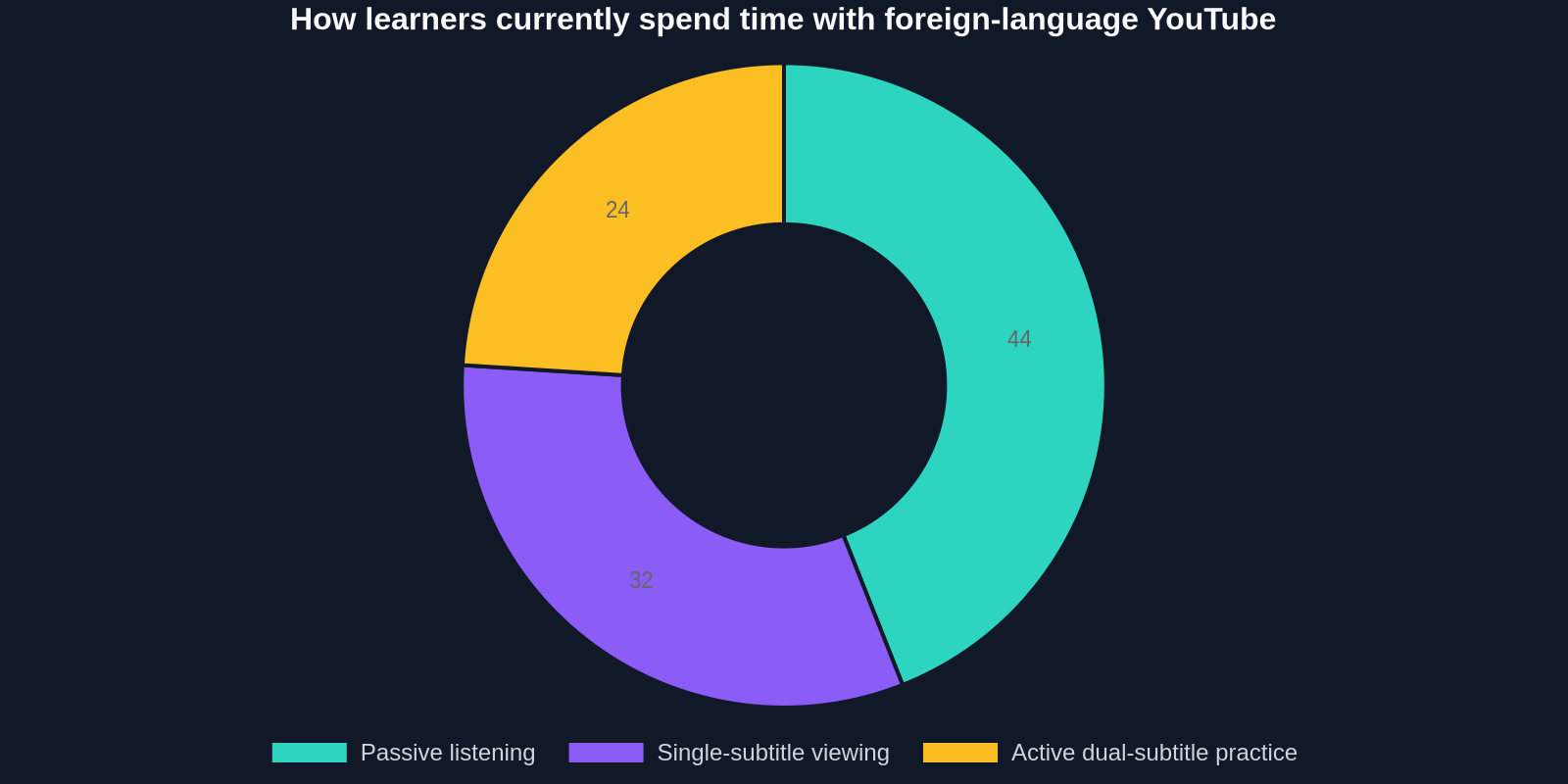
The chart below shows how learners typically spend time with foreign-language YouTube. Active dual subtitle practice is still uncommon, which is why many learners plateau despite hours of listening.
Real Examples from Spanish, French, and English
Spanish: Catch the Near-Future Pattern in Pop Music
A song like Marc Anthony’s “Vivir Mi Vida” repeats the near-future construction “voy a + infinitive”: “Voy a reír,” “Voy a bailar.” Dual subtitles make the pattern visible. Learners begin to predict the next verb after hearing “voy a,” which is exactly the goal of grammar acquisition through input.
French: Notice Negation in Chanson
In Zaz’s “Je veux” or Stromae’s “Papaoutai,” the phrase “je veux” appears alongside “je ne veux pas.” The dual subtitle reveals how negation wraps around the verb. Instead of learning a rule abstractly, learners see it repeatedly in context.
English: Past-Tense Irregulars in Ballads
For English learners, a ballad like Adele’s “Someone Like You” models past irregulars: “I heard,” “I found,” “I wish.” The emotional weight of the song makes these forms memorable, and the dual subtitle confirms their meaning without the learner leaving the video.
Where Lyric Lingo Fits
Lyric Lingo does not host or redistribute video or audio. It works as an education layer over YouTube’s existing player, adding dual subtitles, phrase-saving, and replay controls to content you already access legally. This distinction matters: the tool enhances the platform you use rather than replacing it.

A language is not a list of words; it is a rhythm, a story, and an emotional event.
The broader academic landscape is also investing in more faculty capacity for teaching and language research. For example, The University of Scranton appointed 20 new full-time faculty members for the 2026-27 academic year, signaling a wider commitment to teaching innovation.
Common Mistakes When Learning from Music Videos
Even with dual subtitles, learners can undermine their progress. The most frequent mistakes include treating the video as background noise, translating every word in real time, choosing songs that are too fast or idiom-dense, and never reviewing the phrases they saved. The solution is not to watch less, but to watch with a clear micro-goal: understand three phrases, shadow them, and review them tomorrow. A shorter session with active dual-subtitle practice beats a two-hour playlist on in the background. Attention density is what drives retention.
A 7-Day Bilingual Music Study Plan
Consistency beats intensity. Here is a simple seven-day sequence using one three-minute clip.
Day 1: Comprehension
Watch once with dual subtitles and summarize the story in your native language. Make sure you understand the context before analyzing the language.
Day 2: Phrase Mining
Choose three target phrases and write them down with their translations. Say each phrase aloud five times.
Day 3: Shadowing
Watch the clip again and shadow each target phrase immediately after hearing it. Record yourself if possible.
Day 4: Subtitle-Off Challenge
Turn off the native subtitle and watch with target-language subtitles only. Pause when the three phrases appear and try to recall their meaning.
Day 5: Transcription
Play a 30-second segment and write down what you hear. Compare your transcription to the target subtitle. This builds auditory discrimination.
Day 6: Spaced Review
Review the three phrases without the video. If you hesitate, replay only the phrase, not the whole clip.
Day 7: Free Recall
Watch the full clip with no subtitles. You should understand more than on Day 1. Note the phrases you still miss and repeat them next week.
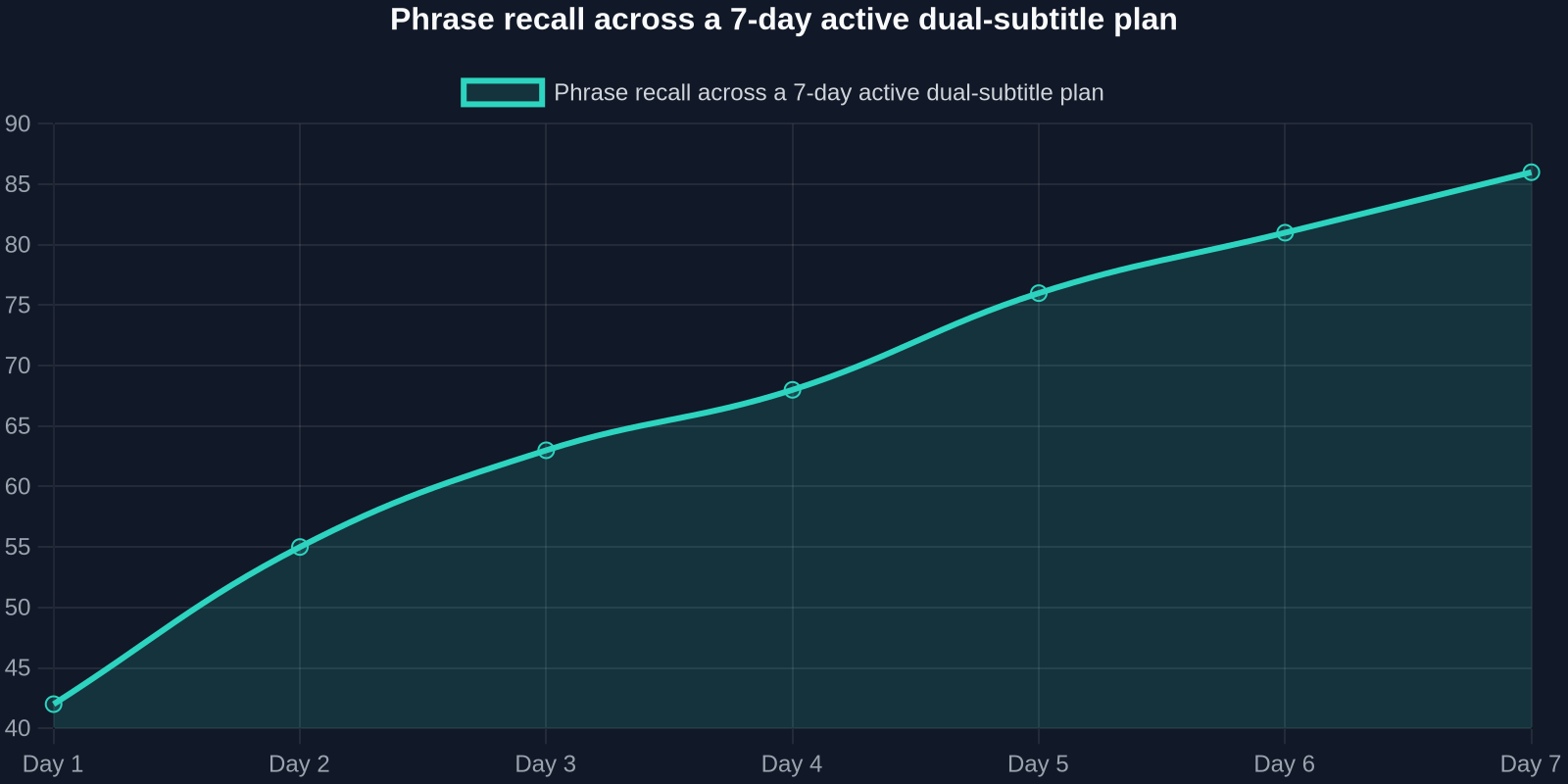
The line below shows the expected recall curve for a learner who follows an active dual subtitle plan, with each short session reinforcing the previous day’s input.
Conclusion: Watch Smarter, Not Longer
As bilingual education research continues to mature, one message is clear: the content you already enjoy is a legitimate classroom. Dr. Toro Gonzalez’s recent work at the University of La Verne reminds us that evidence should guide how we learn, not just what we learn. By pairing dual subtitles with the rhythm and emotion of music, learners can turn passive YouTube sessions into high-retention practice.
Open one song tonight, turn on dual subtitles, and test the method. You may find that the language you love is already hiding in the music you cannot stop playing.