


The Creative Revolution: How AI Films and Dual Subtitles Are Redefining Spanish Language Learning
Learning Spanish often evokes images of verb tables, flashcard stacks, and rigid classroom drills. But a quiet revolution is underway, one that trades rote memorization for cinematic oddity and rhythmic immersion. Recently, an opinion piece on The Drum detailed an experiment in creando pequeñas y extrañas películas de IA para aprender español (creating strange little AI films to learn Spanish). This approach, while unconventional, aligns perfectly with a broader shift toward emotionally resonant, multisensory language acquisition. It’s a shift that platforms like Lyric Lingo are accelerating by turning the music and videos we already love into dynamic, dual-subtitled learning experiences.
In this post, we’ll unpack the science behind why storytelling, music, and even AI-generated oddities supercharge vocabulary retention, and how you can harness these techniques, starting tonight, to finally break through the intermediate plateau.
The Science Behind Storytelling and Language Acquisition
Human brains are not filing cabinets; they are story processors. When we encounter disconnected words (think "la mesa", "el libro", "comer"), our hippocampus has little scaffolding to attach them to. But embed those same words in a narrative, especially one that triggers emotion, and memory solidifies effortlessly. The Drum’s experiment with AI films leverages exactly this: bizarre, vivid scenes that make phrases like el gato baila flamenco unforgettable not because you drilled it, but because you witnessed it.
Cognitive research consistently shows that narrative context activates multiple brain regions simultaneously, Broca’s area for language, the visual cortex for imagery, and the limbic system for emotion. This neural symphony creates robust, interconnected memory traces. When you recall the story, you automatically retrieve the language.
Contrast this with passive video watching, where a learner might hear thousands of words but retain only a handful. Without a narrative hook or emotional anchor, the input becomes background noise. The key is active, contextual engagement, precisely what Lyric Lingo enables by synchronizing dual subtitles with emotionally charged music videos.
From Strange AI Films to Dual Subtitles: A Multisensory Approach
The Drum’s author describes generating AI films that are "casi bueno" (almost good), deliberately imperfect, surreal, and memorable. While few of us have the time or technical skill to produce our own AI shorts daily, the underlying principle is widely accessible: pairing visual storytelling with target-language audio and text. That’s where dual-subtitled music videos shine.
Lyric Lingo overlays YouTube videos with synchronized subtitles in both the original language and the learner’s native tongue. This transforms any music video, interview, or short film into an immersive language lab. Unlike static AI films, music videos add melody, rhythm, and performance, layers that further enhance memory. The visual narrative of a music video, just like a quirky AI film, provides context that single-sentence flashcards never could.
| Method | Engagement Level | Vocabulary Retention | Contextual Learning |
|---|---|---|---|
| Traditional Flashcards | Low | Medium | Isolated words |
| Passive Video Watching | Medium | Low-Medium | Partial context |
| AI Film Generation | Very High | High | Rich, emotional narrative |
| Dual Subtitled Music Videos (Lyric Lingo) | High | Very High | Multi-sensory, rhythmic, emotional |
When you watch a singer pour their heart out, the words don’t just enter your ears, they embed into your emotional memory.
The multisensory nature of this method cannot be overstated. You hear the pronunciation, see the written forms simultaneously, and connect both to a storyline, facial expressions, and musical mood. This is the difference between memorizing a list of fruit names and remembering el limón because you chuckled at a surreal AI film where a lemon wore a sombrero and sang rancheras.
Unlocking the Power of Music for Vocabulary Retention
Music is one of the most underutilized tools in language learning, yet its effects are profound. Melody, rhythm, and rhyme serve as natural mnemonic devices, carving neural pathways that pure speech rarely activates. Have you ever found yourself humming a jingle from years ago? That same mechanism makes song lyrics stick.
Research from the University of Edinburgh demonstrated that singing in a foreign language significantly improves learning outcomes compared to simply speaking the same phrases. The dual-subtitle feature on Lyric Lingo amplifies this by giving you the written anchor: your eyes and ears work together, reducing cognitive load and preventing mishearings.
For Spanish learners, music offers an added benefit: it normalizes the natural cadence, linking, and regional accents of the language. A reggaetón track from Puerto Rico, a flamenco ballad from Andalusia, or a pop hit from Mexico City, each one trains your ear to a different slice of the Spanish-speaking world.
Practical Strategies: Integrating AI Films and Music into Your Study Routine
Ready to move from theory to practice? Here’s how to combine AI-generated content, music videos, and dual subtitles for a study session that actually sticks, no tedious drills required.

Step 1: Choose Emotionally Engaging Content
Seek out videos that make you feel something. It could be a nostalgic 90s pop song, a hilarious short film with Spanish subtitles, or yes, even a "strange little AI film" you prompt yourself. The emotional charge is your secret weapon. On Lyric Lingo, simply open any YouTube video and the platform instantly adds dual subtitles, so you can follow along effortlessly.
Step 2: Watch with Dual Subtitles First
Watch the entire video once with both Spanish and English subtitles visible. Don't pause, don't analyze, just absorb the story, the music, and the general gist. This mirrors how we naturally acquire language: through large amounts of comprehensible input. The synchronized text helps your brain map sounds to meanings without interrupting the flow.
Step 3: Active Listening and Shadowing
On the second pass, play smaller segments and shadow the singer or speaker: repeat aloud immediately after you hear them, mimicking intonation and rhythm. Use Lyric Lingo’s replay feature to loop a tricky line. This active production step moves language from passive recognition to active recall, drastically speeding up retention.
Step 4: Create Your Own (Optional) AI Film Prompts
If you’re technically inclined, embrace the Drum’s method. Take a vocabulary theme, say, "morning routine", and prompt an AI video generator to create a weird, wonderful 30-second clip. Add your own Spanish narration or subtitles. Tools like RunwayML or Pika Labs can output quirky visuals that anchor your target phrases in memory. Even a single sentence like Me lavo los dientes con pasta de fresa becomes unforgettable when accompanied by a surreal animated character brushing with a giant strawberry.
This creation aspect adds what educators call “generative processing”, you’re not just consuming content but constructing meaning, which deepens neural encoding.
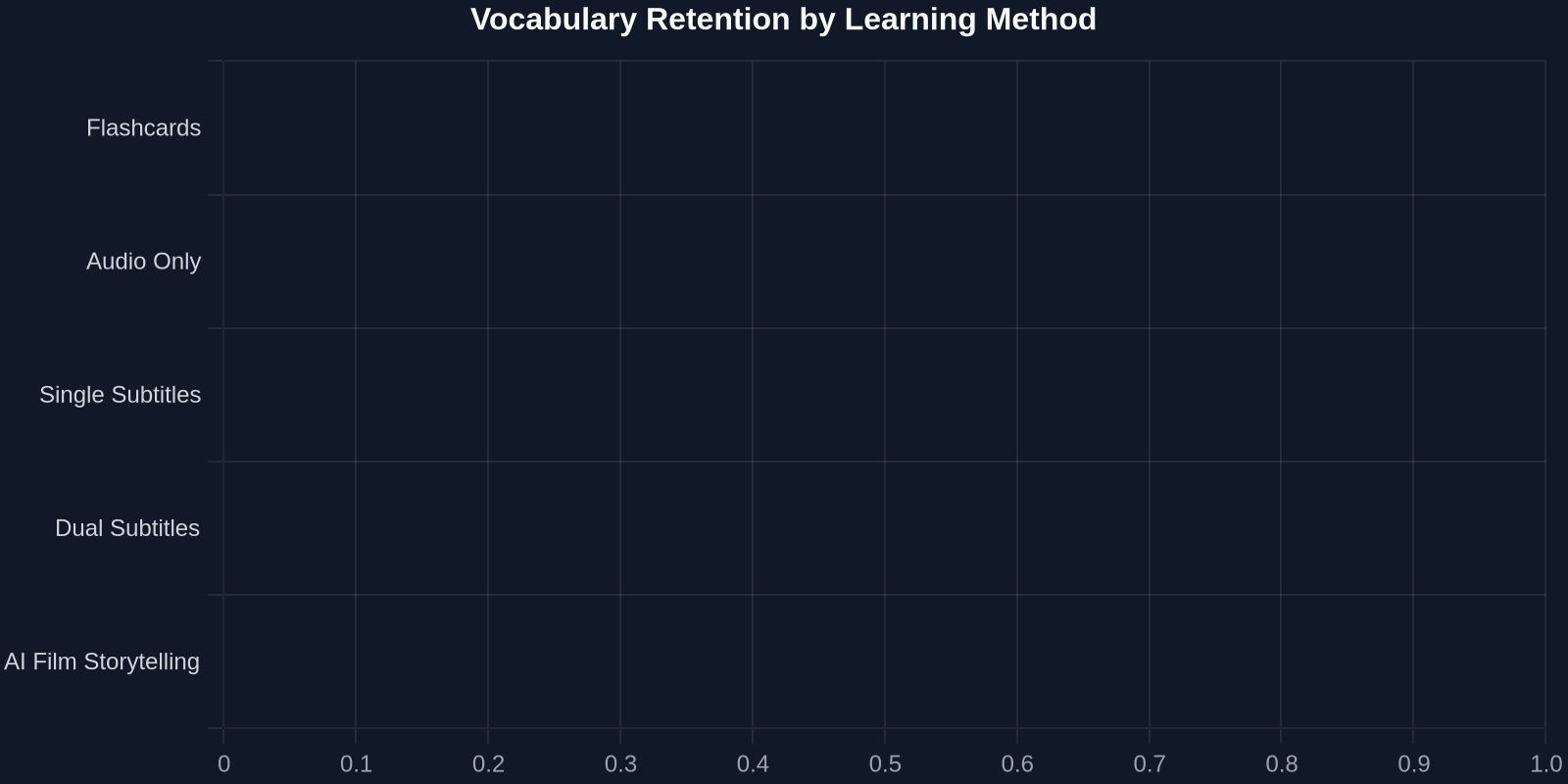
The chart above illustrates why these methods outperform traditional study. When you engage with a compelling narrative (AI film) or combine audio with dual text (Lyric Lingo), you push retention rates into the 75-85% range, compared to a mere 30% for isolated flashcards.
The Role of Technology: How Lyric Lingo Turns YouTube into a Language Lab
Until recently, accessing dual subtitles on YouTube required cumbersome extensions or manually searching for CC1/CC2 files. Lyric Lingo has simplified this into a seamless, one-click experience. It doesn’t host or redistribute any video or audio content; rather, it acts as an intelligent educational overlay that synchronizes dual subtitles over existing YouTube videos. This means you can study with any publicly available music video, interview, vlog, or short film that native speakers already enjoy.
Key features that make this possible:
- Synchronized dual subtitles that highlight in time with the audio, letting you see the Spanish and English equivalents simultaneously.
- Loop and slow-down controls that preserve natural pitch, unlike old-school recording players.
- Tap-to-define functionality on any word, building vocabulary in real time without leaving the video.
- Progress tracking that logs the phrases you’ve practiced, turning entertainment into measurable study sessions.
These tools mirror the best aspects of AI film experimentation: they put you in control of the content, pace, and depth of engagement. Instead of passively watching a 3-minute video and moving on, you transform that same video into a 30-minute active learning session.
Overcoming Common Challenges with Creative Language Learning
Abandoning the textbook in favor of music and AI films can feel chaotic. How do you ensure you’re actually learning and not just having fun? A few strategies will keep your practice both enjoyable and productive.
Selecting Appropriate Difficulty
Not every video is suitable for your level. Beginners might start with slower songs, children’s stories, or simple vlogs where speech is clear and vocabulary is concrete. Lyric Lingo’s library suggestions help you find content at your level, but you can also gauge by how many lines you understand on a first, subtitle-free listen.
Bridging the Speed Gap
Native speakers, especially in music, can be dauntingly fast. Resist the urge to slow everything down permanently, music’s natural tempo is part of the learning magic. Instead, use looping to master short bursts at full speed. This trains your ear to process rapid, connected speech, a skill that typical classroom audio fails to develop.
Navigating Regional Accents and Slang
Spanish spans over 20 countries, each with its own flavor. A learner who exclusively studies "neutral" textbook Spanish will struggle in real conversations. Music and films naturally expose you to this diversity. A corrido tumbado from Mexico will teach you chale and no manches; a trap track from Argentina throws in vos conjugations. Use dual subtitles to decode slang immediately without having to pause and Google.
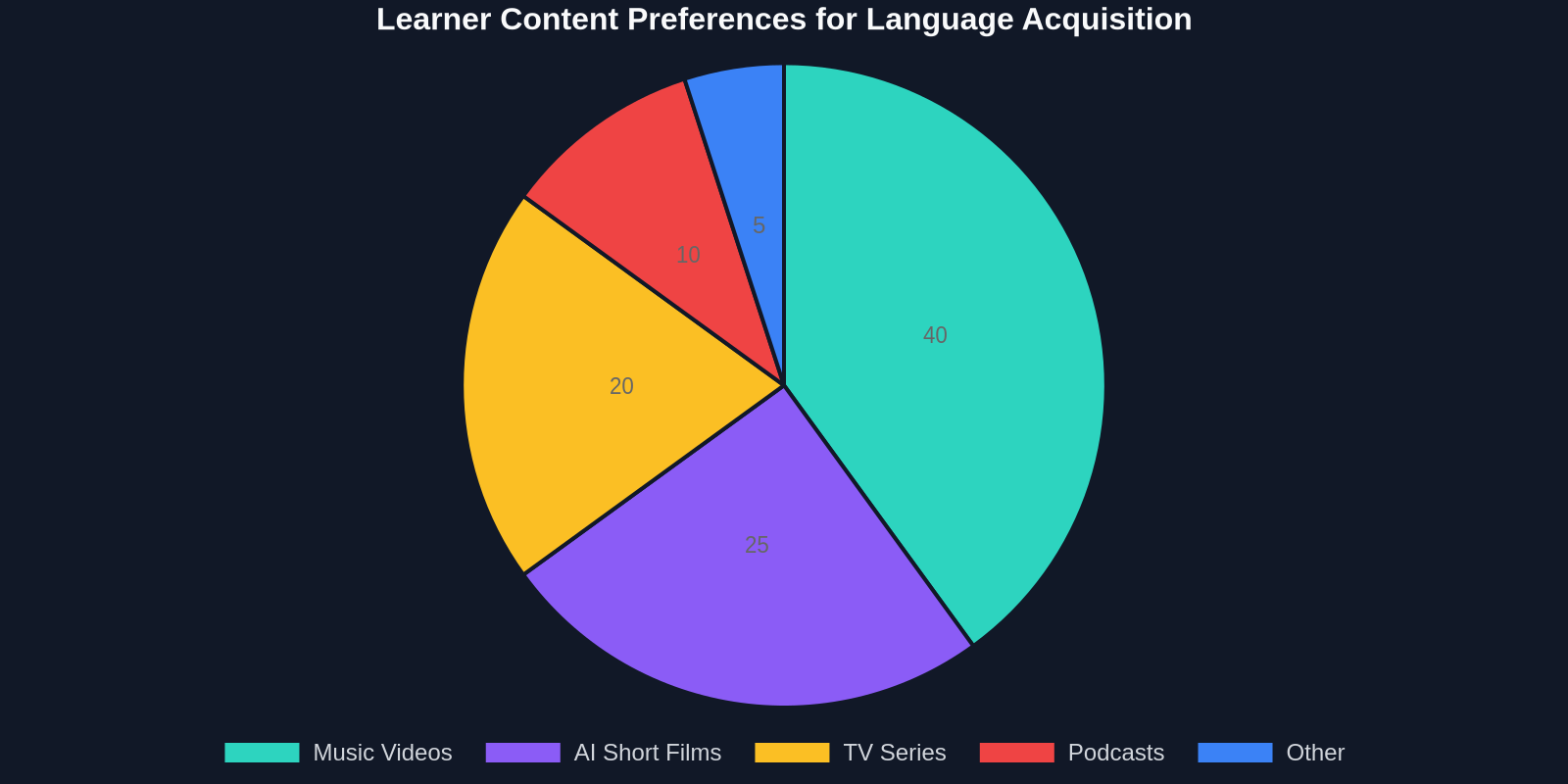
Learner preference data confirms what innovative teachers have long suspected: music videos and short-form creative content like AI films now rival traditional media as preferred study materials. The emotional and rhythmic elements tip the scales in favor of retention.
Case Study: The Drum’s ‘Strange Little AI Films’ Experiment
In the opinion piece that inspired this post, the author describes using AI to generate "purposefully weird" micro-films with Spanish dialogue. One example involved a detective interrogating a sentient piñata, an image so absurd that the target vocabulary became impossible to forget. While the author admits the films were technically flawed (es casi bueno), the learning impact was undeniable.
The stranger the image, the stickier the word.
This aligns with what neuroscientists call the "bizarreness effect", information that violates our expectations draws heightened attention and is processed more deeply. When you combine linguistic input with surprising, emotionally charged visuals, you create a memory that resists decay.
You don’t need AI film tools to replicate this, though. A music video that tells an unexpected story, think of Shakira’s visually rich, metaphor-laden videos or the narrative twists in a Residente song, provides the same cocktail of weirdness and language. Lyric Lingo lets you harness that effect without having to render a single frame.
The Future of Immersive Language Learning
AI-generated content will only become more personalized and accessible. Soon, learners might request a custom rom-com entirely in subjunctive mood Spanish, complete with dual subtitles. While that future brews, the convergence of AI storytelling and platforms like Lyric Lingo hints at a learning paradigm where entertainment and education are indistinguishable.
For now, the takeaway is clear: the days of dry, context-starved language study are numbered. Whether you’re prompting an AI to create a detective-piñata interrogation or simply watching your favorite Latin artist with dual subtitles, you’re tapping into the brain’s most natural learning mechanisms, emotion, rhythm, and story.
Start tonight. Pick a Spanish song you love, open it on Lyric Lingo, and let the dual subtitles guide you through every line. Engage with the video’s narrative. Laugh at its oddities. Your brain will do the rest, weaving vocabulary into your memory as effortlessly as a melody that refuses to leave your head.