


Learning French Through Food: A Delicious Path to Fluency

Imagine walking through a bustling French market, the aroma of fresh baguettes and ripe cheese filling the air. You point to a wheel of Brie de Meaux and say, "Je voudrais un morceau de ce fromage, s'il vous plaît." The vendor smiles, cuts exactly the amount you need, and hands it to you wrapped in paper. That exchange, sensory, practical, and cultural, unlocks more French than a dozen grammar drills.
Learning French through food is not a gimmick. It is a research-backed approach that taps into how the brain encodes memory. When you taste, smell, touch, and manipulate ingredients while hearing or reading French, you create multisensory associations that anchor vocabulary far more deeply than rote repetition. In this guide, you will discover why food is the perfect gateway to French, the core vocabulary you need, proven techniques to learn while you cook, how to use music and video for reinforcement, common pitfalls to avoid, and a 7-day plan to get started tonight.
Why Food Is the Perfect Gateway to French
French cuisine is not just about sustenance; it is a language of its own. Every dish tells a story about geography, history, and identity. When you engage with French through food, you move beyond abstract word lists and into a lived context that mirrors how native speakers acquire language as children: by seeing, doing, and repeating in meaningful situations.
The Psychology of Taste and Memory
The French novelist Marcel Proust famously wrote about a madeleine dipped in tea that triggered a flood of involuntary memories. Modern neuroscience confirms this "Proustian effect": the olfactory bulb and hippocampus are tightly connected, making smell and taste powerful triggers for recall. When you learn the word "la cannelle" (cinnamon) while actually grating cinnamon into a compote, you are not just memorizing a sound. You are linking that sound to a rich sensory file that includes the spice's warmth, the texture of the bark, and the sweet aroma rising from the pot.
High-Frequency Vocabulary in Real Context
Food vocabulary is not niche. It appears in everyday conversation, television, literature, and even business meetings. Words like "manger" (to eat), "boire" (to drink), "le pain" (bread), "la viande" (meat), "les légumes" (vegetables), and "le dessert" (dessert) are among the first two thousand most frequent French words. By mastering food-related terms, you acquire a substantial portion of the lexicon needed for basic fluency.
Moreover, food interactions force you to use essential grammar structures naturally: the partitive article (du, de la, des) when asking for "du fromage" or "de la salade"; the conditional to make polite requests ("Je voudrais", "Pourriez-vous"); and the imperative when following a recipe ("Coupez les oignons", "Ajoutez le sel"). These structures, often dreaded in textbooks, become automatic when you are hungry and need to order.
Core French Food Vocabulary You'll Actually Use
You do not need to memorize five hundred gastronomic terms to start. Focus on high-yield categories that cover market shopping, cooking, and dining out. The following lists provide a practical foundation.

At the Market (Au Marché)
- Les fruits: la pomme (apple), la banane (banana), l'orange (orange), le citron (lemon), la fraise (strawberry)
- Les légumes: la tomate (tomato), la carotte (carrot), l'oignon (onion), l'ail (garlic), la pomme de terre (potato)
- La viande et le poisson: le poulet (chicken), le boeuf (beef), le porc (pork), le saumon (salmon), les crevettes (shrimp)
- Les produits laitiers: le lait (milk), le beurre (butter), le fromage (cheese), la crème (cream), le yaourt (yogurt)
- Autres: le pain (bread), la baguette, les oeufs (eggs), le miel (honey), l'huile d'olive (olive oil)
When you walk through a real or virtual market, practice pointing and saying the word aloud. Better yet, ask a vendor: "Combien coûte un kilo de tomates?" (How much is a kilo of tomatoes?)
In the Kitchen (Dans la Cuisine)
Cooking verbs are action words that pair perfectly with physical movement, reinforcing memory through kinesthetic learning.
- Couper (to cut)
- Éplucher (to peel)
- Mélanger (to mix)
- Fouetter (to whisk)
- Faire cuire (to cook)
- Faire bouillir (to boil)
- Faire revenir (to sauté)
- Assaisonner (to season)
- Goûter (to taste)
- Servir (to serve)
Kitchen tools also matter: la poêle (pan), la casserole (saucepan), le couteau (knife), la cuillère (spoon), la fourchette (fork), le four (oven), le mixeur (blender).
At the Restaurant (Au Restaurant)
Ordering food is a survival skill. Memorize these phrases and you will eat well and feel confident:
- "Je voudrais réserver une table pour deux." (I would like to reserve a table for two.)
- "Qu'est-ce que vous me conseillez?" (What do you recommend?)
- "Je suis allergique aux noix." (I am allergic to nuts.)
- "L'addition, s'il vous plaît." (The check, please.)
- "C'était délicieux!" (It was delicious!)
Techniques to Learn French with Food
Passively reading a menu is not enough. You need structured, repeatable techniques that turn cooking and dining into deliberate language practice.
The Recipe Method
Choose one simple French recipe per week, perhaps a tarte Tatin, a quiche Lorraine, or a soupe à l'oignon. Work through the recipe entirely in French, even if you are a beginner. Here is the process:
- Read the recipe silently, underlining unknown words.
- Look up each unknown word and write a brief definition in French or your native language.
- Read the recipe aloud, focusing on pronunciation of culinary terms (e.g., "hacher" with a silent h, "oignon" pronounced "on-yon").
- Gather ingredients, saying each item out loud as you place it on the counter.
- Cook step by step, narrating your actions in French: "Maintenant, je coupe les oignons. Ensuite, je fais fondre le beurre." (Now I am cutting the onions. Next, I am melting the butter.)
- After eating, write a short review in French: "La tarte était délicieuse mais légèrement trop sucrée." (The tart was delicious but slightly too sweet.)
This method forces active recall, speaking, listening (if you use a video recipe), reading, and writing. It also provides immediate feedback: if you misinterpret "une cuillère à café" (teaspoon) as "a coffee cup," your dish will tell you.
The Grocery List Method
Turn your weekly shopping into a vocabulary drill. Before going to the store, write your list in French. Then, as you shop, read each item aloud and mentally visualize the French word on the package. At checkout, try to say the total price in French or know the names of coins and bills.
For online shopping, change your grocery app language to French. You will learn words like "panier" (cart), "commander" (to order), "livraison" (delivery), and "paiement" (payment) without extra effort.
The Menu Decoding Method
When you eat out at a French restaurant (or browse menus online), do not immediately look for an English translation. Instead:
- Identify cognates: "la salade", "le dessert", "le restaurant", "la moutarde" (mustard).
- Look for word roots: "boeuf bourguignon" tells you beef (boeuf) cooked in Burgundy style.
- Decode cooking methods: "grillé" (grilled), "rôti" (roasted), "poché" (poached), "frit" (fried).
- Guess first, then check. The act of guessing strengthens memory, even if you are wrong.
The Cooking Show Shadowing Method
Shadowing, repeating what you hear immediately after hearing it, is a powerful pronunciation and rhythm tool. Find a French cooking show or YouTube video with clear audio. Play a sentence, pause, and repeat exactly, mimicking intonation and pace. This works best with short, instructional phrases like "Ajoutez une pincée de sel" (Add a pinch of salt) or "Laissez mijoter pendant vingt minutes" (Let simmer for twenty minutes).
For maximum benefit, use a tool that provides dual subtitles, French and your native language, so you can read along without losing the thread of the recipe.
Using Music and Media to Reinforce Culinary French
Food and music share a cultural stage in France. Songs about food, dinner, and wine are abundant, and they stick in your head. The rhythm and melody act as mnemonic devices, making vocabulary easier to retain and recall.

Songs About Food
- "Les Cornichons" by Nino Ferrer: A playful song about a picnic, full of food items (les cornichons = pickles, le jambon = ham, le fromage = cheese).
- "Mangez-moi" by Tryo: A humorous song whose title means "Eat me" and includes many food metaphors.
- "La Bohème" by Charles Aznavour: Not strictly about food, but mentions a café setting and simple meals, evoking the romance of Parisian bistros.
- Traditional children's songs like "Pomme de reinette et pomme d'api" are excellent for learning fruits and nursery rhyme rhythm.
YouTube Videos and Subtitled Recipes
A vast library of French cooking tutorials exists on YouTube, from Michelin-starred chefs like Paul Bocuse's archive to home cooks sharing family recipes. The challenge for learners is understanding rapid, colloquial speech. Using a platform that shows dual subtitles, French on one line, your language beneath, turns a passive watching session into active language study.
Consider these steps:
- Watch a short segment first with only French subtitles. Try to grasp the main idea.
- Rewatch with dual subtitles, pausing to note new food vocabulary and verbs.
- Watch a third time without any subtitles, focusing on listening comprehension.
- Finally, cook along or narrate the recipe yourself in French.
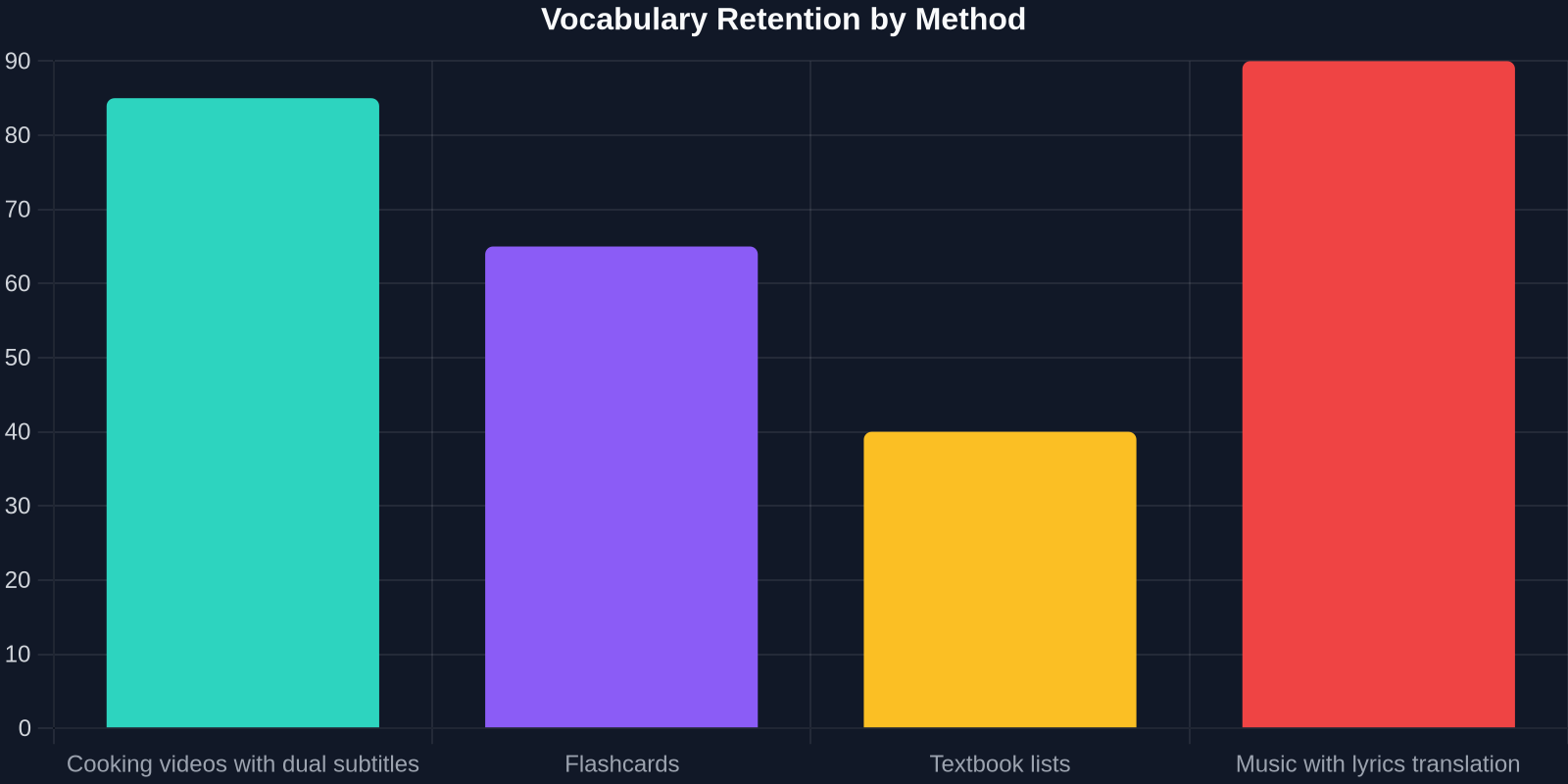
| Method | Vocabulary Retention | Speaking Practice | Time Investment |
|---|---|---|---|
| Flashcards | Medium | Low | 15 min/day |
| Textbook food unit | Low | Low | 30 min/day |
| Cooking with French video | High | Medium | 45 min/session |
| Music + dual subtitles | High | High | 20 min/day |
Common Mistakes and How to Avoid Them
Even motivated learners stumble. Here are the most frequent errors when learning French through food, and how to sidestep them.
Mistake 1: Translating Everything Word-for-Word
French sentence structure and idioms differ from English. "J'ai faim" literally means "I have hunger," not "I am hungry." If you translate word-for-word, you will produce awkward sentences. Instead, learn phrases as chunks: "avoir faim" (to be hungry), "avoir soif" (to be thirsty), "faire la cuisine" (to cook).
Mistake 2: Ignoring Pronunciation
French has silent letters, nasal vowels, and liaisons. Saying "le pain" as "le pay-n" instead of "le pan" will confuse listeners. Use audio resources and mimic native speakers. Pay special attention to food words like "le vinaigre" (vinegar), "la mozzarella" (pronounced the Italian way in French), and "le boeuf" (the f is silent in the singular but pronounced in the plural "les boeufs").
Mistake 3: Sticking Only to Written Recipes
Reading a recipe in French is passive. You must speak, listen, and engage physically. If you only read, you will recognize words but struggle to produce them in conversation. Combine reading with cooking, shadowing, and singing.
Mistake 4: Not Reviewing in Spaced Intervals
You learn "le concombre" (cucumber) on Monday, and by Friday it is gone. Use spaced repetition: after learning a batch of food words, review them after one day, three days, one week, and two weeks. Integrate them into different meals and contexts.
A Sample 7-Day Food-Based French Learning Plan
Here is a realistic, low-cost weekly schedule that requires no prior cooking skills and only about 30–45 minutes per day.
Day 1: Market Vocabulary and Song
- Learn 15 common fruits and vegetables with images.
- Listen to "Les Cornichons" and note food words.
- Practice saying each item aloud while touching or imagining it.
Day 2: Simple Recipe Reading
- Find a recipe for "salade niçoise" in French.
- Read it, translate unknown words, then read aloud.
- Watch a short YouTube video of someone making it with French subtitles.
Day 3: Grocery List in French
- Write a grocery list in French for the week.
- Go shopping (or browse an online store in French) and say each word as you pick items.
- At checkout, try to say the total in French.
Day 4: Cooking with Shadowing
- Choose an easy recipe: omelette aux fines herbes.
- Watch a video with dual subtitles, pause after each instruction, and repeat aloud.
- Cook while narrating your actions in French.
Day 5: Restaurant Role-Play
- Write a dialogue between a customer and server.
- Practice the dialogue aloud, switching roles.
- Record yourself and listen for pronunciation errors.
Day 6: Music and Lyrics Breakdown
- Pick a French song about food or dining.
- Read the lyrics with translation.
- Sing along, even if you are off-key.
- Write a short paragraph summarizing the song's food references.
Day 7: Review and Create
- Review all vocabulary from the week using flashcards or a spaced repetition app.
- Write a short French recipe from memory for something you cooked.
- Share the recipe with a language partner or post it online for feedback.
Conclusion
Learning French through food is not just an enjoyable supplement to your language studies, it is one of the most effective methods available. By combining sensory experience, high-frequency vocabulary, cultural immersion, and structured repetition, you accelerate retention and build real conversational confidence. You do not need to live in France or attend a culinary school. Your kitchen, your local market, and your favorite music app are all you need.
Start tonight. Open a French recipe, put on a French song about food, and let your next meal be your first lesson.