


How to Make Learning French Fun: 7 Playful Techniques for Lasting Fluency
Learning French can feel like an endless climb up a grammar mountain. You memorize verb conjugations, wrestle with gender rules, and all too often, your enthusiasm withers. But what if the very methods you were using were the problem? What if, instead of drilling flashcards, you could learn French through the songs you hum in the car, the YouTube creators you binge, and the small cultural moments that spark genuine curiosity?
This article doesn’t offer a magic pill. It presents seven research-backed, playful techniques that transform French learning from a chore into a daily ritual you genuinely look forward to. We’ll explore how music hacks your memory, why dual subtitles are a game-changer, and how to weave tiny challenges into your routine, all while keeping the process social, forgiving, and deeply human.
Why Traditional French Learning Feels Like a Chore
Most French courses follow a predictable arc: grammar rule, vocabulary list, exercise, repeat. The methodology is sound, but the emotional payload is flat. When your only interaction with French is through a textbook, you miss the raw, musical texture of the language, the rising intonation of a question, the slangy shortcuts of a native speaker, the cultural references that light up a conversation.
Research shows that emotional engagement, like that triggered by a favourite French song, doubles memory retention for new words.
The core problem isn’t the material; it’s the mode. Adults in particular need a "why" that goes beyond passing an exam. When learning feels arid, you procrastinate. The brain’s dopamine system flags the activity as low-value, and you find yourself checking Instagram instead. To counter this, we must bring joy to the centre.
The Motivation Feedback Loop
When you genuinely enjoy a learning session, you’re more likely to repeat it. Repetition leads to proficiency, proficiency breeds confidence, and confidence fuels motivation, a virtuous cycle. The opposite is the dreaded "study guilt" spiral. Breaking into the positive loop requires injecting fun, not as a reward, but as the engine itself.
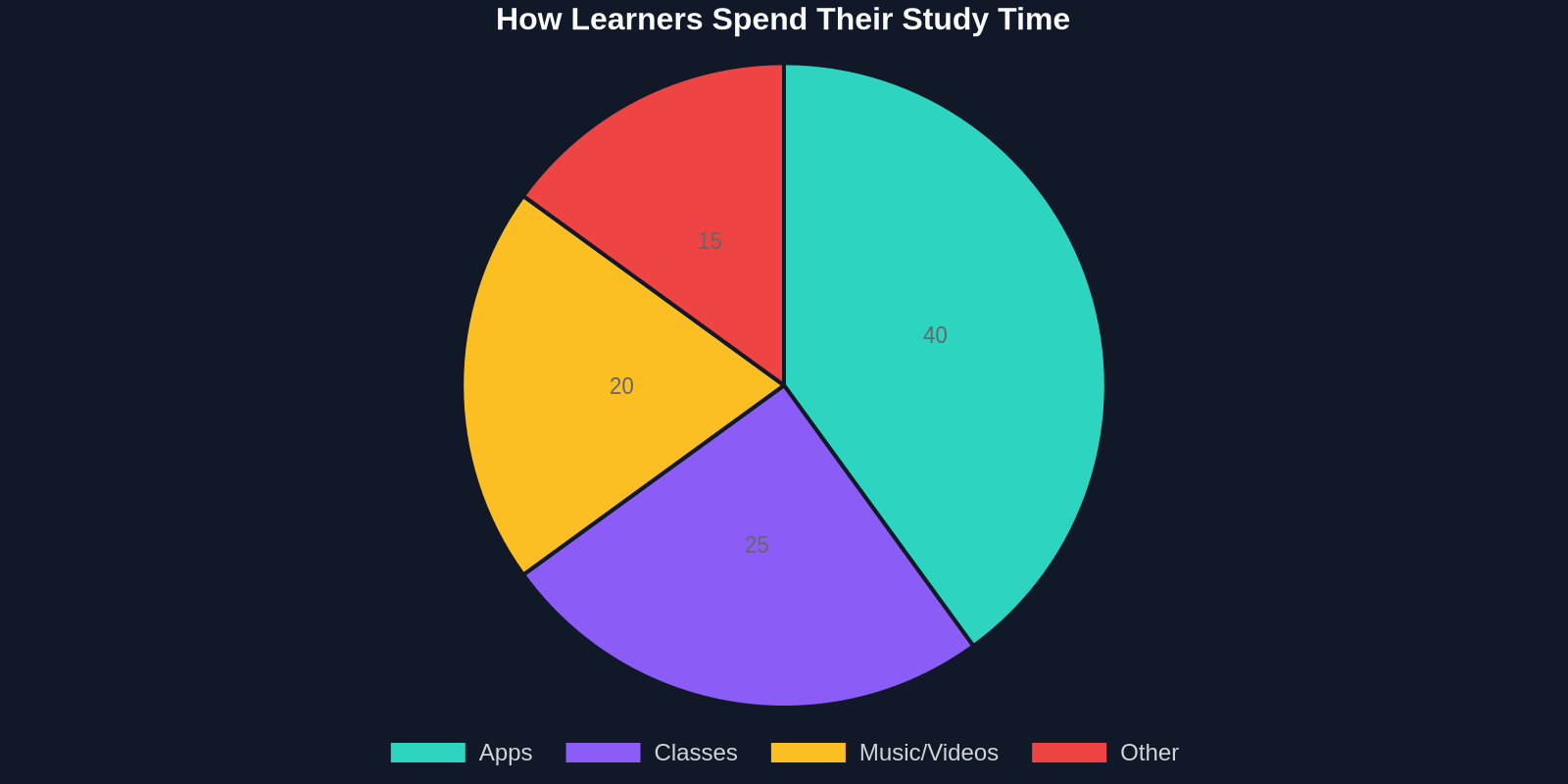
This chart illustrates a common reality: over half of a learner’s time goes to apps or formal classes. While these tools are valuable, they often lack the sensory richness of real language. The techniques below shift the ratio, making music and video the backbone of your study plan.
Technique 1: Harness the Earworm Effect with French Songs
Music is a Trojan horse for language. Melodies and rhythms create a scaffolding that helps vocabulary stick effortlessly. You’ve probably experienced an earworm, a snippet of a song that loops in your mind for hours. That’s your brain’s phonological loop rehearsing the phrase. When the phrase is in French, you’ve unwittingly reinforced pronunciation, intonation, and word boundaries.
How to Turn a Song Into a Mini-Lesson
- Choose a tune you love. It doesn’t have to be slow or "learner-friendly"; it must excite you. Artists like Stromae, Angèle, or even old-school Françoise Hardy work well.
- Listen once without lyrics. Let your brain absorb the mood and pick out familiar sounds.
- Read the lyrics in French. Notice words you recognize and those that puzzle you.
- Use dual subtitles to bridge gaps. A tool like Lyric Lingo overlays French and English subtitles line by line on the official YouTube video, so you see meaning instantly without pausing.
- Sing along. Mimic the singer’s accent, rhythm, and phrasing. This physical act anchors pronunciation in muscle memory.
When you encounter a difficult phrase, loop that 10‑second segment and whisper it repeatedly. Your brain treats repeated listening as intentionality, strengthening synaptic pathways.
3 French Songs to Start Your Playlist
- "Je veux" – Zaz: Upbeat, with clear, conversational lyrics that discuss desires and everyday life.
- "Dernière danse" – Indila: Soulful pop with emotional storytelling, exposing you to past tense and poetic vocabulary.
- "La vie en rose" – Édith Piaf: Classic, simple, and deeply cultural, with timeless romantic phrases you’ll hear in movies.
Technique 2: Turn YouTube From a Passive Black Hole Into an Active Classroom
YouTube is the world’s largest language lab, yet most learners use it passively, watching a travel vlog, reading English subtitles, and calling it a day. Active engagement transforms that video into a dense learning session.
From Passive to Active: The Dual-Subtitle Advantage
Dual subtitles show the original French alongside your native language. This allows you to:
- Map sounds to spellings instantly.
- Understand idiomatic expressions without a dictionary.
- Absorb sentence structure naturally.
Lyric Lingo integrates this as an education layer on YouTube. It doesn’t host or redistribute video; it simply augments the videos you already watch. You open a music video or a street interview, and the dual subtitles appear in sync. You can slow down the playback, repeat a line, and even save tricky phrases to a personal list.
You don’t need to understand every word the first time. Each replay fills in a new gap, that incremental unraveling is where deep learning happens.
A Sample Workflow with a Vlog
Take a 5‑minute Parisian market tour. First watch in full with dual subtitles. Then rewatch, pausing after each sentence to repeat it aloud. On a third pass, hide the English subtitle and test yourself. In fifteen minutes, you’ve exposed yourself to authentic speech patterns, food vocabulary, and the rhythm of casual French, all without a textbook.
Technique 3: Micro-Challenges That Feel Like Play
Gamification works best when it’s bite-sized and autonomous. Massive daily goals breed resentment; tiny, concrete missions create momentum. The following micro-challenges are designed to be completed in under ten minutes but yield impressive cumulative results.
The 5-Song Challenge
Pick five French songs (different artists, tempos, eras). Your mission for the week:
- Monday: Listen and read dual lyrics; highlight 10 new words.
- Tuesday: Sing the chorus of each song from memory.
- Wednesday: Write a one-sentence summary of each song’s theme.
- Thursday: Record yourself singing one verse, compare your accent to the original.
- Friday: Share one song with a friend and explain (in French or English) why you like it.
By Friday, you’ve engaged with over 50 usages of new vocabulary in an emotionally charged context.
Speed-Describe Your Day
For 60 seconds, narrate everything you see around you in French. Start with "Je vois…" (I see…) and string together objects, colours, and actions. The goal is speed and fluidity, not perfection. This exercise limbers your oral muscles and reduces the fear of speaking.
Technique 4: Socialize Your French Before You’re "Ready"
Perfectionism is the enemy of fun. If you wait until you can speak flawless French before opening your mouth, you’ll never start. The social path offers a low-stakes safety net: even short exchanges with real people flood your brain with the dopamine of connection.
Find Your Touche-A-Tout Community
- Language Exchange Apps: A 10‑minute voice message exchange on HelloTalk or Tandem feels like a chat with a pen pal, not a lesson.
- French Meetups: Virtual or in-person, look for "French conversation café" groups. The shared vulnerability of stumbling through sentences creates camaraderie.
- Lyric-sharing circles: In a Lyric Lingo session, you can form small study groups around a playlist. Discuss a music video’s lyrics with peers, like a book club but for songs.
The key is to make your social interactions short and predictable. Schedule a 15‑minute video call where the only agenda is to share a French song you discovered and explain what line resonated. No grammar tests, no performance anxiety.
Technique 5: Anchor Learning to Your Sensory World
French isn’t just a set of rules; it’s a soundscape, a taste, a rhythm. By tying the language to real-world sensory experiences, you create rich memory hooks.
Cook in French
Find a French recipe YouTube channel (e.g., "750 Grammes") and follow along. Pause to transcribe the ingredient list, and speak each step aloud as you chop and stir. The smells and textures associated with words like "oignon" or "mélanger" create a multi-sensory memory.
Narrate Your Commute
If you walk or drive daily, describe the route in French. "Je tourne à gauche. Le feu est rouge. Il y a un chien." This transforms dead time into a personalized speaking drill. Doing this with music in the background, say, a French playlist through Lyric Lingo, subtly tunes your ear.
Neuroscience reveals that the brain’s olfactory and auditory centers are tightly linked. Hearing French while smelling coffee or rain can forge powerful associative memories that resurface naturally later.
Technique 6: Fall in Love with the Music Video, Not Just the Song
Music videos are an underused goldmine. Unlike audio-only songs, they provide a visual narrative that clarifies meaning. When you watch a video where a character gestures, frowns, or dances, you’re receiving comprehensible input, a cornerstone of language acquisition theory.
How to Milk a Music Video
- First pass: Watch with no subtitles; let the story wash over you.
- Second pass: Enable dual subtitles on the Lyric Lingo overlay. Notice how specific words match with actions on screen.
- Third pass: Mute the sound and describe what’s happening in your own French. This tests your recall and pushes you to produce language.
- Fourth pass: Shadow the singer, matching lip movements and gestures. This engages your mirror neurons, which are essential for accent refinement.
Stop trying to learn French. Start living in French moments, five minutes of a song, thirty seconds of a video, one shared laugh with a native speaker.
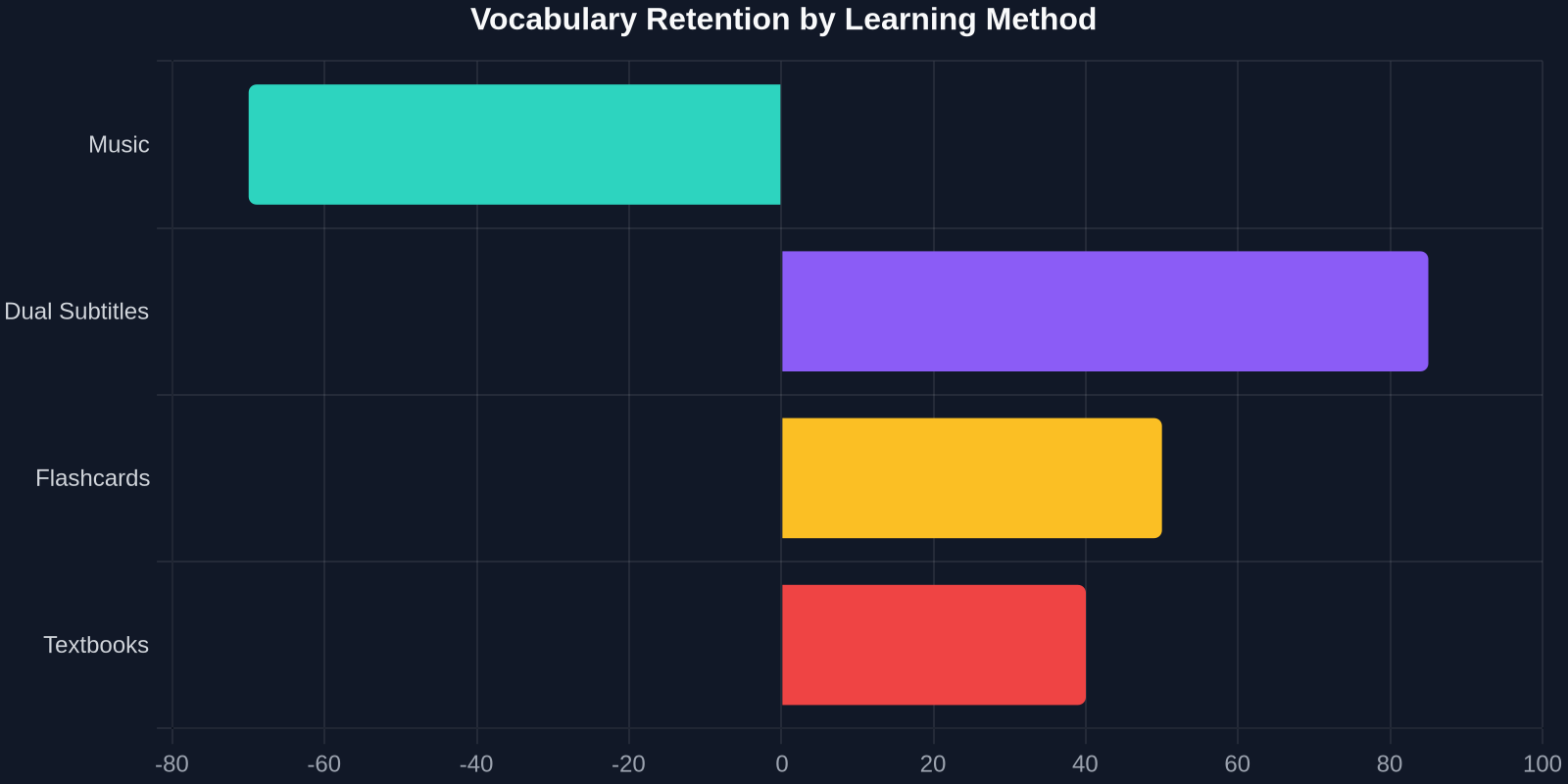
This retention data underscores a powerful truth: methods that engage your emotions and senses (music and dual-subtitle videos) outperform abstract, decontextualized drilling. The chart above shows that after one week, learners who engaged with music and dual subtitles remembered significantly more vocabulary than those using flashcards or textbooks.
Technique 7: Measure What Matters: Progress, Not Perfection
Fun evaporates when you’re constantly gauging yourself against an ideal. Instead of asking "Am I fluent?", ask "Can I understand the chorus of this song? Did I catch a new word in that vlog?" These small wins accumulate and keep the journey delightful.
Keep a Joy Journal
At the end of the day, jot down one French phrase that made you smile. It could be a line from a Serge Gainsbourg song, a pun you stumbled upon, or a compliment you managed to give. This journal shifts your focus from deficits to discoveries.
Use Tech to Track, Not to Judge
Lyric Lingo embeds light-touch tracking: a weekly playlist completion, a "phrase of the week," and a count of videos you’ve studied actively. These nudges feel like accomplishments, not grades. The tool treats learning as a gentle, cumulative process.
A Week of Playful French: Your Sample Schedule
Here’s how you might combine the techniques into a sustainable, enjoyable week:
| Day | Activity | Duration | Tool/Focus |
|---|---|---|---|
| Monday | 5-Song Challenge: listen with dual subtitles, note new words | 15 min | Lyric Lingo music library |
| Tuesday | Shadow one verse a cappella | 10 min | Voice recorder |
| Wednesday | Watch a 3‑minute Paris vlog with dual subs, then narrate what you saw | 15 min | YouTube + Lyric Lingo |
| Thursday | Cook a French recipe using a recipe video, speak instructions aloud | 30 min | 750 Grammes / Lyric Lingo |
| Friday | Language exchange: share your favourite song of the week with a partner | 20 min | Tandem / HelloTalk |
| Saturday | Describe your day’s moments in French; record a 60‑second voice note | 5 min | Phone recorder |
| Sunday | Rewatch your favourite music video, sing freely, no pressure | 15 min | Lyric Lingo |
Total active engagement: roughly 2 hours, but scattered across the week in joyful, digestible chunks.
The Subtle Shift: From Student to Enthusiast
When you make French a source of pleasure, you stop being a "learner" and become an enthusiast. You seek out new songs not because you have to, but because you’re curious. You rewatch videos because you want to, not because an app reminds you. This identity shift is where durable fluency takes root.
The tool that enables this, Lyric Lingo, functions as a quiet companion. It doesn’t interrupt your flow with intrusive ads or lesson plans; it simply offers a dual-subtitle layer on whatever French content you already enjoy. It’s learning by stealth, acquisition that happens while you’re busy being captivated.
Final Refrain
There is no finish line in language, only an ever-unfolding playlist. By infusing your routine with music, video, tiny challenges, and social warmth, you transform French from a subject to be conquered into a world to inhabit. Start tonight: find a song you love, enable those dual subtitles, and let the melody do the heavy lifting. Your most fluent, joyful French self is just a chorus away.
To get started right now, pick one of the songs listed above, open it on YouTube, and engage a dual-subtitle layer. Pay attention to one line that moves you, and speak it out loud. That’s your first French moment of the day, and it counts.